


Right Hand Octaves & Chord Melodies
In this lesson we will create a bigger and more powerful sounding arrangement by playing the melody in octaves above a stride left hand style.
We will also explore the concept of chord melodies where we harmonise the melody with the chord tones of the underlying harmony to create a full sounding solo piano arrangement.
This style of arrangement is heard in the recordings of Erroll Garner – the original composer of the tune “Misty”.
Playing Octave Melody Lines
Whilst the melody on lead sheets is typically shown as a single note melody line, we have the creative freedom to play the melody in octaves. Using the octave pushes the melody into the higher registers and it’s a useful device to add impact to the melody.
We first play through with a single note melody and then play the exact same notes but with the melody doubled in our right hand.
Erroll Garner Style ‘Chord Melodies’
We can take the octaves a step further by adding the chord tones in between the octaves which creates a fuller sound in the upper registers. This technique was used extensively by Erroll Garner, the composer of the tune "Misty".
To create a chord melody with fill in the space in between the octave melody using the primary chord tones 3, 5, and 7. We can also play the alterations within the octave over dominant chords to emphasise the colour of the altered tones.
Single Notes vs Octaves – The Trade Off
There are benefits and limitations to using single note melodies or using octaves/chord melodies. When using single note melody lines we have many free fingers to add other melodic embellishment such as turns, grace notes, and inner voices.
The octave and chord melody approach gives us a stronger sound but our right hand fingers are occupied with a handful of notes and so unable to add intricate melodic decoration.
Ultimately there is no right or wrong approach and these melodic devices should be combined to create different textures and effects in our jazz piano performance.
Lesson Downloads
-
 Octaves & Chord Melodies File Type: pdf
Related Lessons
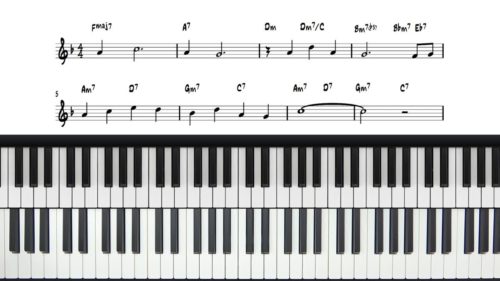
The A Section of the tune repeats 3 times and so we can use passing chords to add interest to otherwise identical har...
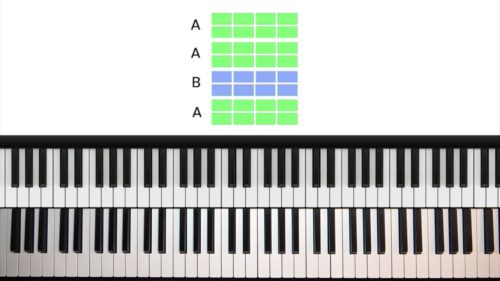
We examine the slight variations on the A Sections and we will then learn how to connect the A & B Sections together ...
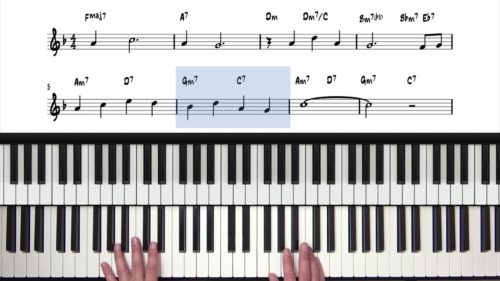
We take each bar of the A Section and apply licks, fills, and melodic ornamentation that we can use to create a soulf...
Practice Tips
-
First play though the melody with octaves to familiarise yourself with the octave shape in your right hand.
-
Practice hands separately until both parts can be played accurately and in control. Then it's time to put both hands together.
-
Intertwine single note melodies with octave melodies to add emphasis and impact to certain parts of the melody.
- When playing octave melodies we loose the facility to add embellishments and decoration such as turns, inner voices, and intricate chromatic lines.


Hi, it looks like this video can’t be played ?
It’s working now!
Hi Davis,
Apologies for the late reply here and I’m glad it’s working for you now.
Sometimes there can be issues with the video hosting but they are usually resolved very quickly.
On another note, the PDF files for this course will be ready soon. Our transcriber is currently creating PDF handouts for ever lesson in the course including the voicings and improvisation.
Cheers,
Hayden
Hi Hayden,
I am really enjoying this course which is very well structured.
The transcriptions are really helpful but I find that playing while watching short segments is what makes me learn and progress (and have fun!).
This is my favorite lesson up to now: I love the sounds of octaves and chord melodies.
And that C7#5#9 – Fm9 fill at 09:00 is so beautiful, I could play it all day long.
Have a nice day,
Matthieu
Hi Matthieu,
Thanks for getting in touch and I’m glad that you are enjoying the course.
Yes those chromatic lines create a beautiful sound, it’s a favourite of mine too. Also try experimenting with an F9 instead of F-9, that can sound lovely too.
Check out the following lessons in the course on “Ballad Voicings, Fills, & Improv” where we use the tune “The Nearness Of You”:
https://pianogroove.com/jazz-piano-lessons/5-augmented-triad-lines/
https://pianogroove.com/jazz-piano-lessons/alterations-altered-lines/ (in particular chapter 5)
We apply the same concept, and the #5 triad / augmented triad line is very nice too.
It’s important to notice that the second line of the A section of the Nearness of You is 2 repeating 3625 progressions, and the exact same for the 2nd line of the A section of Misty. The only different is the key. This means the exact same melodies, progressions, fills, improvisations etc… can be applied over that section of both tunes.
You will also find that when you play the same idea or fill in a different key, sometimes you will find variations such as extra notes, passing tones, etc… that you wouldn’t have done in the original key and so transposing your ideas and applying them to all of the tunes that you are working on, in as many keys possible, is a really great idea.
Try to get into the habit of transposing the things you like into as many keys as possible, and also just as important applying them to other tunes that you are working on. That helps you remember these lines and they will become part of ‘your sound’ when playing jazz. In the longer term this is how we develop our own sound when playing jazz. It’s unique to everyone.
Check out those lessons above which will help you to see the similarities between Misty and Nearness Of You.
I recommend students to study both of these courses together.
Keep me posted on your progress Matthieu.
Cordialement!
Hayden
Indeed, the F9 sounds lovely!
Thank you for the tips, especially the one on transposing 🙂
I will definitely check out the course on “Ballad Voicings, Fills, & Improv”.
Have a nice day,
Matthieu
Hello!
I have 2 questions:
First from 8:09 to 8:14, can you please explain the theory/harmony of how you came up with the left hand rootless voicing? And how you created the right hand chord melodies that you played along with it? You mentioned that you will cover this in the next lessons, but I was not able to find it.
Also, the key of “Misty” on your lead sheet is E-flat major. However, it appears you transposed the audio to D major. Was there a reason for this? Thanks!
Hi William,
Great question!
For the rootless voicings, I explained how those are constructed in the earlier lesson in this course “Stride Left Hand Style” which you can find here:
https://www.pianogroove.com/jazz-piano-lessons/stride-style-for-ballads/
Please see the 3rd chapter “Cycle Drills For Stride” and specifically from 4:30 to 9:00 I explain the voicing constructions.
—-
One tweak that I play in the section you are referring to (8:09 to 8:14 of this lesson) is that I play a rootless voicing for Eb7b9. Here I flatten the 9th of Eb9 which is the note F, to play E natural, or technically Fb, but it’s the same note enharmonically.
So there are many options for rootless left hand voicings. For that dominant chord, we could play Eb9, Eb13, Eb7b9, just as some examples.
When I mentioned I’d cover it in a next lesson, I think I was referring more to the right hand part, as we covered the left hand rootless voicings in the previous lesson (Lesson 2.2 in the course).
Having reviewed my right hand, it seems that i did not cover that in a future lesson of the course. My apologies there. You will notice that when I play the rootless voicing for Eb7b9 in my left hand, my right hand plays a C major triad with the top and bottom note doubled. This is an upper structure triad voicing and it works in this case specifically because I am playing the b9 in my left hand.
When we superimpose a C major triad over Eb7 it gives us the following Eb7 upper extensions: C(13) E(b9) G(3rd) so that creates a very rich Upper Structure Triad Voicing.
I am also harmonising the melody as the descending melody line over Eb7 is the notes C-Bb-G-Eb and we can harmonise the notes C and G with inversions of a C major triad in our right hand, whilst playing the Eb7b9 rootless voicing in our left hand.
If you are new to upper structure triads, you might like to check out these 4 seminars: https://community.pianogroove.com/t/upper-structure-triads-for-beginners-beyond/12629 – click the links on that page to go to the seminar pages where you can find the archived versions of the seminars. Upper structure triads are a very important theory area for solo jazz piano and cocktail jazz piano styles so have fun exploring that theory.
—-
On a related note, you might like also to check out the full course on Rootless Voicings here: https://www.pianogroove.com/jazz-piano-lessons/left-hand-voicings/ – this course covers the Type A and Type B rootless voicings for all 12 major 251s, and also minor 251 theory.
—-
Finally, no I did not transpose the audio to D major. I just played along with the sound of the tutorial on my piano and I confirm it’s in the key of Eb Major.
Are you using a digital piano with a transpose function? That could be the issue there. Please let me know and I can investigate further if needed.
Also if you have any follow up questions on the rootless voicing or upper structure triad information above just let me know. Start by revisiting lesson 2.2. in the course for the rootless voicings theory and construction, then experiment with a C major triad played over the Eb7b9 chord to create a rootless upper structure triad voicing.
Cheers,
Hayden