



Corcovado Beginner Tutorial
In this lesson, we explore the classic Brazilian tune ‘Corcovado’ in a style suitable for both beginner jazz pianists and those new to the Brazilian style.
The A Section
It’s worth noting that this tune follows an A-B-A-C form meaning that the second A section is an exact repetition of the first A section. This helps with internalising and memorising the tune.
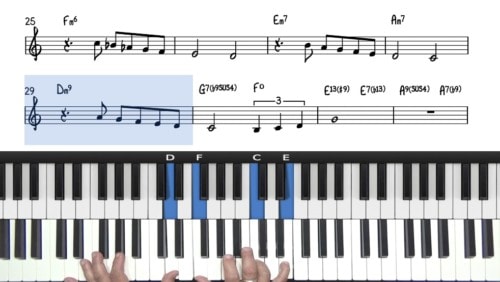
We explore various minor chord voicings and discuss how to find voicings which add extra colour, texture and character to our arranagment.
The B Section
We add interesting and sophisticated harmonies to the B section paying special attention to the implied inner voice movement. When we have a single chord type for more than 1 bar, a useful device to add interest is to add inner movement to the harmony. The first two bars of the B section this is a great example of how this can be applied.
The C Section
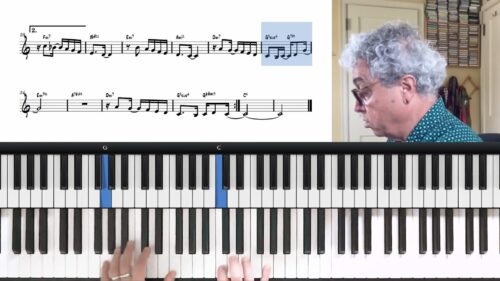
It’s important to note that the C section is 12 bars long. While not highly unusual, it deviates from the standard 8-bar length commonly found in most jazz standards and so it’s an important point to remember when playing this tune.
Related Lessons
In this lesson we will explore the tune “Corcovado” by Antonio Carlos Jobim and analyse the introduction which is...
One of the best ways to learn a piece of music is to first learn how to accompany it. This tutorial demonstrates usin...
The first jazz standard lesson in this course is "Corcovado" written by the great Antonio Carlos Jobim and lyrics by ...
Practice Tips
-
Listen to different versions of this song and play along with the melody to develop your own way of interpreting the tune.
-
Learn the tune by practicing each section separately (the A, B, & C sections) and then putting everything together.
-
If reaching big intervals in the left hand is challenging, use the alternatives shown.
- Ensure that you are comfortable with these basic changes; start by playing only the voicings and then add the melody.


Hi Hayden, I’m working on Corcovado for beginners and I’m looking for the next course that covers the left hand chords and improve for this tune. I can’t seem to find it anywhere, can you point me to that course?
Thanks,
Michael
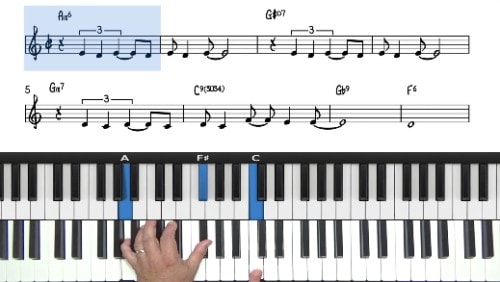
Isn‘t the six of A-minor „F“ instead of F#? That would be one step below the 7 „G“. To which scale does the F# belong? Melodic Minor would contain F# and G#. But have derived the F# from G.
Hi Jochen 👋
Great question!
We have 4 different scale options for A minor which are:
A Natural Minor – This is the C major scale, but played from A to A. Also known as the ‘relative minor scale’.
A Harmonic Minor – This scale contains F natural, and G#.
A Melodic Minor – This scale contains F# and G#
A Dorian Mode – This scale contains F# and G.
I like to look at these scales/modes as different ‘flavours’ of the A minor tonality. In fact they all start with the same 5 notes (A, B, C, D, E), they all contain the minor triad (A-C-E), and it’s just the 6th and 7th notes of the scale which are different which creates the slightly different ‘flavours’.
In this case, if we played “F” instead of “F#”, the chord would be very dissonant because of the half step interval between the 5th of the chord “E” and the note “F”.
If we play F#, that dissonance is removed and it creates a lovely ‘moody’ minor character. It’s a little dark and a little melancholy. A beautiful sound!
—-
From a harmonic standpoint, ie. when creating chords…. whether we are playing A6 (Amaj6) or Am6 (A minor 6), the 6 is the same note for both chords (F#).
From a melodic standpoint ie. when creating melodies over an A- chord , we can choose from any of the scales above and each one has a slightly different ‘flavour’.
I hope that helps and please let me know if you have any follow up questions.
Best,
Hayden