



The Key of C Major for Beginners
Welcome to the first lesson in our beginner course on the key of C Major. In this lesson we delve into fundamental music theory focusing on the C Major scale and the chords that we can create using the notes of the scale.
The C Major Scale
The C Major scale is an ideal starting point for beginners as it contains all white keys making it easy to visualise the notes on the piano. We start by outlining the correct fingering to ensure smooth transitions as we move up and down the scale. We also emphasise the importance of a natural wrist position whilst playing scales on the piano.
The Numerical Approach To Scales
Transitioning from traditional note names to a numerical understanding of scales offers a more versatile and functional framework for analysing jazz harmony. This approach involves viewing the scale as a series of numbers rather than letters. The numeric system simplifies the process of building chords, chord progressions, and understanding the relationships of the chords within a particular song or key.
C Major Diatonic 7th Chords
From each degree of the C Major scale we construct triads and then extend these triads to create seventh chords which adds a richer sound compared to basic triad voicings.
7th chords are a foundational component of jazz harmony and pave the way for exploring more complex chord progressions and voicings.
Related Lessons
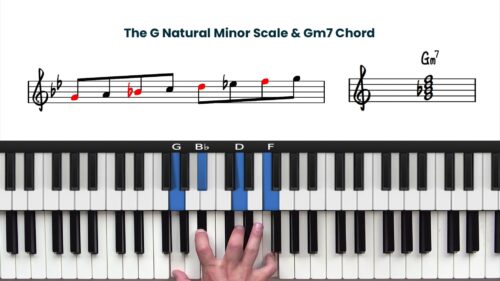
A seventh chord is a triad which has been extended to include the 7th degree of the scale. This creates a fuller soun...
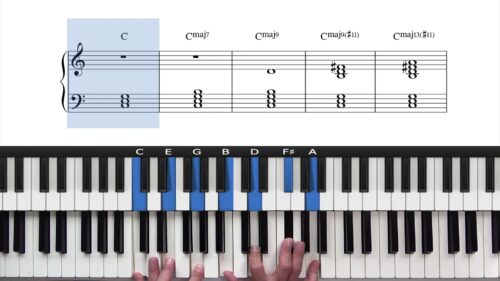
The triad is the basic building block for many different types of chords. The 4 types of triads are major, minor, dim...
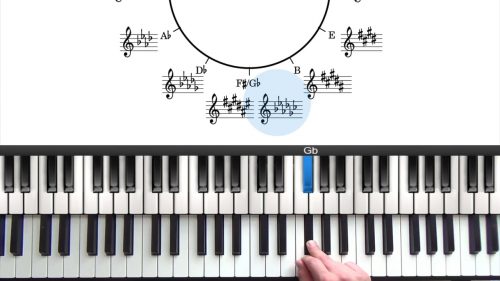
Scales provide the basis for understanding harmony. Learning and memorising the 12 major scales is the first step in ...
Practice Tips
-
Warm up with the C Major Scale: Focus on correct fingering and maintaining a natural wrist position when moving up and down the scale. Practice the C Major scale over 1 octave, and then 2 octaves.
-
Think Numerically: In jazz, we visualise scales numerically which helps to analyse chords, chord progressions, and jazz standards. For each major scale, think 1-2-3-4-5-6-7 instead of the note names.
-
7th Chord Drills: Learn the diatonic 7th chords in the key of C Major and complete the drills in chapters 4 and 5 to help you visualise the notes of each 7th chord split between 2 hands.
- Apply The Theory: In the upcoming lessons of this course we use these concepts to play "Moon River" & "Fly Me To The Moon" - spend 50% of your practice time on the theory drills, and 50% playing jazz standards.


Reviewing
Being able to read and play music at intermediate and advanced level
I have skipped the basics
So returning to basics
Damn it
Hi Hayden,
On chapters 4 and 5 (the drills), you end up playing the root and 5th on LH with fingers 3 and 1, respectively, and the 3rd and 7th on RH with fingers 1 and 4, respectively. I understand that once we start playing the tune there is fluidity on this as can be shown in chapter 6.
BUT, since the drills are important as you emphasize, is your finger configuration here the suggested one based on your experience. I say this because i naturally went for fingers 5 and 1 (LH) and 1 and 5 (RH) since the fingers in-between them correspond exactly to the 3 keys in-between the notes being played.
Hi Nivaldo,
Firstly please excuse my late reply – I’m just catching up on comments after a busy weekend.
This is a great question.
The fingering I use here is somewhat different to when playing a jazz standard. To be honest I didn’t really think about the fingering I was using, but my goal was to try to clearly show the notes of the 7th chord being shared between both hands. If I was to use LH 5-1 and RH 1-5 it might make it a little harder to see what I’m playing as my hands and fingers would be covering all of the keys.
So the short answer is that I chose this fingering to make it easy to visualise the notes being split between both hands.
—-
As you will see in the graphic that I shared in the forum thread earlier today – also attached to this comment – I wrote the fingerings as as 5-2 for every left hand chord in Moon River.
The reason is that in later lessons, we often develop the left hand further by playing the 7th, the 9th, or the 10th with our left hand thumb. For this reason we want to keep our thumb ‘available’ which is why I wouldn’t play my left hand as 5-1 (pinky and thumb) because then the left hand is far less ‘mobile’ and ‘adaptable’ as the left hand fingers cannot overlap the thumb.
However, if we look at another one of our beginner tunes, such as “In A Sentimental Mood” – https://www.pianogroove.com/jazz-piano-lessons/sentimental-mood-for-beginners/ (watch from around 4:50).
You will see that I voice the triad in my left hand with my 4th finger on the bottom and my thumb on the top, this is because we are adding a descending ‘minor line cliché’ which is very common device to play over minor chords.
The point I’m trying to make here is that the fingering very much depends on the harmonic context, what is happening in the melody, what chord is coming next and what chord came before.
There is no ‘set-in-stone’ fingering in jazz piano and as you correctly highlight we have a certain degree of fluidity and flexibility.
—-
What I’m demonstrating in this lesson is simply a drill to help you visualise the notes of a 7th chord spread between both hands. The fingering is in some ways irrelevant because there is no harmonic context and no melody note or melodic context.
So in short, I wouldn’t get too hung up on the fingering, and instead focus on learning lots of new jazz standards.
Once you get 15 or 20 jazz standard under your belt, I guarantee that your fingering will be much more intuitive and almost ‘2nd nature’.
I hope that helps Nivaldo and let me know if you have any further questions.
Best,
Hayden
Thanks for all this info Hayden!
When I started practicing the first 8 bars for Moon River this morning I switched my LH to use fingers 5-2 based on your graph from your fingering email reply. I had the suspicion that you did that to allow a greater role for the LH later or something like that…and from your response now I see I was not off the mark. So…already busy practicing the 5-2 on LH.
Just one additional comment here: according to the PDF, in bars 1-2, your LH descends from Cmaj7 to Am7 but in the video your left hand ASCENDS from Cmaj7 to Am7. I like the sound of the latter better but wanted to ask you if there is a reason for this difference…
Thanks!
Nivaldo
My pleasure, Nivaldo.
I believe in the next lessons on this song (found in the same module) I show that the left hand can be played in different registers, ie. we can move the left hand down one octave which creates a ‘stronger’ foundation.
Playing the left hand further down the piano will often open up more options, for example in this lesson which is “2.4” in this course – https://www.pianogroove.com/jazz-piano-lessons/moon-river-extended-voicings/ – you will see that I introduce some chord extensions into the A-7 voicing, and the left hand root and 5th must be voiced an octave down for this to work.
My recommendation would be to study all of the lessons in this module and the voicing variations that I demonstrate.
Always remember that anything you see written in 2-staff notation (transcriptions) is simply one possible way to play the song and voice the chords.
When playing jazz piano our goal is to play spontaneously. By studying my video lessons and demonstrations it will help you to see and visualise chord voicing options on the actual piano keyboard, and not needing to rely on written notation.
Anyhow, please work through the rest of the lessons in this module and my explanations and demonstrations should answer your question in more detail.
If I can help further just let me know and enjoy the lessons!
Cheers,
Hayden
My question is of this lesson:
CMajorTriads& 7th Chords EasyJazz Piano Lesson
Has 6 “sub chapters”
Is there somewhere on the website I can go and see all the lessons with their sub charters listed?
So like in this course I would like to go to the:
Split 7th chords over two hands I would be able to find it easily!
Presently it takes me 10 minutesto able to find it when I would like to go back to it but I did not mark it!
Hi Gabor,
Thanks for this suggestion. I can look into showing lessons and chapters on a new page, but I’m not sure exactly what that would involve from a tech implementation standpoint.
My best suggestion would be to use the “Bookmark This Lesson” button that you see just above the top right hand corner of the video player.
When you click that button, you can then add your own personalised notes such as “revisit chapter 4 on splitting notes between 2 hands” and this note will be saved to the bookmark.
The bookmarks page is accessible in the header of the website (see the bookmark icon in the top right hand cover) and that will take you to this page: https://www.pianogroove.com/bookmarks/ – where your bookmarks are listed.
Your bookmarked lesson notes can be edited on that page, and you can click the bookmark to go straight to the lesson.
We created the bookmark feature for exactly the issue you are describing (not being able to find a lesson or remember which part of a lesson you are working on).
There are over 1000 lessons and seminars on the website, and so a page which lists 1000+ lessons with 6 chapters in each lesson could be quite an unwieldy page/interface to navigate.
I feel that using the Bookmark feature /interface would be much more manageable and practical.
You can also add your own personalised notes and reminders, including timestamps in mm:ss format which will give you even more granular reminders than chapters. For example you could write “continue from 10m12s in chapter XYZ”.
Please let me know if that helps.
Cheers,
Hayden
I have found the bookmarking to be a wonderful help, especially with notation of the timing of the things I want to return to, for example/
Practice drills:
– playing fingering correctly for C major scale
– memorize diatonic triads names and numbers
-play root note in left hand and seventh with root in right hand, working up the scale and saying the number and name of chord (8:07)
-(8:43) move left hand down an octave, walk up and down
-(9:06)now drop root from right hand, walk up and down
-(10:18) right hand plays 3 and 7 and left plays root and 5
– (10:45) extra challenge, move left hand down to lower register
Hi Deborah,
Thanks for commenting and I’m really glad to hear that the bookmark feature is useful for you.
That’s exactly why we created it; to help students revisit specific parts of the lesson they are working on.
It’s great that you are using timestamp reminders too, so that you can jump back to the exact point in the lesson.
If you have any questions or need further assistance, don’t hesitate to get in touch.
Cheers,
Hayden