


"My Foolish Heart" – Navigating The B Section
Welcome to the 2nd lesson in our exploration of the jazz standard "My Foolish Heart" for beginners. After exploring the A section in our previous lesson, we now focus our attention on the B section of the tune to solidify our knowledge of 2-handed spread voicings.
Always Analyse The Melody
This lesson emphasises the importance analysing the melody note in relation to the underlying chord. Analysing the melody and its relation to the underlying harmony can help us to choose the most suitable voicing configuration. Often the 3rd or 7th is the melody note!
Shell Voicing Technique
When the melody is busy – ie. lots of notes in the same bar – we can play left hand shell voicings which are most commonly played using R-7 or R-3-7 of the chord voiced exclusively in our left hand. This is a useful technique to ‘free up our right hand’ whilst ensuring that the harmony is still clearly established.
Shell Voicings & Melodic Embellishments
A key benefit of left hand shell voicings is that they ‘free up’ our right hand for additional melodic embellishments such as turns and grace notes.
An example of this is the D7 chord in bar 13 of the B section. The left hand shell voicing would be D-F#-C which is the R-3-7. This voicing technique can be used in combination with 2-handed spread voicings to create a more varied arrangement style with additional melodic embellishments added where appropriate.
Lesson Downloads
-
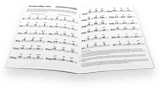 “My Foolish Heart” – B Section Beginner Notation File Type: pdf
Related Lessons
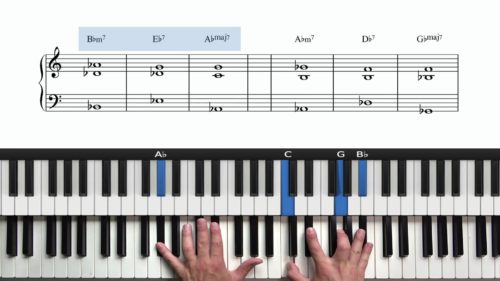
We introduce the concept of whole-step 251 drills, and how they can be an interesting alternative to drills around th...
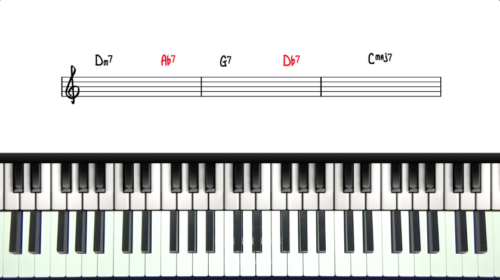
This type of passing chord is a dominant chord built a half step up. Dominant chords always have a strong pull to res...
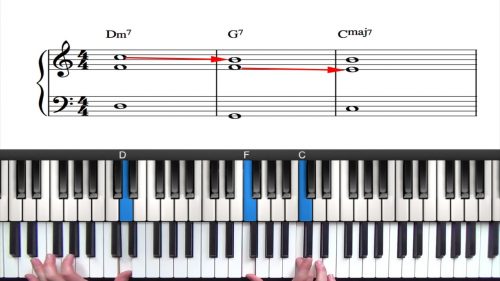
Most jazz standards that you come across will contain a 251 progression in some form so it is essential that you know...
Practice Tips
-
Master the A Section: Ensure a solid grasp of the A section's chords and melody before tackling the B section.
-
Spread Voicings: Continue visualising the notes of the chords spread between both hands. Creating an even spread in the placement of 3rd and 7th notes is important when arranging lead sheets for solo piano.
- Analyse Melody and Chord Relations: Always analyse how the melody note relates to the underlying harmony. This often helps in choosing the most appropriate chord voicing(s).


Hi Hayden, when using the “rollin” technique on the left hand (on the EbMaj7 eg) do you advise to quasi systematiclly try tu use the pedal to improve the legato ?
Hi Guillaume,
Great question!
Yes I recommend to use the sustain pedal at the same time as rolling the notes in the left hand.
As you mention, if we don’t use the sustain pedal it won’t create a legato effect which is important when playing in jazz ballad style. Without the sustain pedal, the bass note “Eb” will fade away too quickly when playing with the left hand ‘rolling’ technique.
On a related note, I hosted a seminar on using the sustain pedal which you can find it here: https://www.pianogroove.com/live-seminars/how-to-use-the-sustain-pedal/
I hope that helps and please let me know if you have any further questions.
Best,
Hayden
Thanks !
Would you have a printed resource on the Dorian keys?
Hey Joyce 👋
Yes we have a PDF download which contains all of the major modes, you can find it on this page in the “Downloads” section: https://www.pianogroove.com/jazz-piano-lessons/modes-major-scale-tutorial/
It’s important to remember that the Dorian Mode is simply the major scale with the 3rd and 7th degree flattened. So if you know your 12 major scales, simply drop the 3rd and 7th degrees by half a step and you have the Dorian Mode. This is the exercise that we outline in the “Essentials Practice Guide” that you can find here:
https://www.pianogroove.com/jazz-piano-lessons/essentials-practice-guide-simplified/
In that lesson/practice guide, we play each major scale, and then flatten the 3rd and 7th to play the Dorian Mode. I recommend to practice this way instead of reading the notes from a page. The former will help you visualise the 3rds and 7ths in each major and minor scale, which is a very important.
I hope that helps Joyce, and please let me know if you have any follow up questions.
Best,
Hayden
PS. as you’re interested in the Dorian Mode, you might like to check out this course “In A Sentimental Mood – Minor Improvisation” – which is a very accessible method into improvisation for beginners: https://www.pianogroove.com/jazz-piano-lessons/minor-harmony-improvisation/ – we explore the different minor scales, and how they are used in jazz piano.
Hi, thanks for updating your video player on apple devices, the loop function is lovely. It helps me a lot.
Hi Jürgen,
Thanks for letting me know – I’m really glad to hear that you like the new video player.
I agree that the A/B loop and speed controls are much better than the previous player we used.
Please let me know if I can be of further assistance, and enjoy the lessons!
Best,
Hayden