



"Autumn Leaves" For Beginners
After completing the brief harmonic analysis in the previous lesson, we now start arranging "Autumn Leaves" with basic chord voicings. We arrange the A section of the tune using the ‘3-note spread voicing technique’ to reinforce our understanding of the key of Bb major and its relative minor key: G minor.
By the end of this lesson, you will have a solid grasp of the 2 A sections of "Autumn Leaves" using 3-note spread voicings.
What are 3-Note Spread Voicings?
Three-note spread voicings offer a simplified approach to arranging lead sheets while still capturing the essence of a song’s harmony. Focusing on the A section which is the first eight bars of "Autumn Leaves" we move slowly to clearly visualise the ‘guide tones’ which are the 7ths falling to 3rds in the 251 progressions.
"Autumn Leaves" Pick-Up Bar
A important aspect of the tune "Autumn Leaves" is the ‘pick-up bar’ which is the incomplete measure that precedes the 1st bar of the song’s form. This lesson emphasises the importance of recognising the pick-up bar and how this is used to set up the start of the song.
Remember that the pickup back is not classified as bar 1, instead bar 1 of "Autumn Leaves" is the C-7 chord.
7ths & 3rds – Visualising Guide Tones
We pay special attention to the voice leading between the chords in the A section. This is achieved through the ‘guide tones’ which are the 7ths falling to 3rds in both the major and minor 251 progressions. This lesson walks you through each chord in the A section, demonstrating how to incorporate the melody in our voicings whilst also maintaining smooth voice leading and clean connections between the chords.
Related Lessons
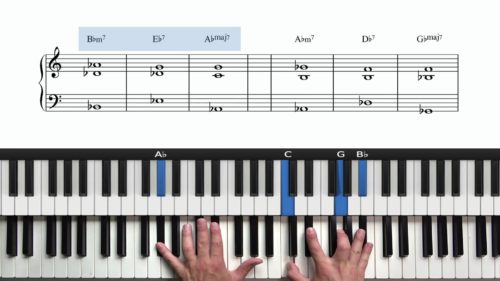
This whole step 251 drill will ensure that you are comfortable with the 251 progression in all keys using simple root...
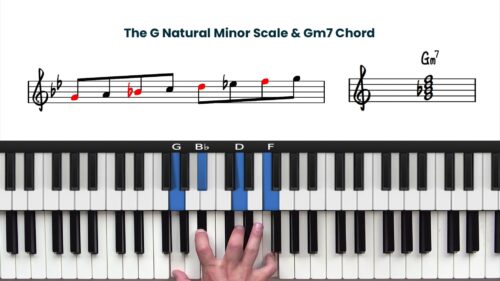
A seventh chord is a triad which has been extended to include the 7th degree of the scale. This creates a fuller soun...
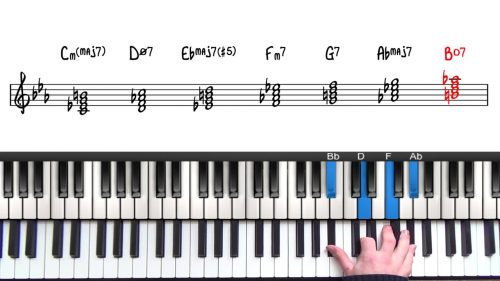
Minor harmony is much more complex than major harmony and so the minor 251 progression takes much more time and patie...
Practice Tips
Familiarise Yourself with the Melody: Start by playing the melody alone to become familiar with the melodic contours and phrasing.
Identify 2-5-1 Progressions: Always analyse the song's structure and locate the major and minor 2-5-1 progressions. Add annotations to your lead sheet in pencil to jog your memory on these common progressions.
Practice Three-Note Voicings: Spend time practicing the three-note spread voicings and ensure that you can clearly visualise the movement of 7ths dropping a half step to the 3rd of the next course.
Master the A Sections: Before tackling the B section and C section, ensure you are comfortable with the A section, including the melody, the 251 progressions, and visualising the voice leading.


Hi Hayden. I think you refer to this tune as the “infamous Autumn Leaves” during the lesson. Why is that?
Hi Greg,
That was an error on my side – I meant to say “famous jazz standard”.
I have fixed the narration in the video. Apologies for the confusion and please let me know if I can help further.
Enjoy the lessons!
Best,
Hayden
Oh. I thought that maybe it was one of those standards that are done so often that players got ‘sick’ of it! 🙂
Hi Hayden,
Between 8:50 and 9:00, particularly, you play the last two notes of each melody phrase with a sort of 2-beat comping, the first beat in the RH and the second in the LH. This is really nice…I know I watched another video where you talk about this technique but can’t remember where…can you give me a brief account of it here with any considerations you deem important? Thanks!!
Hi Nivaldo,
Great question!
Yes I’m breaking up the chord tones so that I don’t play them all simultaneously.
I play the root on beat one with my left hand pinky, then either the 5th or 7th in my left hand on beat 2, and then on beat 3 I play the rest of the chord in my right hand.
The important consideration is to be aware that we can stagger the notes of a chord onto different beats of the bar. If we play all of the notes of the chord simultaneously in every bar, it can sound a little ‘flat’ and lacking in movement.
The left hand pattern that I outline above also adds some movement into the left hand.
Regarding the other lesson you mention, I’m not sure which one that could be. I’d recommend using the lesson bookmark feature to write notes on the lessons that you are studying, and also the search box will return all lessons which cover this song: https://www.pianogroove.com/?s=autumn+leaves
If it’s a beginner-focused lesson that you are referencing, it will likely be one of the lessons in this course as many of the other lessons on Autumn Leaves incorporate more advanced theory.
I hope that helps Nivaldo – please let me know if you have any further questions.
Best,
Hayden