


3 Slow Blues Turnarounds In C
Welcome to this lesson where we explore three distinct turnaround options that you can use at the end of a 12-bar slow blues in the key of C.
Turnarounds are a key component of blues piano and are essential for smoothly transitioning back to the beginning of the form, especially when playing multiple choruses in a single performance.
This lesson breaks down three stylistically and harmonically diverse turnaround progressions, helping you expand your vocabulary and develop a confident approach to ending phrases in the blues.
Turnaround 1: The Blues Scale Turnaround
We start with a blues scale turnaround using notes derived from the C minor blues scale. This turnaround begins on the I chord (C), moves to C7, then travels through F7, F#dim7, and finally G7 chord before resolving back to C at the top of the form. This classic movement features bluesy melodic embellishments in the right hand while the left hand outlines 10th intervals and 7th chord voicings:
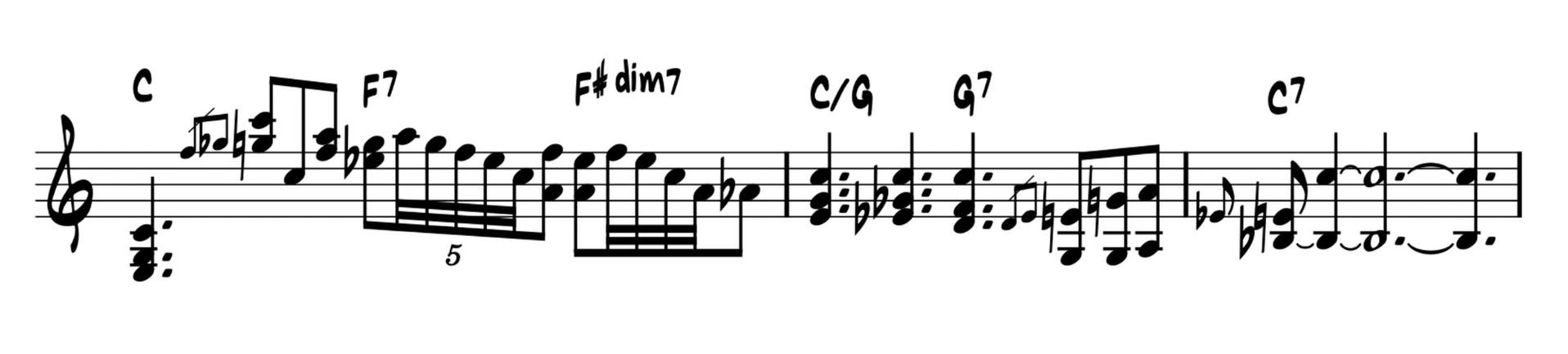
You’ll learn how to “crush” notes, roll chords for expression, and use octave and shell voicings to fit your hand size and comfort level. The turnaround concludes with a G7(#5) leading naturally back to the top of the form.
Turnaround 2: The 1-6-2-5 Progression
The second turnaround introduces more advanced jazz harmony, using the progression: Cmaj7 to A7(b9) to D9 to G13sus. This 1-6-2-5 formula is common in jazz and creates a smoother, more chromatic transition through secondary dominants:

You’ll explore chromatic passing chords, altered tensions such as the b9, and smooth voice leading to connect each chord in the progression. This approach lends a more sophisticated, modern jazz feel to your blues playing.
Turnaround 3: Reharmonised Tritone Substitution
The final turnaround explores chord substitution techniques. Here, the progression starts on C, then moves through Eb7 to Ab7 to G7 before returning to C. These are tritone substitutions for the typical 2-5 (D-7 to G7), giving the turnaround a more colourful and surprising harmonic twist:

This section emphasizes root motion by fourths, strong bass movement, and classic voicings that add richness and tension before the final resolution. You’ll also learn how to roll chords for dramatic effect and use octave bass notes for added weight and clarity.
Lesson Downloads
-
 Slow Blues Performance File Type: pdf
Related Lessons
In this lesson you will discover essential blues turnarounds for piano, from simple C7 transitions to sophisticated G...
Discover the backdoor 2-5-1 progression, a powerful chord substitution option. We explore its role in jazz standards ...
In this lesson where we explore some more advanced harmonic variations for the final line of the blues including the ...
Practice Tips
-
Master the C minor blues scale – It forms the foundation for melodic embellishments in the first turnaround.
-
Focus on smooth transitions – Use proper fingering and hand positions to move between C7, F7, F#dim7, and G7 without hesitation.
-
Experiment with shell voicings – Try root-7 or root-3-7 shapes in the left hand to support a busier right hand melody.
-
Apply tritone substitutions – Practice moving from Eb7 to Ab7 to G7 to develop fluency with altered dominant sounds.
- Use rhythmic variation – Roll chords and add syncopation to bring life and personality to each turnaround.

