


Blue Bossa Part 1
Blue Bossa is a great tune to use as an intro to Bossa Nova style. It has a relatively short form at just 16 bars long and it contains both a major and a minor 251 progression. This gives you the opportunity to practice these important progressions in context of a Bossa tune.
When starting out playing Bossa Nova standards, it’s a good idea to separate and isolate the different elements that make up a Bossa Nova groove.
In this lesson I will demonstrating a 5 step process which you can use to approach any Bossa Nova tune you would like to learn.
1) Play through with just the comping voicings — do this in your right hand first and pay attention to good voice leading. Then move onto your left hand.
2) Next play through just the bass line in your left hand– remember that a nice bass line to start with is root and 5^th^. During this step you should also try to add chromatic approach patterns where applicable.
3) Step 3 is to play the baseline and the comping voicings together. Remember to play slowly and accurately to begin with and then gradually speed up the tempo. Add in chromatic approach patterns and also vary the alterations you are playing in your right hand.
4) Next introduce the melody on top . This will allow you to visualize where you can fill in with comping chords when the melody is static.
5) Step 5 is to play the bass line and the melody over the top. This step is trickier than the last step and it requires a lot of hand independence.
Spend some time isolating these different areas and then when you feel more comfortable with this move onto Part 2 of the tutorial.
Related Lessons
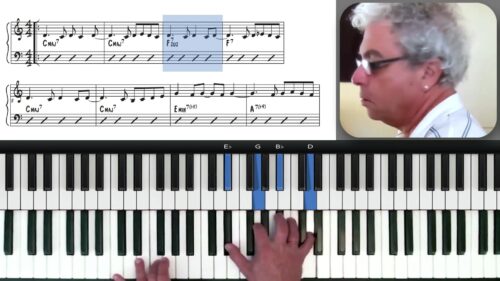
We explore the tune "Fotografia" and isolate the different components of performance including harmony, melody, compi...
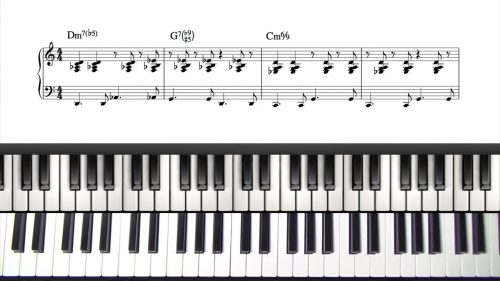
251s feature heavily in Bossa Nova music and it’s a good idea to learn to play major and minor 251 progressions wit...
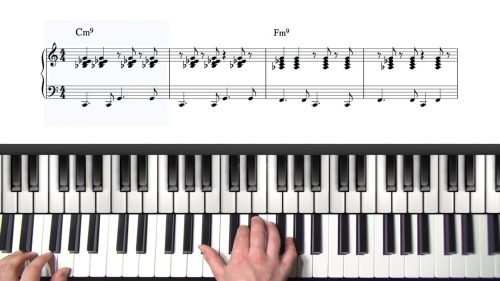
In terms of harmonic structure, Bossa Nova has a lot common with jazz music as both share a sophisticated use of seve...
Practice Tips
- Separate and isolate the different elements that make up a Bossa Nova groove.
- Take your time with each individual step.


Hi Hayden!
Is there a sheet music for this lesson ?
Thank you
Hi Neil 👋
Thanks for getting in touch.
When I created those 2 bossa nova lessons, I decided not to add the note-for-note notation.
My opinion was: that by giving the full transcription, it acts as a disincentive for students to learn the style properly.
If you listen to any bossa records, you will hear that the rhythms and basslines are not set in stone, they are fluid from bar to bar, depending on the melody and other factors. To really get this down you must listen to lots of bossa. I thought it was counter-intuitive to encourage students to read the rhythms off a page.
I’m actively looking for a dedicated Latin tutor to further develop that section of PianoGroove. My guess is that he/she would have a similar opinion to me on the matter but I’ll leave that to them. Bossa Nova isn’t a sound/style that I specialise in, but to create those tutorials I did so simply by listening to a bunch of bossa nova records.
This is a nice tune to experiment with because there is both a major and minor 251, so you can apply different altered and extended voicings. The perfect beginner tune in my opinion.
I hope this helps Neil. If I can be of further assistance let me know :-)
Cheers,
Hayden
Why does the picture break up? This happens from time to time. In this case, it’s happening on the Blue Bossa lesson Part 1. Also, there is no sheet music for this lesson to show the various rhythmic variations.
really struggling with step 4 and 5. I can play Bossa nova rhythm and 2 5 1 progression in both minor and major keys – no problems. But mixing syncopated rhythm in left hand and melody in right hand- borderline impossible. Are there any foundational lessons I am missing ( or maybe master classes ) that I need to dive in to help with this? And this is just bossa nova for beginners!
Hi Panda,
Yes solo bossa nova piano is very difficult because we have 4 roles: the bass line, the comping patterns, the harmony/voicings, and finally the melody.
Usually these roles are split between multiple musicians (drummer, bass player, pianist/guitarist, and singer) and so we are effectively playing 4 musical roles simultaneously.
I’d recommend spending time to internalise the samba groove and syncopation, here’s a lesson on that: pianogroove.com/bossa-nova-lessons/samba-pattern-for-beginners/ – bossa nova has the same patterns as samba, but slowed down. Then use these patterns when the melody and/or harmony rests.
We can also play bossa nova music as a ballad (without the syncopation) – here’s a lesson which is very beginner focused: pianogroove.com/bossa-nova-lessons/corcovado-tutorial-beginners/
It’s incredibly difficult to coordinate bass lines, comping, and melody at the same time, so start by playing these tunes as a ballad, and then when there is space in the melody and/or harmony, add the comping patterns that you mention you are comfortable with.
I hope that helps and please let me know if you have any further questions.
Best,
Hayden
PS. I’d also recommend to study Jovino’s arrangements to see how he arranges these songs for solo piano. He is Brazilian and a master of the style. This is not a style that I specialise in and so I recommend to study Jovino’s lessons and emulate his performances. Here are Jovino’s 2 bossa nova courses:
pianogroove.com/bossa-nova-lessons/brazilian-grooves-course/
pianogroove.com/bossa-nova-lessons/brazilian-vamps-grooves/