

“Sentimental Mood” Blues Scale Improvisation
Welcome to this improvisation-focused lesson where we explore how to apply the blues scale over the A section of the classic jazz ballad “In a Sentimental Mood.”
This tutorial is perfect for beginner to intermediate jazz pianists who are developing their soloing skills with blues scale vocabulary.
Introducing the D Blues Scale
We begin by outlining the D blues scale, which consists of six notes: D, F, G, Ab, A, C, and back to D. This scale introduces the characteristic “blue note” (Ab) which adds the tense and bluesy character to our melody lines. The D blues scale can be used as a melodic palette over much of the A section as we explore in this lesson.
However, it’s crucial to remember that improvisation is more than just running scales. Logical improvised lines often centre around chord tones of the basic triad – root, 3rd, and 5th – and use the the colorful scale tones as embellishments or passing tones.
Improv Triads and Five-Note Clusters
Rather than relying solely on scale runs, we build improvisations around triads and five-note cells. These limited note groupings force more intentional, melodic improvising.
You’ll learn how to sprinkle in colour tones such as the major 7th from the melodic minor scale and the b5 from the blues scale to add more interest to 5-note cell improvisation.
Mixing Scales and Creating Motifs
We discuss the concept of “neighboring” blues scales. For example, mixing the D minor blues scale with the A minor blues scale creates new melodic possibilities. This can add variety and expands our melodic vocabulary using the same blues scale soloing ideas.
We also discuss blues scale "motifs" which are short repeatable musical ideas or phrases. Motif development adds structure to our solos and helps our improvisation sound more logical and coherent.
Relative Key Relationships: Major vs. Minor
Towards the end of the lesson, we analyze how the D blues scale can also function over the relative major key of F. This shift in context changes the emotional tone from dark and moody to bright and optimistic.
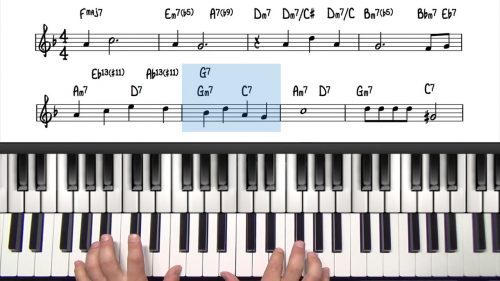
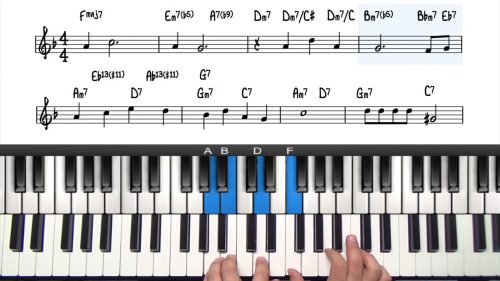
Understanding the relationship between relative major and minor keys (251 In D Minor and 251 In F Major9 helps to apply blues vocabulary across both minor and major 2-5-1 progressions. It’s very common for jazz standards to feature the relative major and minor keys.
Related Lessons
In this tutorial we create a solo arrangement for "Georgia On My Mind" applying the major blues scale with some soulf...
Using the tune "Georgia" - we will also explore the concept of the major blues scale and how to apply this to major 2...
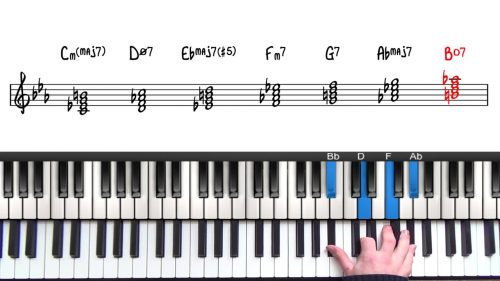
Minor harmony is much more complex than major harmony and so the minor 251 progression takes much more time and patie...
Practice Tips
-
Focus on Triad Shapes: Build your lines around the root, 3rd, and 5th of each chord. This creates strong melodic anchor points.
-
Use the Blue Note Sparingly: The Ab in the D blues scale is expressive, but overuse can make lines sound monotonous. Treat it like adding seasoning to a dish.
-
Avoid Running Scales Linearly: Instead of only playing the blues scale up and down, focus on intervallic skips, motifs, repeated notes, grace notes, and phrasing around chord tones.
-
Blend Scales Thoughtfully: Experiment by mixing D blues with A blues or D melodic minor, but always return to strong harmonic centres.
- Create and Develop Motifs: Repeating and varying short ideas gives your solos shape and helps your playing sound more intentional and musical.



Hi Hayden,
Thank you very much for this improvisation lesson on the blues scale.
I still have a lot of trouble knowing which blues scale to use. You also mention the neighbouring blues scale of D minor, i.e. the A minor blues scale. Could you elaborate on this or point me to a lesson that deals with these neighbouring blues scales? I’m also a bit confused between the minor and major blues scales. Thank you for enlightening me, Hayden.
Best regards,
Véronique
Hi Véronique,
Great questions.
Every major scale has a relative minor scale. The relative minor scale starts a minor 3rd below the major scale. Jazz standards very commonly move between the relative major and minor key in their harmonies.
Perhaps the most famous example of this is “Autumn Leaves” where almost the entire tune is 251 progressions in Bb Major and G Minor – the relative major and minor 251. Notice that G is a minor 3rd below Bb.
This song (In A Sentimental Mood) is in the key of D minor, and you will see in the A section we also have a 251 in F major. F major is the relative major key to D minor.
If you play the F major scale from D to D, we have the D natural minor scale. As we explored earlier in this course there are 3 minor scales which have different ‘colours’ or ‘flavours’ … we have the natural minor scale, the melodic minor scale, and the harmonic minor scale.
—–
The blues scale works in the same way, if we play the D minor blues scale (which I demonstrate in this video) but from F to F, we have the F major blues scale.
I explain the major and minor blues scale relationship in this video on “Georgia On My Mind”: pianogroove.com/blues-piano-lessons/the-major-blues-scale/ – again you will see that this song is mainly composed of 251 or 36251 progressions in F Major (251: G-7 / C7 / Fmaj7) or (36251: A-7 / D7 / G-7 / C7 / Fmaj7) and also the relative minor 251 progression which is D minor (E-7b5 to A7alt to D-) is used in the A section and also throughout the B Section.
Moving from the relative major to the relative minor (or vice versa) is an extremely common harmonic movement in jazz standards.
—–
If you’d like a list or diagram of relative major and minor keys, the circle of fifths is perhaps the best reference for this. This is included as a PDF download in our Foundations course.
Download a copy of the circle of 5ths here: pianogroove.com/media/2015/11/circle_of_fifths.pdf – you will see the major scales on the outside of the circle, and the relative minor keys on the inside of the circle.
You can print this and keep it close to the piano as it’s a handy reference.
—–
For neighbouring blues scale, simply look at the circle fifths diagram that I shared above.
You will see the key of D minor at 11 o’ clock on the inside of the circle, and the 2 keys that are neighbouring are G minor and A minor.
You can also think “minor blues scale a 5th away in both directions”. If you count a perfect 5th below D we get G, and a perfect 5th above D is A.
Remember this is the circle of 5ths and so the keys are separated by a 5th. Neighbouring keys on the circle are close to each other harmonically speaking, and so in this case we can also incorporate the notes of the blues scales of the neighbouring keys.
I mainly incorporate neighbouring blues scales by adding the ‘blue note’ which is the b5 in the blues scale and ‘crushing’ up and down as I demonstrate in this lesson. Please note that I don’t play the entire G minor and A minor blues scale, rather just incorporate the ‘bluesy’ parts of the scales (4th, b5th, and 5th of the blues scale which can be used to add ‘crushed’ grace notes that creates a strong bluesy character).
I hope that helps Véronique, check out the lesson on Georgia On My Mind above, we also look at major and minor blues scale improvisation in this seminar on Georgia On My Mind: pianogroove.com/live-seminars/georgia-improvisation-workshop/
If you have any further questions let me know.
Cheers,
Hayden
Salut Hayden,
Merci infiniment pour cette réponse très détaillée et instructive sur les gammes blues et les gammes blues voisines.
Je regarderai attentivement les cours proposés sur cette thématique.
Toute belle suite à toi et encore merci. J’apprends toujours énormément avec tes cours.
Bien à toi
Véronique