


Eb Major Spread Voicing Drills
In this lesson we dive into the key of Eb major covering the essential harmonic components including the major scale, diatonic 7th chords, and common progressions like the 2-5-1 and 3-6-2-5-1.
By the end of this lesson, you will be able to visualise the Eb major diatonic 7th chords in both root and spread voicings.
Eb Major Scale & Diatonic 7th Chords
We begin by familiarising ourselves with the Eb major scale played over two octaves. From each degree of the scale we can build the diatonic seventh chords:
Ebmaj7 / F-7 / G-7 / Abmaj7 / Bb7 / C-7 / D-7b5.
Understanding the structure and function of these chords will help you to quickly analyse jazz standards and group together related blocks of harmony.
Root Position to Spread Voicings
Root position chords are where all chord notes are stacked sequentially and all played within the space of an octave. While occasionally used in jazz piano performance, they typically can sound too dense and unbalanced and so instead we turn root position chords into 2-handed spread voicings.
By learning to play spread voicings — where the notes of the chord are distributed across both hands — we achieve a more resonant and balanced sound. This technique is essential for harmonising and arranging jazz standards.
Mastering Common Jazz Progressions
We explore the 2-5-1 progression (F-7, Bb7, and Ebmaj7) and the 3-6-2-5-1 progression (G-7, C7, F-7, Bb7, and Ebmaj7). These common progressions are the building blocks of many jazz tunes. Isolating and practicing these progressions will significantly improve your ability to navigate and interpret jazz standards.
Lesson Downloads
-
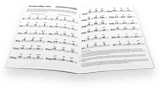 Eb Major Diatonic Harmony File Type: pdf
Related Lessons
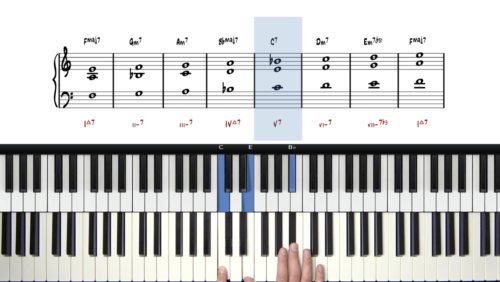
We take the diatonic 7th chords and change the chord qualities to dominant which allows us to access more interesting...
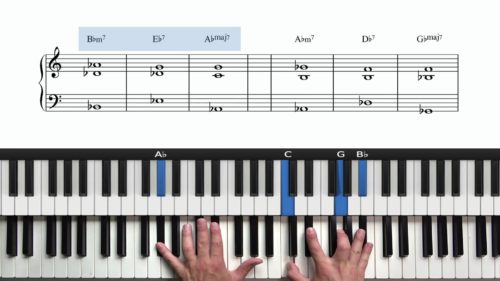
We introduce the concept of whole-step 251 drills, and how they can be an interesting alternative to drills around th...
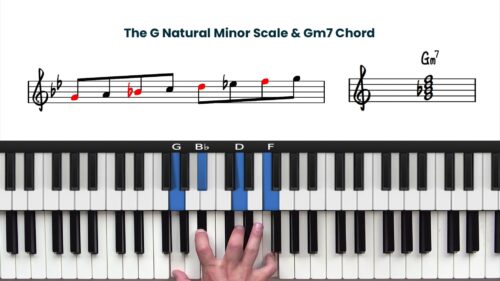
A seventh chord is a triad which has been extended to include the 7th degree of the scale. This creates a fuller soun...
Practice Tips
-
Scale and Chord Practice: Start each practice session by playing the Eb major scale and the diatonic seventh chords in root position. This reinforces your understanding of the key’s harmonic structure.
-
Create Spread Voicings: Transition from root position to spread voicings for each chord. Move to root into the lower registers and play the 3rds and 7ths in your right to create a more balanced sound.
-
Practice Common Progressions: Isolate and practice the 2-5-1 and 3-6-2-5-1 progressions using 3-note spread voicings. This will enhance your fluidity in moving between chords when playing jazz standards.
- Consistent Practice: Dedicate 10-15 minutes at the start of each practice session to these drills. Regular practice will solidify your understanding and help you to visualise these essential harmonic components.


Hi Hayden,
The resource PDF titled Eb Major Diatonic Harmony that you posted here is such a great resource! I love the way it sets the path for learning Misty. This kind of compilation could become standard for reading Lead Sheets organized by Keys.
Do you have something similar to this for learning Moon River and Fly Me to the Moon…in other words a PDF titled C Major Diatonic Harmony?
I looked at several C major resources and couldn’t find something similar or a way to handily put this together from the existing ones.
Many thanks!
Nivaldo
Actually, I am going to reply to my own comment :)
It will be an even BETTER experience if I myself write a CMajor Diatonic Harmony sheet. You already showed us a good way of doing it with the Eb example…I just have to follow the treasure map. I am sure this way I will get even more out of it.
Please disregard my request. Thanks!
Hi Nivaldo,
You will find other courses that have this style of notation, for example the course “Georgia On My Mind” – Bluesy Stride Piano” – pianogroove.com/blues-piano-lessons/bluesy-stride-piano-beginners/
The first lesson in that course covers the same drills in the key of F Major: pianogroove.com/blues-piano-lessons/diatonic-7th-chords-in-f-major/ – and you will see a download called “F major diatonic workout”.
The first lesson in this course also covers similar drills and there is a PDF file in the Downloads section: pianogroove.com/jazz-piano-lessons/elegant-stride-improvisation/
—-
Yes I think it would be a great exercise to write out a similar notation document in C Major.
I highly recommend MuseScore which is free and open source notation software: musescore.org/en/download
Click the small blue link “download without MuseHub” otherwise it bundles a program called MuseHub into the download which you do not need.
Cheers,
Hayden