



Moon River Jazz Piano Tutorial
In this lesson we create a full solo piano arrangement of the tune "Moon River" incorporating interesting voicings, fills, and reharmonisations.
Moon River is a delightful jazz waltz ballad composed by Henry Mancini. The tune has a very carefully constructed melody and delightful harmonic passages and cadences.
Moon River Solo Piano Arrangement
We will arrange the tune for solo piano performance using 2 handed spread voicings, passing chords, upper structure triads and altered harmony, and some interesting tritone substitutions. If any of these theory areas are new to you check out the related lessons below.
Related Lessons
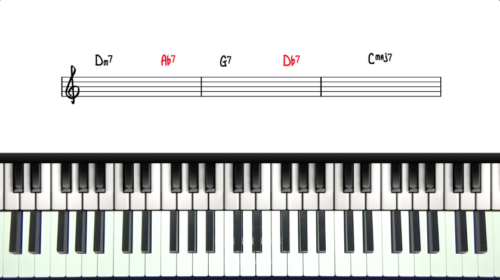
This type of passing chord is a dominant chord built a half step up. Dominant chords always have a strong pull to res...
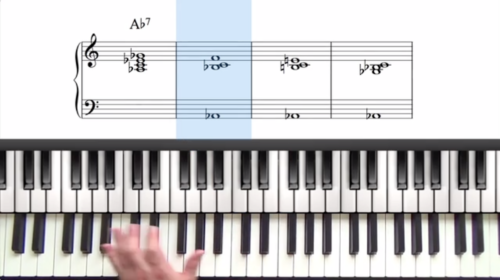
Cluster voicings are tightly spaced groups of 3 or more notes that act as a chord. They don't usually contain both �...
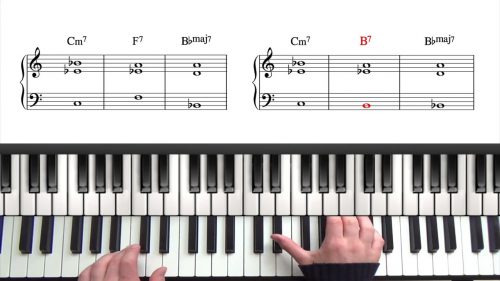
Tritone Substitution is a useful reharmonisation technique that can be used to add harmonic interest and variety to a...
Practice Tips
-
Experiment with the melody in different registers of the piano.
-
Harmonise the melody with 3rd and 6th intervals to create more interest and texture in the upper registers.
-
Study the fills which are used when the harmony, melody, or both, are static. Fills and ornamentation enhance our solo jazz piano performance.
- Practice both the regular changes and the reharmonisations such as tritone substitutes.


I really liked the extra rhythm you added to your left hand in the C section. Any suggestions of other places on PianoGroove for finding similar rhythm-related fills?
Hi Wendy, Apologies for the late reply here – I missed this comment.
Yes this kind of rhythmic related fill in the left hand is useful for navigating the minor line cliché such as in the tune “In A Sentimental Mood”, check out chapter 4 of this lice seminar:
https://pianogroove.com/live-seminars/sentimental-mood-jazz-standard/
The reason this works well is that we only have one note changing which creates a moving voice and allows us to add rhythmic interest when the voice moves.
I hope that helps to give you another example of where this could be used. The key is to watch out for that minor line cliché or some kind of slash chord notation in the bass which is usually to indicate that a moving half or whole step bass line can be used.
Cheers,
Hayden
In the B section on the E7 I used a C major triad for the 1st two melody notes follow by a Bflat triad for the D.
Hey Tim,
That’s great that you have figured out those voicings for that section. It sounds beautiful.
An important point to understand is the relationship between the 13#11 UST and the #5#9 UST.
When we play a C Triad over Bb7, we have Bb13(#11), and when we play that same C Triad over E7 (The Tritone of Bb7) we then have E7(#5#9) and so by just changing the bass note we change the flavour of the chord completely.
Interestingly here, the Bb triad gives you a b9#11 sound over the E7, and so in combination with the C Triad you play all alterations over the E7 (b9, #9, #11, and #5/b13) by using those 2 triads.
When playing USTs always ask yourself, “what would the tritone give me here” and it will immediately unlock more options for harmonising the melody.
Have fun playing around with this stuff!
Cheers,
Hayden
What a lovely rendition of this song!
Where is the beginner version. Search only reveals intermediate and advanced….
Hi Mivi,
The previous lesson in this course is a “harmonic analysis” of this tune which covers the basic chord changes, you can find that lesson here:
https://pianogroove.com/jazz-piano-lessons/moon-river-harmonic-analysis/
In this lesson we discuss the numerics of the original harmony without the reharmonisations and chord substitutions. This is the beginner-level tutorial that we have on this tune and it will also help you to understand the harmonic construction of the song which is useful before we add the reharmonisations.
I also hosted a seminar on this tune which you can find here:
https://pianogroove.com/live-seminars/moon-river-jazz-standard-workshop/
The light-up keyboard for the seminar was accidentally recorded in lower quality so the visual quality is not as sharp as usual, but hopefully it’s not too much of an issue.
Let me know if I can help further and enjoy the lessons!
Talk soon,
Hayden
Where do I find the beginner tutorial on Moon River you mention in the intro? Thank you….
HI Mivi,
Did you see my previous reply to your question?
You should be able to see it if you scroll up.
The previous lesson in this course is a “harmonic analysis” of this tune which covers the basic chord changes and voicings, you can find that lesson here:
https://pianogroove.com/jazz-piano-lessons/moon-river-harmonic-analysis/
This lesson will help you to understand the harmonic framework of the tune which is useful before diving too deep into reharmonisations.
There is also a seminar on this tune which you can find here:
https://pianogroove.com/live-seminars/moon-river-jazz-standard-workshop/
Let me know if I can help further.
Cheers,
Hayden
Hi Hayden,
Is there any chance you could generate a MIDI file for the first 1min + 32sec of this lesson, with separate channels for RH and LH? Can it be done using this exact rendition? ***It’s impossible to describe how incredible this sounds to my ears…*** I would like to dedicate time to emulate this…a (long) side project to go with all the other great lessons I’ve been studying.
Thanks!
Hi Nivaldo 👋
Please excuse my late reply.
I have located that MIDI file and added it to the “Downloads” section for you. The midi file is just one channel and so I’m not sure how to go about separating the right and left hand.
This is an advanced arrangement but also a great study of harmonic devices and arranging techniques.
Have fun playing around with it and have a great weekend!
Cheers,
Hayden
Hi Hayden,
Excellent cet arrangement piano solo. Très intéressant.
Tu pourrais me réexpliquer la fin, le passage de G7 à Abmaj7 à Db7 ? Pas sûre d’avoir bien compris, mais c’est tellement beau. C’est quelque chose qu’on peut faire régulièrement en fin de morceau ?
Merci d’avance pour ta réponse.
Belle journée.
Véronique
Hi Veronique 👋
Great question!
When ending a jazz standard, it can be nice to play a major 7th chord a half step above the final resolution point. This creates a delayed resolution.
For “Moon River” – the final resolution point is Cmaj7, as we are playing in the key of C Major (jazz standards usually end on the 1 chord of the key).
A half step above Cmaj7 is Dbmaj7, and so we can first play Dbmaj7 which creates an unexpected, surprising, and uplifting sound. We then arpeggiate the notes of Dbmaj7 or Dbmaj9 and finally resolve to Cmaj7 for the final resolution.
—-
To take this a step further, I’m just thinking of a major chord a 5th above Dbmaj7 which is Abmaj7.
Harmony often moves in 5ths (think of the circle of fifths) and so Abmaj7 moving to Dbmaj7 sounds pleasing to the ear.
In this particular song, the final melody note is “C”. The note “C” is the 3rd of Abmaj7, and so the “C” melody note fits the Abmaj7 chord. Moving to Abmaj7 sounds even more unexpected and surprising that moving to Dbmaj7.
Abmaj7 then moves beautifully to Dbmaj7 because the chords are a 5th apart, and Dbmaj7 resolves beautifully into Cmaj7 because it’s a half step above the final resolution.
—–
To answer your other question… yes we can do this on any jazz standard.
As an exercise, pick any jazz standard that ends on the 1 chord with the root in the melody (in fact most jazz standards end on the 1 chord with the root in the melody!).
For example “Misty” ends on Ebmaj6 with “Eb” in the melody.
A half step above Ebmaj7 would be Emaj7, and a fifth above would be Bmaj7.
So to create the exact same ending for “Misty” we would play:
F-7 –> Bb7 –> then we add our ending here –> Bmaj7 –> Emaj7 –> final resolution to Ebmaj7.
Have fun experimenting with this!
Cheers,
Hayden
Hi Hayden,
Merci infiniment pour ta réponse, c’est génial.C’est tellement clair et précis. Tes réponses me sont précieuses et m’aident beaucoup.
Je m’ai m’entraîner à ce beau final.
Bien à toi
Véronique
Bonjour Véronique,
Je suis ravi que mon explication vous ait été utile et qu’elle ait permis de clarifier ce passage.
Prenez votre temps avec cette fin. C’est un très beau passage, et plus vous le jouerez, plus il vous paraîtra naturel. Essayez également d’appliquer ces mêmes concepts à d’autres jazz standards.
N’hésitez pas à m’écrire si d’autres questions vous viennent.
Bien à vous,
Hayden