


Two-Handed Chord Voicings For Jazz Piano
Welcome to day three of PianoGroove’s 7-Day Jazz Piano Jumpstart.
In the previous lesson, we learned how to construct 7th chords. In this lesson, we take those same notes and rearrange them across both hands to create a fuller, more balanced jazz piano sound.
One of the most common mistakes for beginner jazz pianists is to play the melody in the right hand and the entire chord in the left hand. While this works, it can sound dense, blocky, and disconnected.
The solution is to use two-handed spread voicings, where the notes of the chord are distributed across the keyboard to create more space, depth, and movement.
What You’ll Learn
In this beginner jazz piano lesson, you’ll learn:
-
How to transform root-position 7th chords into two-handed spread voicings
-
How to analyze the melody note in relation to the underlying chord
-
How to split chord tones between the left and right hands
- How to create a gentle rolling and rocking motion for jazz ballads
Why Spread Voicings Sound Better
If we play a full 7th chord in the left hand with the melody above it, the notes can become clustered into the same register of the piano.
This often creates a heavy sound in the lower part of the voicing, with too much space between the chord and the melody.
With a spread voicing, we simply rearrange the same chord tones.
We don’t necessarily need to add any new notes. By moving some notes into the right hand and placing the lower chord tones further down the keyboard, the harmony immediately sounds more open, balanced, and sophisticated.
Start With The Melody Note
Before creating a spread voicing, the first step is to identify the melody note in relation to the chord. For example, over Cmaj7, if the melody note is G, then the melody is already playing the 5th of the chord.
This means we don’t necessarily need to double that note in the left hand. Instead, we can rearrange the remaining chord tones around the melody and create a more spacious voicing.
This habit of analyzing the melody first is extremely important because it helps us understand which chord tones are already present and which notes still need to be voiced.
Root & 5th In The Left Hand, 3rd & 7th In The Right
A very useful starting formula for two-handed spread voicings is:
Left hand: Root + 5th
Right hand: 3rd + 7th + Melody
The 3rd and 7th are especially important because they define the harmonic quality of the chord, ie. is the chord major, minor, dominant etc…..
By moving the root and 5th into the lower register and placing the 3rd and 7th closer to the melody, we create a much more balanced distribution of chord tones across the keyboard.
It’s important to understand that the 3rd and 7th can appear in either order, depending on the melody note and the most comfortable voicing shape.
Spread The Notes Across The Keyboard
Register plays a major role in how a jazz piano voicing sounds. Playing all four chord tones closely together in the left hand can sound dense and muddy, particularly in the lower register.
Moving the root and 5th down an octave gives the harmony a stronger foundation, while the upper chord tones remain closer to the melody.
The result is a voicing with more depth, separation, and clarity.
Create Movement By ‘Rolling’ Voicings
Jazz ballads don’t always require every note of a chord to be played at exactly the same time. A beautiful alternative is to roll or gently rock through the notes of the voicing.
This creates a soft sense of movement and works particularly well in a tune like Moon River.
You might begin with the lower notes, move upward through the chord tones, and then allow the melody to sit clearly on top. This gives the arrangement a more flowing and expressive quality than simply striking every chord as a block of simultaneous notes.
Use The Melody As The Top Note
When both hands share responsibility for playing the chord, the fingering of the melody often needs to change. Instead of thinking of the right hand as playing only the melody, it now plays both melody and harmony.
For this reason, it is often useful to play the melody with the 5th finger, which leaves the remaining fingers free to play the 3rd, 7th, and other chord tones underneath.
This is one of the key changes when moving from a simple left-hand chord / right-hand melody approach into true two-handed jazz piano arranging.
Don’t Worry If This Feels Difficult!
Two-handed spread voicings can feel very challenging at first, especially if you are used to playing all of the chord in one hand. The important thing is to work slowly and understand the relationship between the melody and the chord tones.
With repetition across different songs, these shapes begin to feel much more natural and intuitive.
Throughout the Lead Sheet Fundamentals learning path, you’ll repeat this same arranging process across 9 jazz standards, gradually developing the ability to create spread voicings without having to calculate every note individually.
Related Lessons

We delve into fundamental music theory, focusing on the C Major scale and the chords that we can create using the not...
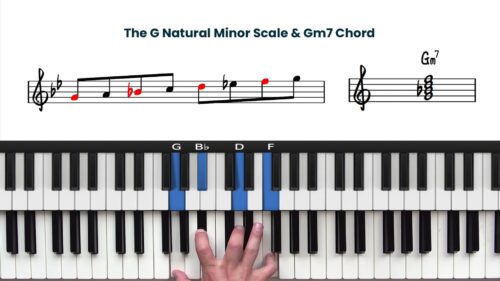
A seventh chord is a triad which has been extended to include the 7th degree of the scale. This creates a fuller soun...
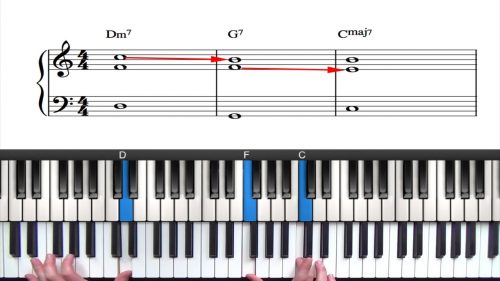
Most jazz standards that you come across will contain a 251 progression in some form so it is essential that you know...
Practice Tips
-
Analyze the melody note first - Before building the voicing, identify whether the melody is the root, 3rd, 5th, 7th, or a non-chord tone. This tells you which notes may already be present in the right hand.
-
Use a simple starting formula - Try root + 5th in the left hand and 3rd + 7th in the right hand, then place the melody above. This gives you a reliable framework when you’re unsure where to start.
-
Move the left hand lower - If the voicing sounds cramped, move the root and 5th down an octave. This creates more space and gives the harmony a stronger foundation.
-
Practice one chord at a time - Stop, take your hands off the keys, identify the next melody note and chord, and then build the voicing from scratch. This develops your ability to visualize chord tones instead of simply memorizing shapes.
- Use the PDF as a reference, not as sheet music - The goal is to learn to visualize and understand the chord tones, rather than read every voicing note-for-note from the page.

