


Developing Smooth Chord Transitions
Welcome to day four of PianoGroove’s 7-Day Jazz Piano Jumpstart.
In this lesson, we introduce the second eight bars of “Moon River” and continue developing our two-handed spread voicings.
Towards the end of this section, the harmony begins to move more quickly, with two chord changes per bar and a series of descending progressions.
This gives us the perfect opportunity to explore how to create smooth chord transitions and how to practice difficult sections effectively.
Rather than repeatedly playing the passage at full speed, we’ll learn how to slow it down, isolate the tricky chord changes, repeat them accurately, and revisit them over multiple practice sessions.
What You’ll Learn In This Lesson
In this beginner jazz piano lesson, you’ll learn:
-
How to create smooth transitions between jazz piano chords
-
How to use voice leading to minimize unnecessary movement
-
Why slow practice is essential for accuracy and control
-
How to practice a passage four times in a row without mistakes
- Why returning to difficult material the following day is so effective
Identify The Difficult Section
When learning a new song or jazz standard, not every part will require the same amount of practice. For example, in the first section of “Moon River,” each bar contains just one chord per measure.
Towards the end of the B section, however, we encounter two chord changes per bar, which makes the harmony move much more quickly.
Instead of repeatedly practicing the entire song from the beginning, it is much more efficient to identify and isolate the section that is causing difficulty.
Focused practice allows us to spend our time working directly on the material that needs the most attention.
Understand The Chord Movement
The final bars of the B section contain a sequence of minor and dominant 7th chords:
F♯m7♭5 → B7
Em7 → A7
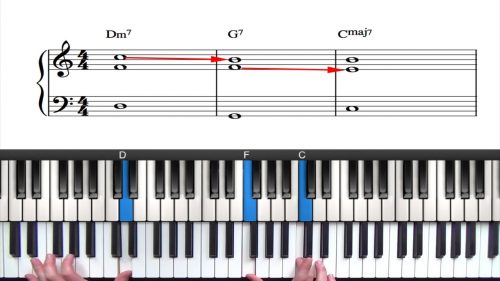
Dm7 → G7 → Cmaj7
The final Dm7 – G7 – Cmaj7 is a 2-5-1 progression in C major, one of the most important chord progressions in jazz. You do not need to fully understand the theory behind every chord at this stage.
For now, focus on recognizing the shapes and noticing how the chord tones can move smoothly from one voicing to the next.
Create Smooth Chord Transitions
When we play each chord in root position, our hands have to jump around the keyboard.
This can make the progression sound fragmented and disconnected.
Instead, we can rearrange the notes into two-handed spread voicings and look for small movements between neighboring chord tones.
For example, the 7th of one chord will often move down by a half step to become the 3rd of the next chord. These small movements create smoother voice leading and make the progression easier to play once the shapes become familiar.
Slow Difficult Passages Right Down
When a passage feels difficult, the first step is simple:
Slow it down.
Reduce the tempo until you can comfortably visualize the chord tones, move between the voicings, and play the passage accurately. The tempo may initially feel extremely slow — and that is completely fine.
If we cannot play something slowly and accurately, we are unlikely to play it quickly and accurately. The goal is not speed. The goal is to give your hands and your brain enough time to understand exactly what needs to happen next.
Repeat The Passage Without Mistakes
Once you have found a tempo where the passage feels comfortable, repeat it four times in a row without making a mistake.
If you make a mistake during any of those four repetitions, return to the first repetition and start again. This forces us to prioritize consistent accuracy rather than simply getting through the passage once.
You may find that the fourth clean repetition feels noticeably easier than the first. That is a sign that the movements are beginning to become more familiar.
Revisit The Passage The Next Day
One of the most important parts of effective piano practice happens away from the piano.
After you have practiced a difficult section accurately, leave it and return to it the following day. You may be surprised to discover that a passage that felt awkward during the previous session now feels noticeably more comfortable.
Learning an instrument is similar to physical training: progress does not always appear immediately during the practice session.
Give your brain and hands time to absorb the movements, and then reinforce them again the following day.
Don’t Rush The Learning Process
When you are new to jazz harmony and two-handed spread voicings, these progressions can initially feel difficult to visualize.
That is completely normal.
The goal is not to master every chord immediately. Instead, focus on developing a reliable practice process that you can use whenever you encounter a difficult section in a jazz standard.
Slow it down, repeat it accurately, and revisit it the next day.
Follow this process consistently and passages that initially feel awkward will gradually become comfortable, fluid, and intuitive.
Related Lessons
This whole step 251 drill will ensure that you are comfortable with the 251 progression in all keys using simple root...
A seventh chord is a triad which has been extended to include the 7th degree of the scale. This creates a fuller soun...
Most jazz standards that you come across will contain a 251 progression in some form so it is essential that you know...
Practice Tips
-
Isolate the difficult section - Don’t repeatedly play the entire song if only two or three bars are causing problems. Focus your attention on the smallest section that needs work.
-
Slow the passage right down - Choose a tempo where you can play every chord change comfortably and accurately. Speed can be added later.
-
Count aloud while you practice - Counting helps you place the chord changes accurately and prevents you from rushing through difficult transitions.
-
Play it four times without mistakes - Once you can play the passage slowly, aim for four clean repetitions in a row. If you make a mistake, start the count again from one.
- Sleep on it and return tomorrow - Don’t expect every difficult section to become effortless in a single session. Practice it accurately, leave it alone, and revisit it the next day.

