


Create More Expressive Jazz Piano Melodies
Welcome to day five of PianoGroove’s 7-Day Jazz Piano Jumpstart.
In this lesson, we shift our attention away from the harmony and focus on the melody.
One of the most important things to understand about jazz lead sheets is that the written melody is often just a starting point. It gives us the basic shape of the tune’s melody, but it also leaves space for interpretation, expression, and personalization.
Rather than playing every melody note exactly as written, we can use techniques such as rephrasing, turns, grace notes, repeated notes, slides, and scale-based passages to make the melody sound more expressive and personalized.
Melodic ornamentation is one of the key differences between simply reading a lead sheet and creating a sophisticated jazz piano arrangement.
What You’ll Learn In This Lesson
In this beginner jazz piano lesson, you’ll learn:
-
How to rephrase a melody without changing its character
-
How to add turns and grace notes to decorate important notes
-
How to identify stable target notes in the melody
-
How to make jazz piano melodies sound more vocal and lyrical
- How to personalize the melody without over-decorating every phrase
The Lead Sheet Melody Is A Starting Point
When we read a jazz lead sheet, the melody is not always intended to be played exactly as written. In many cases, the written line has been deliberately simplified so that the performer has room to create a more personal interpretation.
If you come from a classical piano background, this can initially feel unusual because you may be accustomed to following every note and rhythm exactly.
In jazz, however, having less information actually gives us more freedom to shape the melody.
We can change the phrasing, add subtle ornamentation, and create a version that feels more expressive and individual.
Rephrase The Melody
One of the simplest ways to embellish a melody is to change the timing of the notes. We do not necessarily need to add or change the notes, but just change the placement of the existing notes written on the lead sheet.
For example, you might hold one note slightly longer and then play the following notes more quickly. This can make a phrase feel less rigid and more conversational.
Instead of thinking of the rhythm on the lead sheet as fixed, think of it as a guide that can be adjusted while still preserving the recognizable shape of the melody.
Add Turns To The Melody
A turn is a simple melodic decoration where we briefly move around a target note before resolving back into the melody. This can be especially effective when the written melody moves stepwise or follows the notes of a scale.
The important point is that the ornamentation should support the original melody rather than distract from it. Used sparingly, turns can add subtle movement and elegance to a jazz piano arrangement.
Use Grace Notes & Slides
Grace notes are another effective way to add expression to the melody. Instead of playing a target note directly, we can approach it from a nearby note and slide into the target.
The approach note may sound dissonant on its own, but when it quickly resolves into a stable chord tone, it creates a beautiful sense of tension and release.
This technique also helps us imitate the expressiveness of the human voice. A singer can naturally slide between pitches, while a piano produces fixed notes. Grace notes and slides allow us to create a similar sense of movement on the keyboard.
Make The Melody Sing
One of the main goals in solo jazz piano is to make the melody sound as if it is singing. Try to imagine how a vocalist might interpret the phrase.
A singer would rarely perform every note with exactly the same weight, length, and articulation. Instead, they might stretch one note, slide into another, repeat a syllable, or delay an important phrase.
We can use the same approach at the piano to create a melody that feels more natural, lyrical, and expressive.
Identify Target Notes
When adding ornamentation, it helps to identify the important target notes in the melody. These are often notes where the phrase comes to rest, particularly stable chord tones such as the 3rd, 5th, or 7th.
We can decorate the notes leading into these targets, but it is usually a good idea to preserve the important melodic landing points.
This helps us embellish the tune while still keeping the original melody clear and recognizable.
Embellish Scale-Based Passages
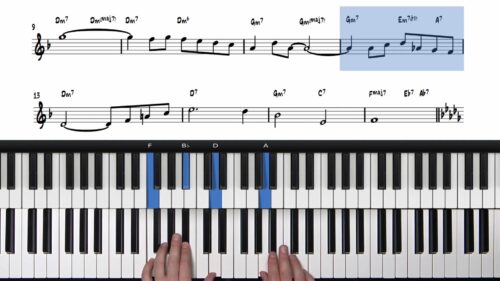
Melody lines that move through the notes of a scale are often excellent places to add ornamentation. Bars 3 and 5 are good examples of this in the A Section of Moon River.
Instead of playing the scale exactly as written, we can add:
- Turns
- Repeated notes
- Grace notes
- Changes in rhythm
- Additional ‘passing’ notes
These small changes can transform a simple scale passage into something that sounds much more personal. The goal is not to add as many notes as possible. The goal is to create subtle variation and expression.
Use Ornamentation Sparingly
When first practicing these techniques, it can be useful to exaggerate them and try each type of ornamentation repeatedly.
In an actual performance, however, we would not decorate every melody note. Too much ornamentation can make the arrangement sound busy and can obscure the original tune.
Think of these techniques as tools in your toolbox. Use them selectively in places where they add interest, emotion, or movement to the melody.
Learn & Apply These Techniques Gradually
The techniques in this lesson are not something that you will master immediately!
Melodic ornamentation becomes more natural as you play more jazz standards and experiment with these different ideas over many tunes.
Over time, you will begin to recognize places where a grace note, turn, repeated note, or change of phrasing feels appropriate.
The goal is not to memorize a fixed set of decorations, but to gradually train yourself to play with more freedom, spontaneity, and creativity.
This is exactly what you will learn by studying the 9 jazz standards in the Lead Sheet Fundamentals Learning Path.
Related Lessons
Enhance “Sentimental Mood” with grace notes and melodic embellishments. Perfect for jazz pianists looking to add ...
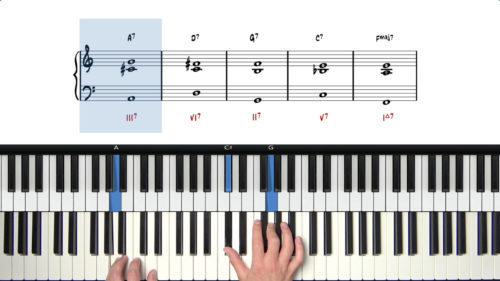
Learn the tune "Georgia On My Mind" in the soulful style of Ray Charles, starting with the most basic arrangement tec...
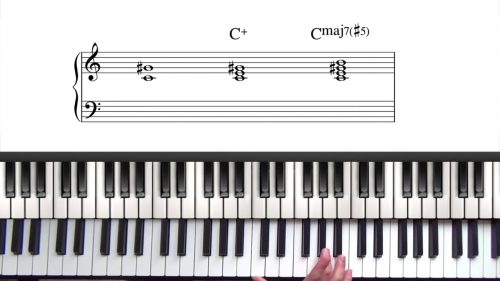
As a jazz pianist, you need to have a solid understanding of intervals so that you can build extended chords quickly ...
Practice Tips
-
Start with the written melody - Make sure you can play the original melody clearly before you begin adding decoration.
-
Choose one embellishment at a time - Practice just grace notes, turns, or rephrasing separately before combining several techniques.
-
Protect the target notes - Keep the important 'melodic landing points' clear and use ornamentation mainly to approach those notes.
-
Practice embellishments slowly - Decorative passages can easily become rushed or uneven, so practice them at a tempo where you remain relaxed and in control.
- Don’t embellish every note - Use ornamentation selectively. A few well-placed decorations will typically sound more musical than constant embellishment.

