



Chromatic Passing Chords in Slow Blues
In this lesson we add chromatic passing chords into the 12-bar blues progression in the key of C. Chromatic passing chords add tension, colour, and strengthen the sense of resolution when changing chords.
We explore how and where to seamlessly integrate passing chords into our 12 bar blues performances.
Adding Passing Chords in 12-Bar Blues
Chromatic passing chords are particularly effective to enhance the transitions between the primary chords in the blues progression which are the 1 chord, the IV chord, and the V chord. Passing chords create brief moments of tension and dissonance which is then resolved as we move into the next bar.
Starting from the top of the form we add various passing chords into the 12-bar blues progression. Our first opportunity is to use a passing chord in the first bar of C7 which sets up a smooth transition to the F7 in the 2nd bar.
We also introduce a G7#5 passing chord in the 3rd bar. Whilst this is not a chromatic passing chord, it serves a similar function. In bar 3 the primary chord is C7 and G7#5 is the respective dominant 7 chord. The addition of the #5 alteration functions as a leading tone which pulls us back to the 3rd of C7 in the 4th bar.
We continue to work through the rest of the form identifying passing chord opportunities.
Passing Chord Voicing Options
We demonstrate different voicing options for each passing chord and identify that there are usually multiple voicings that can work for any given passing chord.
When choosing voicings for passing chords, it’s important to focus on clean voice leading and smooth transitions from the passing chord to the target chord to achieve a polished and professional sound.
Related Lessons
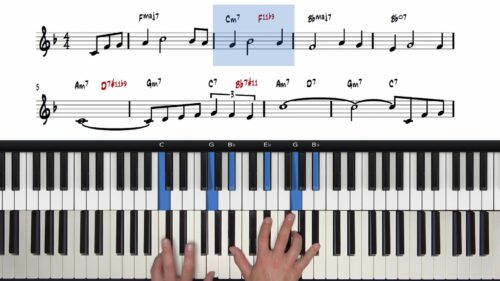
Passing chords are effective when added into common chord progressions such as 251s and 3625s which feature heavily i...
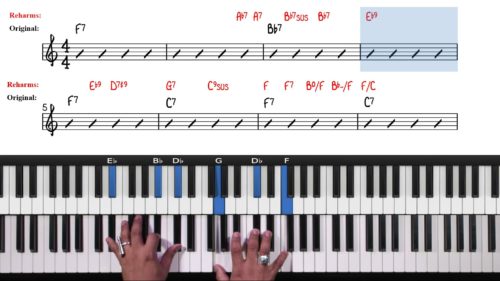
In this lesson we broaden the harmony of the 145 progression by introducing alternate chord changes, reharms, and pas...
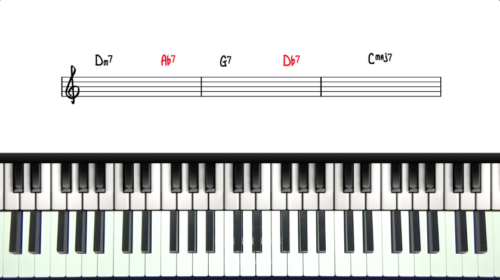
This type of passing chord is a dominant chord built a half step up. Dominant chords always have a strong pull to res...
Practice Tips
-
Target Specific Notes: Focus on targeting specific notes after the passing chords, such as the 3rd, 7th, or 9th. This creates smooth transitions and maintains a cohesive sound.
-
Explore Different Voicings: Practice various voicings for each passing chord, experimenting with different inversions and positions on the keyboard.
- UST Voicings: Passing chords can also be voices as Upper Structure Triad voicings. See the related lessons above for more information.


Hey there,
thank you a LOT, I’m really enjoying the course.
In the lesson about the passing chords, I’m a bit confused about the Db7 in bar 10, leading back to C7.
In the download it’s notatded as a Db maj7 and in the video you also play the C on top wich would be the major 7 but as I learnd, a passing chord is to be regarded as a dominant 7 (tritone sub).
Could you help me there?
Hi Swen,
Please excuse my late reply here.
Great question!
Yes usually chromatic passing chords are dominant in chord quality as this creates a stronger pull into the target chord. Also when using dominant chords we can add chord alterations such as b9s, #9s, #11s, and b13s which creates even more dissonance in the passing chord and a stronger sense of resolution afterwards.
However, it is possible to use major chords as passing chords in a 251 progression. This arguably works better when the resolution chord is also a major chord, for example D-7 to Dbmajor7 to Cmajor7. It creates quite an unusual and unexpected sound, but it works and sounds nice.
If I’m completely honest, I didn’t really think about this when playing/demonstrating. In the demonstration that you are referring to at around 22m30s, I start ‘toggling’ the note C over the F7 in bar 9, and continue doing this over the “Db7” passing chord which then becomes Dbmaj7 becuase I am playing the note C (and not Cb).
You will notice that I then continue to play the note C in melody as we move into bar 10. I actually just play a C triad at the start of bar 10, and then my left hand comes up to play a C7 shell.
This works well because I am playing a ‘drone note’ which is “C” and this note remains consistent across F7, Dbmaj7, and C which creates a a sense of synergy and logic between the chords.
To summarise:
1) Yes strictly speaking chromatic passing chords are dominant in quality.
2) Major passing chords can be used, in this case Dbmaj7 resolving into C Major.
3) In this situation the ‘drone note’ “C” is helping to logically connect the chords.
4) You could also play a Db7 here but then we wouldn’t get the ‘toggle’ effect in the melody.
I hope that helps Swen – if you have any follow up questions here, please let me know.
Cheers,
Hayden
p.s. I’m really glad to hear that you are enjoying the course and having fun with this playing style.
You might also like to check out this seminar where I cover some improvisation ideas and principles over the slow blues in C: https://www.pianogroove.com/live-seminars/slow-blues-piano-improvisation/