


Arpeggio Connectors & Chord Tones
In this jazz piano improvisation lesson, we explore how to connect chord tones and arpeggios to create longer improvised lines and phrases.
Building on the previous enclosure lessons, this tutorial shows you how to add extra chord tones between your resolution points, giving your lines more shape and movement.
You will learn how to move through the chord changes of ‘Autumn Leaves’ using arpeggio connections, chord tone pathways, passing tones, and bebop-style resolution points. The goal is to stop thinking in isolated chords and start creating lines that move naturally from one chord into the next.
What You Will Learn in This Lesson:
-
How to string together roots, 3rds, 5ths, and 7ths into melodic pathways.
-
Methods for linking major and minor 2-5-1 progressions across Autumn Leaves.
-
The voice-leading power of 7ths resolving smoothly down to 3rds.
- How to integrate staccato upbeats and other bebop articulations.
Connecting Chord Tones Through the Changes
Once you can target chord tones with enclosures, the next step is learning how to connect those target points using additional chord tones.
These connections can move up or down, and they do not need to follow a predictable order such as root, 3rd, 5th, and 7th. In fact, using jumps, direction changes, and varied pathways helps your improvised lines sound more musical and less like a technical exercise.
Arpeggio Connections Over Autumn Leaves
‘Autumn Leaves’ is an ideal tune for practicing arpeggio connections because the harmony moves through clear major and minor 2-5-1 progressions. By using arpeggios and chord tones as guideposts, you can create improvised lines that clearly outline the underlying harmony.
A key part of this lesson is learning to think ahead. When improvising, your chord tones often become part of the next enclosure or approach pattern, which means you are always preparing the next resolution point before the chord arrives.
This mindset creates essential forward motion in your solos. Rather than simply playing over the current chord, you begin aiming towards the next chord and shaping your phrases around where the harmony is going.
Why the 3rd Is a Powerful Resolution Point
The 3rd of the chord is one of the strongest places to resolve because it clearly outlines the structure of the underlying harmony. The voice leading of 7ths falling to 3rds in 251 progressions is the most fundamental movement in jazz harmony.
Example: In the progression C-7 → F7 → Bbmaj7, the 7th of C-7 falls a half step to the 3rd of F7, and the 7th of F7 falls to the 3rd of Bbmaj7. When your improvised lines follow this movement, they sound naturally connected to the underlying harmony.
Staccato Upbeats & Bebop Articulation
This lesson also introduces the idea of placing short, staccato chord tones on the upbeats after we have targeted a chord tone via an enclosure pattern. This is a common bebop phrasing device and helps your lines feel more rhythmic, articulate, and stylistically authentic.
Rather than playing every note with the same dynamic weight, you will start to shape your lines with accents, intentional space, and lighter upbeat notes. This creates a more natural jazz feel and prepares you for more advanced bebop language.
Major & Relative Minor Key Connections
The harmony of ‘Autumn Leaves’ moves almost exclusively between relative major and minor 2-5-1 progressions of Bb major and G minor. Because these 2 keys share the same parent scale, many melodic ideas can be easily adapted and applied between the major and relative minor progressions.
Understanding this relationship helps you reuse and transform melodic pathways across the tune, making the harmony feel less overwhelming and more connected.
The main purpose of this lesson is to help you create your own custom pathways through the chord changes. Some ideas will sound stronger than others, and that exploration is part of the creative process.
By cycling around the form repeatedly, you gradually flatten the path, just like walking the same route through a grassy field. Over time, the chord tone connections become more familiar, intuitive, and easier to navigate from memory.
Related Lessons
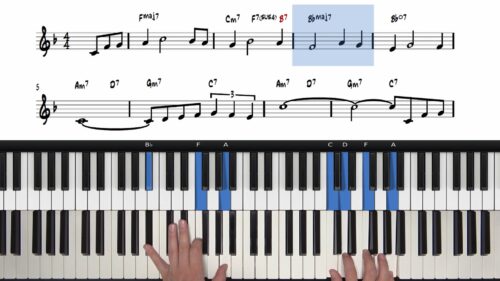
We explore arpeggio runs and fills to tastefully fill in the space when the melody rests and to connect the melody pl...
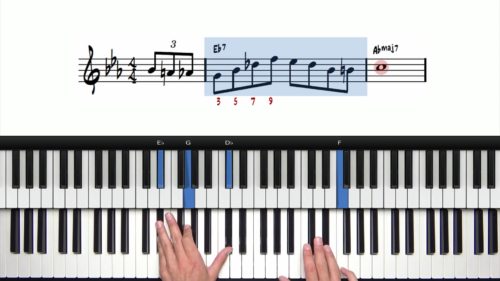
We start with single alterations, then double alterations, then we will explore a versatile altered arpeggio run to u...
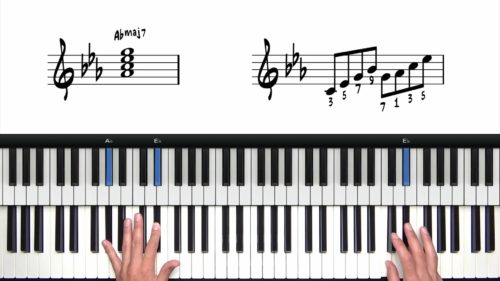
We will combine arpeggios runs and arpeggio patterns with chord tones and approach patterns that we have explored in ...
Practice Tips
-
Practice without the metronome first: Give yourself plenty of time to explore different chord tone pathways freely before adding tempo pressure.
-
Aim for clear resolution points: Focus especially on resolving into 3rds, as they strongly define each chord connection in 2-5-1 progressions.
-
Avoid predictable arpeggio patterns: Don’t always play root, 3rd, 5th, and 7th in exact sequential order. Use jumps and direction changes to create more interesting phrases.
-
Think one chord ahead: As you play through each chord, begin preparing the next enclosure or target note before the next bar line arrives.
- Cycle the form daily: Loop the Autumn Leaves chord changes again and again. With repetition, the pathways become clearer and your improvisation will start to feel more natural.

