


‘Autumn Leaves’ Rootless Voicings Tutorial
In this jazz piano improvisation lesson we introduce the essential preparation steps before attempting to improvise over a jazz standard.
Before exploring melodic devices such as enclosures, chord tone targeting, arpeggio patterns, licks, and improvised lines, it is vital to first memorize the melody, harmony, and form of the tune.
This course focuses exclusively on the iconic jazz standard ‘Autumn Leaves’ which is a great tune for beginner improvisers.
What You Will Learn in This Lesson:
-
How to play the full 32-bar AABC form of Autumn Leaves.
-
Smooth and efficient rootless left-hand voicings to navigate the chord changes of ‘Autumn Leaves’ intuitively and confidently.
-
How to utilise jazz backing track to practice effectively and to prepare yourself for playing in a jazz band.
- How to add chord alterations such as b9s, #9s, #11s, and #5s/b13s to create more interesting left hand voicing configurations.
‘Autumn Leaves’ – AABC Form & Structure
‘Autumn Leaves’ follows a classic 32-bar AABC song form, consisting of two similar 8-bar A sections, an 8-bar bridge or B Section, and a final 8-bar C section. Memorising the form and the 8-bar sections is an essential skill for jazz improvisation and helps you to visualize your place in the tune at all times
The best way to internalize the chord changes, melody, and form is to cycle around and around the form repeatedly. It’s also useful to listen to recordings of the jazz standards you are working on and visualise where the musicians are in the form at all times.
Once a song form, harmony, and melody has been internalized you then creative freedom to focus on building improvised phrases rather than reading and referencing a lead sheet.
Rootless Voicings for Major & Minor 2-5-1 Progressions
The harmony of ‘Autumn Leaves’ is built around a repeating sequence of major and minor 2-5-1 progressions which makes it an accessible jazz standard for beginner improvisers.
In this tutorial, we explore rootless voicing shapes for essential progressions including:
-
C minor 7 → F7 → Bb major 7
- A minor 7b5 → D7 → G minor 7
You will learn how small half-step movements between chord tones create smooth voice leading, allowing your left hand to move efficiently through the changes.
Rootless Voicings & Smooth Voice Leading
One of the main benefits of rootless voicings is that they minimize unnecessary hand movement. Instead of jumping around the keyboard with root-based chords, rootless voicings provide compact voicing shapes that sound best when played around middle C.
When voicing 251 progressions with rootless voicings, our left hand can navigate between the chords by just changing one or 2 notes. The moving notes are often just half step movements and with practice these progressions can be played entirely from muscle memory.
Once your left hand chord voicings become natural and intuitive, you can focus almost entirely on melodic ideas, phrasing, and right hand solo development.
Adding Alterations to Dominant Chords
After mastering the basic rootless shapes, this lesson introduces optional chord alterations on dominant chords, including b9, #9, and #5/b13.
Alterations create additional tension in the harmony and are especially useful in minor 2-5-1 progressions. You will see how altered voicings resolve smoothly into both major and minor tonic chords.
How to Practice with Jazz Backing Tracks
This lesson demonstrates how to practice ‘Autumn Leaves’ with a backing track. Our left hand is used to outline the rootless voicings while the right hand plays the melody.
Working with a synchronized drum and bass track helps you to develop a steady time feel, harmonic confidence, and the ability to play in a realistic jazz setting. A key goal for beginner improvisers is to cycle around entire form without relying on a lead sheet.
Melody Embellishment: Preparing for Improvisation
Once the harmony and form are memorized, you can begin to add subtle melodic embellishments to the written melody. This is your first step towards jazz improvisation.
Rather than reading transcribed solos from notation, we emphasize the importance of listening to classic recordings, singing the melody internally, and developing a deeper ear-connection to the harmony. This prepares you for the upcoming modules on enclosures, chord tone targeting, and bebop vocabulary.
Related Lessons
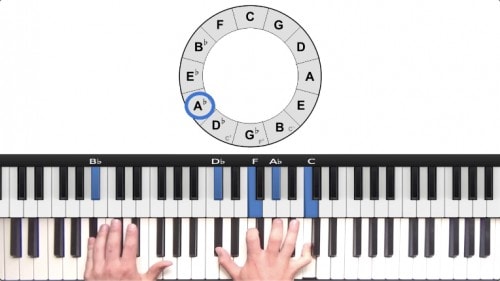
In this lesson we will be exploring the major 251s with b9 and #5/b13 alterations. This will help you visualise alter...
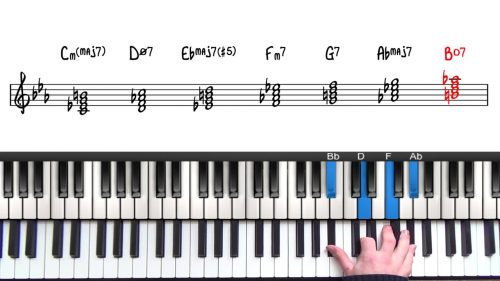
Minor harmony is much more complex than major harmony and so the minor 251 progression takes much more time and patie...

Rootless voicings sound more professional than root based 7th chords and they voice lead much more smoothly in a 251 ...
Practice Tips
-
Memorize the melody & harmony: Make sure you can play the melody and left hand voicings of ‘Autumn Leaves’ flawlessly before trying to improvise over the tune.
-
Cycle the form daily: Spend 15–20 minutes daily looping the full AABC form until the structure and chord changes feel comfortable and predictable.
-
Start with basic rootless voicings: Focus first on clean, simple 3-note and 4-note voicings before introducing the altered chord voicings.
-
Ditch the lead sheet: Move away from reading the chart early so that you can feel the harmony and form entirely from memory.
- Use a slow backing track tempo: Practice with the drums and bass at a comfortable, relaxed tempo, and increase the speed only when your voicings and melody are in control.

