


Landing Zone Resolution Phrases
In this jazz piano improvisation lesson, we explore landing zone resolution phrases over the major and minor 2-5-1 progressions in Autumn Leaves. These short melodic phrases help your improvised lines resolve clearly into the harmony.
Building on the previous lessons on enclosures, chord tone targeting, and arpeggio connections, this tutorial shows how to turn technical drills into more idiomatic jazz language. You will learn several useful resolution phrases for both major and minor chords, and discover how to apply them over the key resolution points in Autumn Leaves.
What You Will Learn in This Lesson:
-
How to identify and target the primary landing zones in Autumn Leaves.
-
Major resolution phrases that outline core chord tones (3rd, 5th, 7th, 9th, root, and 6th).
-
Minor resolution phrases that incorporate melodic minor color and triad-based melodic phrases.
- Essential bebop phrasing techniques, including chord tones on strong down beats, ghost notes, and ending phrases on the up beats.
Understanding Landing Zones in Autumn Leaves
The harmony of ‘Autumn Leaves’ bounces continuously between the 2-5-1 in Bb major and the 2-5-1 in G minor. These two structural resolution points are the main "landing zones" of the entire tune.
-
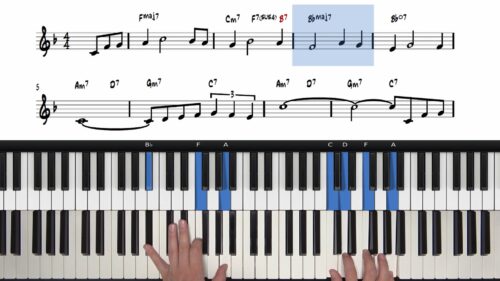
In the major progression, C-7 → F7 resolves directly to Bbmaj7.
- In the minor progression, A-7b5 → D7 resolves directly to G-7.
By memorising specific phrases for these structural arrival points, your improvisation will instantly begin to sound more intentional, cohesive, and deeply connected to the underlying harmony.
Major 2-5-1 Resolution Phrases
The first half of the lesson covers three distinct major resolution phrases. These phrases start with a resolution into the 3rd of the chord before outlining additional chord tones such as the 5th, 7th, root, and 6th.
Rather than thinking strictly in terms of scales, the focus here is on chord-tone-based phrases. This structural approach creates a stronger resolution because the melodic phrase directly outlines the underlying harmony by resolving cleanly into the 3rd, and then outlining the other essential chord tones.
Bebop Phrasing & Upbeat Endings
A defining feature of bebop language is that melodic phrases frequently finish on an upbeat. This structural placement gives the line a lighter, more swinging feel and prevents your phrases from sounding too blocky, square, or heavy.
In this lesson we practice resolving our phrases strongly into a chord tone and then finishing rhythmically on the “and” of the beat. Ghost notes and subtle rhythmic variations are also introduced to help you develop a relaxed, swinging jazz feel.
Minor 2-5-1 Resolution Phrases
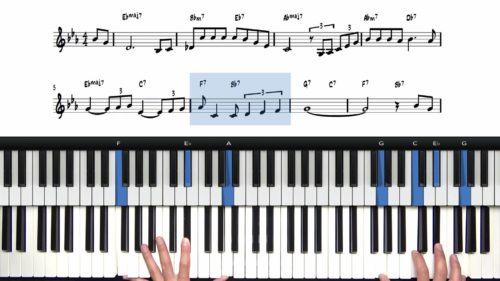
The second half of the lesson shifts focus to minor resolution phrases over the A-7b5 → D7 → G-7 progression. Again these lines target the 3rd of G minor before outlining the base minor triad and introducing other color tones such as the 9th.
You will learn how basic, triad-based ideas can be creatively expanded using chromatic approach tones, enclosures, and the melodic minor color to create authentic bebop jazz language.
Using the Melodic Minor Sound
One of the most important harmonic colors introduced in these minor resolution phrases is the major 7th played over a minor chord. This note creates the distinct melodic minor sound which is highly sophisticated jazz color and a staple sound found throughout bebop and modern jazz vocabulary.
The lesson demonstrates how to use this advanced sound tastefully within a resolution phrase, ensuring you connect non-chord tones smoothly back into chord tones.
This tension-and-release dynamic is exactly what gives landing zone phrases their structural strength: they beautifully combine melodic color with unambiguous harmonic resolution.
Preparing for Full 2-5-1 Licks
These landing zone phrases serve as a bridge connecting technical enclosure drills to full, fluid jazz arpeggio-based vocabulary. Instead of merely practicing isolated approach patterns in a vacuum, you are now actively incorporating them as musical phrases over major and minor 2-5-1 progressions.
In the next lessons of the course, these baseline ideas will be expanded into complete, full-length 2-5-1 licks and applied across different chord types using the “chameleon effect”.
Related Lessons
We explore arpeggio runs and fills to tastefully fill in the space when the melody rests and to connect the melody pl...
We explore 2 chromatic lines that work beautifully over the 3625 progression. Apply this technique to any tune that y...
We will combine arpeggios runs and arpeggio patterns with chord tones and approach patterns that we have explored in ...
Practice Tips
-
Isolate the landing chord first: Practice executing each melodic phrase directly over Bbmaj7 and G -7 in isolation, then precede with an eclosure.
-
Avoid purely scalar resolutions: Try not to just run up and down standard scales for landing zones. Strong landing zone phrases incorporate structural chord tones usually outlining triads, secondary enclosures, and chromatic approach notes.
-
Notice where phrases end rhythmically: Remember that many classic bebop phrases finish on an upbeat. Count carefully as you play so you can feel how the line resolves musically while still maintaining a swing feel.
- Apply each phrase in context: Once a phrase feels comfortable in isolation, practice it throughout the form combined with enclosures and approach patterns.


Is it possible to print the examples you showed for each of the lessons in this course? Thanks.
Hi John 👋
Yes, I will ask the editor to send me the notation from the lesson.
I did create a PDF document which shows the ‘landing zone phrases’ separated from the melodic lines that we cover later in this course.
You can find that PDF here: https://www.pianogroove.com/media/2026/05/Tension-Release-G-.pdf
I covered this in the related seminar that you can find here: https://www.pianogroove.com/live-seminars/autumn-leaves-improvisation-for-beginners/
—-
In the PDF above, the resolution phrases are shown for the major and minor 251 resolution points, but remember that those same arpeggio patterns can be used over other chord types, too.
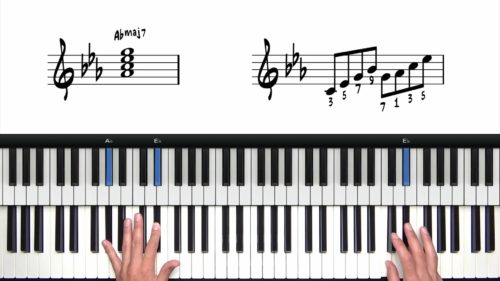
For example the first resolution phrase is arpeggio-based and contains the scale degrees: 3-5-7-9-7-R-3-5-7 etc…
Part of internalising this material is applying these shapes and patterns to other chords. For example, we can take that arpeggio pattern and also apply it to the Ebmaj7 chord in bar 4 (of course using the scale tones of Eb Major, but the same same scale degrees or ‘formula’ that we play for the Bbmaj7 resolution point).
I’m mentioning this because it’s far more efficient to memorise these phrases numerically in terms of scale degrees, and then apply the same numeric formula to different chords.
We could also take that exact sequence of notes from Ebmaj7 (3-5-7-9-7-R-3-5-7), but apply it over C-7, and that would give us 5-7-9-11-9-3-5-7 in terms of C minor. Keep doing this and slowly we start to visualise shapes and pathways that work over many chord types.
Play around with that and let me know if you have any follow up questions!
—-
I’ll get the notation over to you asap.
Cheers,
Hayden
This is very helpful. Great course. Thank you.
Awesome, thanks John!
Any other questions don’t hesitate to ask.
Best,
Hayden