


As Time Goes By Tutorial – Part 1
“As Time Goes By” is a delightful tune written by Herman Hupfeld.
Most commonly associated with the 1942 film “Casablanca”, this timeless classic is written in the key of Eb Major and follows a standard 32 bar A-A-B-A form.
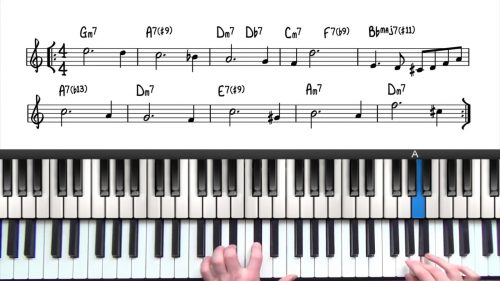
In part 1, we’re going to quickly run through the form with the melody and left hand voicings so that we can familiarise ourselves with the chord changes and melodic movement.
In part 2 we discuss how you can repurpose sections of the form to create an interesting and engaging introduction. We first look at developing an introduction with the last few bars of the tune and then we’ll look at how we can repurpose the whole of the bridge as an introduction.
In part 3 we explore the form with 2 handed voicings. We build upon what we have covered in the previous tutorials by introducing upper structure triads, suspended chords and a stride left hand style.
I’ll provide a few different ways to play through the changes, ranging from simple to advanced. Some of the stride style in the bridge is quite challenging to play and I’ll give you some guidance on how to practice this style of playing.
Related Lessons
We start the lesson by recapping the basic theory behind sus chords and then explore them in context of major and min...

Rootless voicings sound more professional than root based 7th chords and they voice lead much more smoothly in a 251 ...
To play a rootless voicing we leave out the root of the chord and play one of the upper extensions to get a richer, m...
Practice Tips
-
Spend some time to play through the form with left hand voicings and the melody. This will help you become familiar with these useful voicing shapes.
-
In part 3 of this tutorial, we play with a stride style in our left hand and so you need to know these rootless left hand voicing shapes.


Hi there,
I have a question, in the 6th measure I see an Fm7 played over the melody which has two, now I seem to go automatically to Gm7 in this measure, could you explain your choice please, and wonder how far off I am when using a Gm7, as I normally try to find my own chords as much as possible to help me understand choices and try to rationalise a choice.
THanks and regards
Bill k
I have it. regard last post as not sent, the Fm Upper structure gets to the melody
My excuses
Regards
Bill k
There is a constant problem loading lesson 2.3. It loads very slowly – or not at all. But after it loads it works ok. It does not seem to affect the other lessons in this course. Can someone please look into this?
Hi Bruce,
Thanks for letting me know about this and please excuse my late reply.
I have tried loading the lesson on my laptop and cell phone and I didn’t experience any issues.
Please can you confirm that you are still experiencing the issue?
Which web browser are you using? and if you try a different web browser, does the issue persist? I know it’s a bit of pain to check in a different browser, but doing so would rule out your current browser having “cached” an older version of the website.
If you can let me know the above, that will help me to identify the issue, as I cannot replicate it on my side.
I’m here to help further if needed and you can also email me at info(at)pianogroove.com
Cheers,
Hayden
Hi Hayden,
I think the issue may have something to do with my tablet (android). For one or two particular lessons (not all of them) it seems to load very, very slowly. But if I have discovered that if I go to your website and wait a few minutes before accessing the lesson that is giving problems, everything is just fine. I can also access everything OK with my laptop (using chrome). So I think it is probably NOT an issue on your end. Sorry to trouble you!
By the way, I find your lessons fantastic! Some other internet websites teach similar things, but yours is by far the clearest, both visually and in terms of the technical explanations of voicings, etc. It is also very comprehensive.
My only gripe is that my progress is very slow, but I am getting better.
Bruce
Hi Bruce,
Thanks for the update.
I first recommend to check that your Android device is up-to-date and running the latest version. , ie. no software updates are available.
Next I would make sure that you are using Google Chrome Browser – which is the native browser for Android devices – and also make sure that Google Chrome is up-to-date and running the latest version.
Then power OFF your device and power ON again.
That’s the first port of call.
—-
Thanks for the kind words about the lessons, I really appreciate it!
Regarding your progress, don’t worry too much about the speed. Jazz piano is a vast subject, and there’s a lot to absorb. I get the exact same feeling on a regular basis. I think that all jazz musicians wish their progress was faster!
The most important thing is that you’re making progress, even if it feels slow at times. I’d encourage you to keep revisiting the same tunes and concepts regularly. I find that by working on a more limited repertoire, I can get a deeper understanding of the songs and the harmonic concepts, but if your goal is to play many jazz standards – that’s fine too!
Cheers,
Hayden
Regarding your comments about my concerns about slow progress. I have been reflecting on this, and would like your opinion on one aspect of it.
When learning a new tune on your website, I notice now that sometimes I am able to predict the chord or the voicing you are going to choose next. Sometimes, I also find myself preferring something slightly different. The result is that – while I still follow your arrangements quite closely – I sometimes change a chord or a voicing based on another song I have learned, or an exercise I have tried.
It is still hard, and I still struggle! But I suppose the things I have mentioned above is a sort of progress. Any thoughts?
Bruce
Hi Bruce,
Thanks for sharing this and yes… what you’re describing is a very important sign of progress.
In fact, I’d say this is one of the most significant developments in learning jazz piano.
When we first start learning jazz, we’re often simply copying the voicings and arrangements that someone else demonstrates. Over time, as we encounter the same chord progressions, voicings, and harmonic movements across different tunes, we begin to recognise patterns and anticipate what might come next.
The fact that you’re now able to predict some of my voicing choices shows that you’re starting to internalise these patterns rather than simply memorising individual arrangements.
And perhaps even more importantly, you’re beginning to develop your own preferences and make different harmonic choices based on what you’ve learned elsewhere.
That’s exactly what I hope students will eventually achieve with PianoGroove!
The goal isn’t to reproduce my arrangements note for note. It’s to understand the underlying harmony well enough that you can sit down with a lead sheet and create your own interpretation of a tune.
So whilst you might feel that your progress is slow in terms of learning new songs or playing at faster tempos, you’re clearly developing something much deeper which is harmonic understanding, musical intuition, and your own personal taste in jazz harmony.
These are skills that take many years to develop, and they become increasingly valuable as you progress.
I’d encourage you to continue experimenting with alternative voicings and chord substitutions whenever something catches your ear.
Keep up the great work, Bruce!
Cheers,
Hayden