


Chord Tones: Targeting The 7th
In the previous lesson we explored a number or drills which targeted the 3rd of each chord in the A Section of the tune “Misty”. In this lesson we will repeat the same drills but this time targeting the 7th of each chord.
The 3rds and 7ths are the most important tones which define the harmony and so when we target these notes from a melodic standpoint it keeps our improvised melodies in sync with the underlying harmony.
Later in this course we will repeat these exercises for other tones such as the chord extensions and chord alterations. For now we will focus on the 3rds and 7ths as these tones are the foundation of the harmony.
Diatonic & Chromatic Approach Patterns
Just like the last lesson we will create diatonic and chromatic approach patterns to help us to visualise the 7th as a strong landing point that we can use when improvising.
- Approach from above diatonically (2 scale degrees)
- Approach from above chromatically (2 half steps)
- Approach from below diatonically (2 scale degrees)
- Approach from below chromatically (2 half steps)
- Enclosure around the 7th
What we have covered in these first 2 lessons will create strong foundations for exploring the upcoming improvisational concepts and principles.
In the next lessons we will discover how the original melody can be used as inspiration for our solos and we will start to incorporate arpeggio runs and patterns which are an important component of cocktail piano improvisation technique.
Lesson Downloads
-
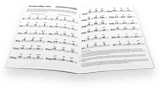 Targeting The 7ths Notation File Type: pdf
Related Lessons
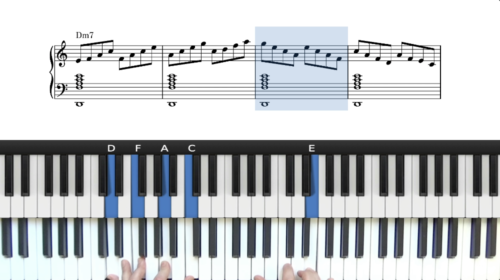
In this masterclass we look at using chord tones rather than scales as the basis for creating improvised lines.
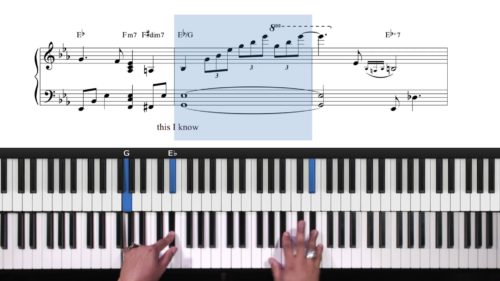
We study leading tones and how they are used to create smooth connections between chords and also to guide the vocali...
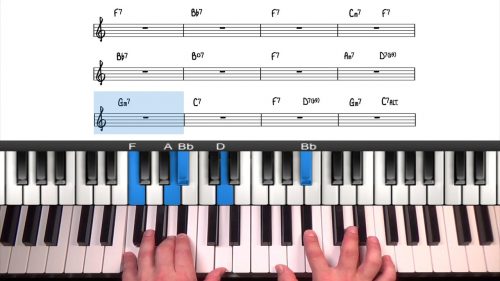
Chord tone soloing is the process of creating improvised lines predominantly or exclusively with the primary tones of...
Practice Tips
-
These drills take time and patience to master. Remember to start slowly and gradually increase the tempo.
-
For an extra challenge play the root notes as low on the piano as possible to expand your field of vision.
-
Ensure that you can complete these drills comfortably and it will act as the glue that holds together the other improvisational building blocks.


Hi Hayden. The notation has same page for 3 and 4. Is there a page different 4 that cover items in last ~4min with enclosures?
Hi Rick,
Thanks for letting me know about this. Indeed the 4th page was duplicated by mistake.
I have corrected the file and re-uploaded the PDF, so please download it again and you will see the correct notation for page 4. Thanks again for bringing this to my attention.
A new improv course is coming shortly on the tune “The Nearness Of You” – more updates to follow.
Cheers,
Hayden
Hayden, You are right about this being very difficult at first! I had been practicing rootless voicing from your website (and others) for months before trying this and the previous exercise, but it still was tough for the left hand coordination.
I come from a classical piano background, so I know all the standard major and minor scales pretty well. Despite this it was a struggle at first to identify the 3rds and 7ths as fast as I needed to in order to play the exercise even slowly. I also got the 3rds and 7ths mixed up sometimes! Thanks for playing through the exercises as an example. It really helps to have a reference that you can watch at 50 per cent speed.
At the moment, I am taking it on faith that the exercises will help me with improvisation in future.
Hi Bruce,
Yes these exercises are very difficult to begin with, so do persevere.
The 3rds and 7ths are the ‘resolution point’ or ‘landing points’ that make our improvisation in sync with the underlying harmony. If we simply run scales up and down it will not sound musical and it will not sound in-sync with the underlying harmony.
I am in the process of creating some up-tempo improvisation courses over jazz standards such as Autumn Leaves, There Will Never Be Another You, Have You Met Miss Jones, and other faster tempo songs that are commonly performed at jazz jam sessions. Targeting 3rds and 7ths is equally, if not more important, in faster styles of jazz improvisation.
I recently hosted a seminar on “Bebop Enclosures & Approach Patterns” … you can find it here: pianogroove.com/live-seminars/bebop-enclosures-approach-patterns/ – this seminar covers similar material in terms of targeting chord tones, and the essential role that chord tones play in improvised melodies and improvised solos.
Please check out that seminar at your convenience and it will further solidify the principles in this course.
As mentioned I have more improvisation lessons in the pipeline, so keep an eye in the community area for updates.
If you do have any questions with the material please don’t hesitate to get in touch.
Best,
Hayden
Hi Hayden,
I am still working on exercises 3.1 and 3.2. How well should I be able to play these exercises before moving on to the next lessons in the course?
Bruce