


Hayden Hill
Hayden founded PianoGroove in 2015 with the goal of making the world a more musical place. He shares his love for jazz piano through his online courses and manages the community area of PianoGroove.
Live Seminar Resources
Live Seminar Resources
PDF Downloads
- Hayden's Blues Transcriptions
Join PianoGroove Pro to access all downloads and learning resources.
Download theory supplements, midi files, chord changes and full note-for-note transcriptions of every lesson.
- Hayden's Autumn Leaves Transcriptions
Join PianoGroove Pro to access all downloads and learning resources.
Download theory supplements, midi files, chord changes and full note-for-note transcriptions of every lesson.
- Major 251 Lines & Ideas
Join PianoGroove Pro to access all downloads and learning resources.
Download theory supplements, midi files, chord changes and full note-for-note transcriptions of every lesson.
- Minor 251 Lines & Ideas
Join PianoGroove Pro to access all downloads and learning resources.
Download theory supplements, midi files, chord changes and full note-for-note transcriptions of every lesson.
Related Lessons
Forum Threads
Seminar Description
Seminar Description
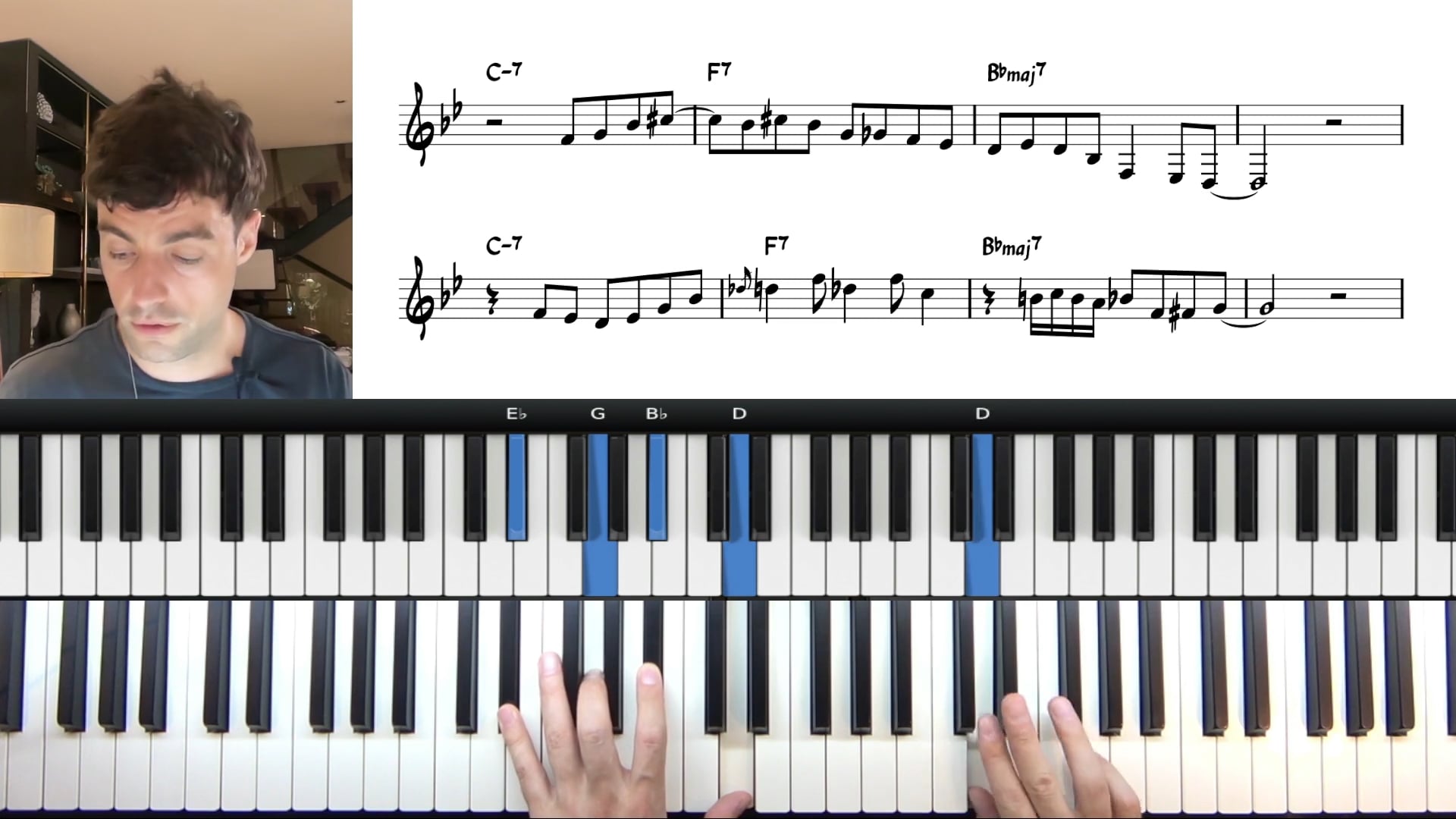
Explore bebop enclosures and approach patterns with practical tips to improve your jazz vocabulary, phrasing, and improvisation skills.
Comments
Leave a reply
Ask questions and get instant replies from our team of teachers. Get Started With PianoGroove Pro.Details
Bebop Enclosures & Approach Patterns
Related Seminars




Hi Hayden,
Just wanted to say thank you for that outstanding seminar. There was a lot of information to process and everything you said made sense. I will be watching this again soon, but next time taking notes and interacting on my piano. Also, what you said toward the end was 100% true! You’re a great teacher and we enjoy coming along the ride with you!
Rich.
Thanks Rich – I really appreciate your feedback and kind words.
The exercises that I outline might seem simple but they create a very strong foundation and framework around which we can build logical improvised melodies and even entire solos.
I’m aiming to record my first ‘medium-up tempo’ jazz standard course this week, and these will be housed in a new section of the website.
Improvisation is difficult to teach as it’s not as ‘visual’ as chord voicings and chord progressions etc… A lot of the ingredients of jazz improvisation are almost subconscious which is achieved through lots of repetition (of the drills/exercises in this seminar for example) and also by having a deep familiarity with the chord progressions and harmony of the song/jazz standards in question (which is also best gained from a LOT of repetition).
As mentioned one of the most important aspects – for my development at least – has been regular listening and transcribing from the solos and players that I admire and want to sound like. In my opinion this is the best way to learn swing feel and other ‘invisible nuances’ of jazz performance. Of course listening and transcription isn’t an ‘instant reward’ process, it’s a very slow and gradual process, but one that yields great results in the medium/long term.
Anyhow, I’m very confident that my new up-tempo improv courses will help students to dive into improvisation in a structured and focused way.
More to follow on this the next week.
Cheers,
Hayden
Hi Hayden,
Thank you so much for this long pending seminar on Bebop Enclosures and Approach Patterns. Actually, I went through it three times to understand the gist of it, which I found extremely interesting as this is such an important aspect of jazz improv. Guess I am at a beginner level, so forgive me for some basic questions:
1. Can you please suggest a good transcribing software ?
2. You mention the need to create ‘little documents’ which will be useful for practice. How does one do this?
3. When we visualise chord tones as targets, do these necessarily need to be the Root, 3rd, 5th and 7th only?
4. When we move through chord progressions, how do we choose our targets? Do they need to alternate from say the 3rd and 7th or can they be any chord tone including chord extensions?
5. Are the Approach Patterns on the same principle of tension and release so would hitting the target note be a release? So we release on a chord tone?
6. Which are the notes you need to accent? Are there any principles on this? Chord tones / strong beats?
7. Can we arpiggiate and land on the target note?
Thank you so much
Arun
Hi Arun,
My pleasure – I’m glad you found it useful.
To answer your questions:
1. Can you please suggest a good transcribing software ?
Yes I recommend to use “Transcribe!” – https://www.seventhstring.com/xscribe/download.html – they offer a 30 day trial period and then $39 payment for a lifetime license.
Here are 2 seminars which we explore the features of Transcribe and more guidance on transcription:
Transcribe Features: https://www.pianogroove.com/live-seminars/how-to-transcribe/
Transcribing Lines & Melodies: https://www.pianogroove.com/live-seminars/transcription-advice-guidance-jazz-piano/
——-
2. You mention the need to create ‘little documents’ which will be useful for practice. How does one do this?
I recommend to use MuseScore for this: https://musescore.org/en – make sure click the download link that says “Download MuseScore Studio without MuseHub”, otherwise it will download MuseHub which you don’t need.
MuseScore is free and open source and perfect for creating transcriptions and also creating PDFs of lines and melodies. The ones in the download section of this page were created in MuseScore.
——-
3. When we visualise chord tones as targets, do these necessarily need to be the Root, 3rd, 5th and 7th only?
It’s not a ‘set in stone’ rule, but resolving into chord tones on strong beats will create the cleanest sound that is most in-sync withe the underlying harmony. As you transcribe from recordings you will see how important it is to resolve into chord tones.
Please look at the examples lines and melodies in the download section. The “Major 251 Lines” and “Minor 251 Lines” PDF files – analyse the lines and you will learn a lot. You will notice that resolving into the 3rds is the most common from these ideas.
——-
4. When we move through chord progressions, how do we choose our targets? Do they need to alternate from say the 3rd and 7th or can they be any chord tone including chord extensions?
Start by targeting 3rds, 5ths, and 7ths. There are no definitive rules here such as “alternate targeting the 3rd and the 7th”. The exercises that I outline will help you to visualise the chord tones and also create forward motion by anticipating the chord changes.
Targeting chord tones will keep your melodies in sync with the underlying harmony.
It’s possible to target alterations too, I demonstrate this around 28:00 in the seminar where I show adding an enclosure around the note “F” over C-7 which is the 11. As I mention in the seminar this is used to create more forward motion into the next A section, so that my melody line actually starts on the G7 chord but I’m using an enclosure into the C-7. Please study that chapter of the seminar.
——-
5. Are the Approach Patterns on the same principle of tension and release so would hitting the target note be a release? So we release on a chord tone?
Yes we can certainly look at it that way. When we target a chord tone via an enclosure or double enclosure, the surrounding tones are dissonant but the chord tone is consonant with the underlying harmony. This creates tension and release in our lines.
——-
6. Which are the notes you need to accent? Are there any principles on this? Chord tones / strong beats?
The best way to learn this is to transcribe and play along with an improvised solo that you really like, and that you want to sound like.
As you are interested in bebop, I suggest players like Bud Powell, Hank Jones, Red Garland, Thelonious Monk, Wynton Kelly. Please see Tuomo’s studies here in the forum: https://community.pianogroove.com/t/read-me-transcription-exercises-levels-of-difficulty/
——-
7. Can we arpeggiate and land on the target note?
Yes arpeggios are a very useful part of melodic vocabulary. If you study the example lines in the PDF files mentioned above, and also check out Tuomo’s improvisation exercises, you will see that it’s very common for improvised melodies to be a mixture of arpeggios and approach patterns. Approach patterns are used when changing chord. There are many types of approach pattern a such as:
– chromatic from above
– chromatic from below
– scale degree from above
– scale degree from below
– single note enclosure
– double note enclosure
I hope that helps Arun – and let me know if you have any follow up questions.
Enjoy working on these techniques!
Cheers,
Hayden
Hi Hayden
Loved the seminar too. Also you mention about software MuseScore Studio without MuseHub, can you recommend a good one for the light up keyboard you use or similar.
Many thanks