


Introduction to Modulations for Beginners
Welcome to the 1st lesson in our course on "Jazz Modulations for Beginners". In this course, we will focus on two jazz standards — "Body & Soul" and "In a Sentimental Mood" — both of which feature key modulations which are essential to understand for jazz pianists.
Understanding Jazz Modulations
Modulation occurs when the key signature of a piece changes during the song. This lesson begins by exploring the key of Db major. We start by examining the diatonic harmony within this key, including the major scale, triads, 7th chords, and the 251 progression which is the most common progression in jazz music.
Db Major Scale, Diatonic Triads & 7th Chords
We begin by playing the Db major scale over one and two octaves. This scale fits comfortably under the hand and serves as the foundation for the harmony in "Body and Soul."
From each note of the Db major scale, we can construct triads and 7th chords. These chords form the backbone of the tune’s harmonic structure and so it’s useful to have an awareness and understanding of how these chords fit into the key of Db major:
- Dbmaj7 (I)
- Eb-7 (ii)
- F-7 (iii)
- Gbmaj7 (IV)
- Ab7 (V)
- Bb-7 (vi)
- C-7b5 (vii)
Root Position Chords and Spread Voicings
When playing jazz piano we typically use 7th chords as a minimum to create a basic jazzy-sounding arrangement. Playing the 7th chords in root position is a great way to familiarise ourselves with their basic structure.
However, for a smoother and more connected sound, spread voicings are most often the most appropriate and preferable choice of voicing. Spread voicings allow us to distribute the chord tones evenly between both hands, resulting in a more balanced and resonant sound.
Common Progressions in Db Major
The most common progression in jazz is the 2-5-1 progression. In the key of Db major, this progression involves moving from Eb-7 (ii) to Ab7 (V) and resolving to Dbmaj7 (I). Understanding this progression is crucial for navigating the harmony of "Body and Soul."
Analysing the A Section of "Body and Soul"
To finish this lesson we briefly analyse the A section of "Body and Soul" and we find multiple instances of the 2-5-1 progression as well as the other diatonic chords that we explored in this lesson.
For example, in bars 2 and 3, the harmony moves from Eb-7 to Ab7, and then resolves to Dbmaj7. This pattern also repeats in bars 7 and 8. In addition to the 2-5-1 progressions we also identify the iii, VI, and vii-7b5 chords and how they featured in the harmony of the A section of "Body & Soul".
Recognising the diatonic 7th chords and common chord progressions helps us to play the tune more fluidly and with a deeper understanding of its harmonic structure.
Related Lessons
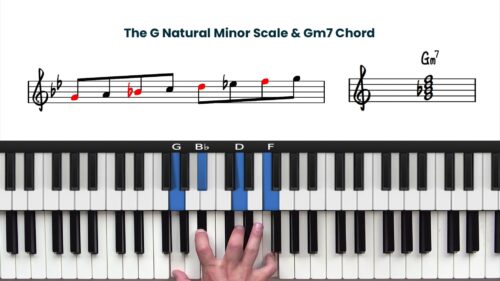
A seventh chord is a triad which has been extended to include the 7th degree of the scale. This creates a fuller soun...
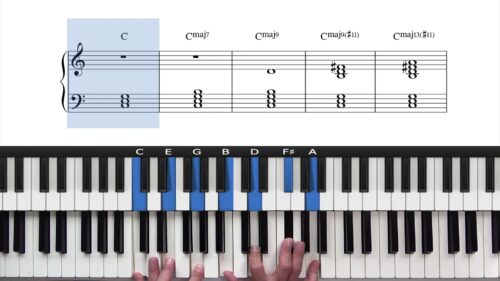
The triad is the basic building block for many different types of chords. The 4 types of triads are major, minor, dim...
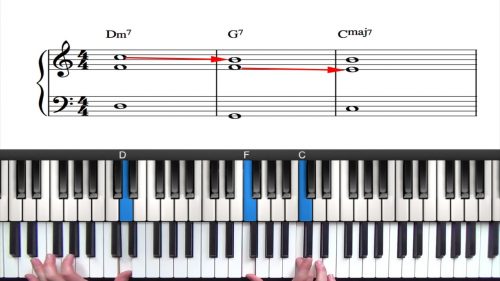
Most jazz standards that you come across will contain a 251 progression in some form so it is essential that you know...
Practice Tips
-
Db Major Scale: Start by playing the Db major scale over one and two octaves to become comfortable with the fingering and the notes of the scale.
-
Diatonic 7th Chords: Practice playing the diatonic triads and 7th chords within the Db major scale, focusing on accuracy and fluidity when playing up and down the scale.
-
2-Handed Spread Voicings: Play the diatonic 7th chords in both root position and then with 2-handed spread voicings - as demonstrated in the exercises.
-
Drill 2-5-1 Progression: Drill the 2-5-1 progression in Db major (Eb-7 to Ab7 to Dbmaj7) until it becomes second nature and you can clearly visualise the 7th falling to the 3rd of the next chord.
- Lead Sheet Analaysis Get into the habit of analysing lead sheets to identify the 2-5-1 progressions - as we do at the end of this lesson for the A section of "Body and Soul".


I love going through all these lessons, and I feel like I am learning a lot! I just wish I could figure out how to effectively remember all the information on chords. It is overwhelming to think how much there is to supposedly memorise. Knowing the scale degrees of each key and relating them to chords, and then knowing what notes make up each chord….Maybe it is because I am still new to piano in general that it feels so overwhelming.
Hi James 👋
I’m glad to hear you’re enjoying the lessons and let me help you with some guidance:
Firstly, you are not expected to memorize everything overnight. Learning jazz piano is very much like learning a spoken language.
Imagine you wanted to learn Spanish. You wouldn’t expect to memorize the entire dictionary, every verb conjugation, and every grammatical rule before having your first conversation. If you did, you’d probably never speak a word!
Instead, you learn a handful of useful words and phrases, you start having simple conversations, and then, over time, your vocabulary and understanding naturally grow.
Jazz works in exactly the same way.
Learning tunes/jazz standards is like having conversations in the language. We don’t need to know every scale, every chord, and every chord progression in all 12 keys before we can enjoy playing famous jazz standards like Autumn Leaves, Misty, Body & Soul etc….
In fact, the opposite is true, we often only need to know a handful of chords/scales to play a single jazz standard. Each jazz standard is a ‘mini study’ into a handful of chords/progressions/scales, and the more jazz standards that we learn the better players we become.
Learning and playing jazz standards is where the theory begins to come alive. Jazz standards are ‘the vehicle’ in which we become competent in the jazz language.
First set a goal to learn the 9 jazz standards in this Lead Sheet Fundamentals Learning Path: https://www.pianogroove.com/syllabuses/lead-sheet-fundamentals/
Then pick another 5 tunes from the jazz standard index: https://www.pianogroove.com/jazz-standard-index-difficulty/ – and repeat.
With each new tune we learn, we learn something new about jazz harmony and how to put the theory in practice. The more tunes we learn the easier and quicker it becomes to learn the next ones.
—-
Alongside learning tunes, I recommend spending around 15 minutes a day on the “Essentials Practice Guide” which you can find here: https://www.pianogroove.com/jazz-piano-lessons/essentials-practice-guide-simplified/
Work through it gradually, slowly building up to get through all 12 keys in the 15 minute practice slot. It covers the core building blocks of harmony:
– Major scales
– Minor scales
– Triads
– Diatonic 7th chords
– 2-5-1 progressions
Don’t stress about how long it takes to become fluent in all 12 keys. It’s perfectly normal for this to take time just like learning any language. Even experienced jazz musicians are continually refining these fundamentals.
The important thing is that we don’t postpone the enjoyable part of the journey until we’ve “mastered” all the theory.
The reality is that there isn’t ‘a finish line’ where suddenly we know everything and are finally allowed to play jazz standards.
The standards themselves are how we learn the jazz language.
So keep enjoying the tunes, keep building your repertoire, and let the theory slowly develop alongside your playing. Before long, you’ll find that many of the chord progressions and voicings start to feel familiar and intuitive, just like common phrases in a spoken language.
I hope that helps!
Best,
Hayden
Thanks, Hayden. I appreciate you writing all this out for me. I think this will help to ground me a bit in my learning. I was actually going through the essentials practise guide and I think that is what got me feeling overwhelmed as I was trying to play through all 12 keys, and the trying to memorise all the 7th chords in each scale which is a lotttt. But I should realise that as I do it more it will start to become more natural.
I have gone through and learned the two tunes in C major and will keep working my way through tunes in other keys. I’ll keep in mind the idea that I don’t have to know everythingg to be able to start playing jazz, and that it will all build upon itself over time as I learn more standards.
My pleasure, James.
Yes when you’re ready, move onto the next course which focuses on the key of Bb Major:
https://www.pianogroove.com/jazz-piano-lessons/reading-lead-sheets-bb-major/
In this course you will learn the jazz standards “My Foolish Heart” and “Autumn Leaves”.
Just ‘chip away’ at the theory each day. When working on the Essentials Practice Guide, make sure that you do not start on the same key each practice session. Grouping keys into groups of 3 of 4 can be useful and make each practice session a little more focused.
It’s also useful to print the circle of fifths diagram and stick it on or close to your piano for easy reference:
https://pianogroove.com/media/2015/11/circle_of_fifths.pdf
If you have any questions or need further guidance, don’t hesitate to get in touch.
Best,
Hayden