


"Misty" Combining The A & B Sections
Welcome to the 2nd lesson in our beginner exploration of the tune "Misty".
"Misty" follows an AABA form, meaning the 8-bar A section repeats 3 times with slight variations. In this lesson we play through the 1st and 2nd A sections and then explore the B section – also referred to as ‘the bridge’.
The Repeating A Sections
We start by playing the 1st A section and transition smoothly into the 2nd A section. The A sections are identical except for the final 2 bars where the harmony and melody changes. The final 2 bars of the 2nd A section is used to create a smooth transition into the B section of the tune.
Enhancing the A Section
To add variation to the repeated A sections, we introduce some simple yet effective melodic embellishments. These include minor adjustments to the phrasing and slight changes to the melody using turns and grace notes to add interest and avoid monotony.
Navigating the B Section
The B section introduces different harmony, offering a refreshing contrast to the A sections. The harmony of this section might seem complex at first and so we break down each bar individually and finally combine everything into a full performance.
Related Lessons
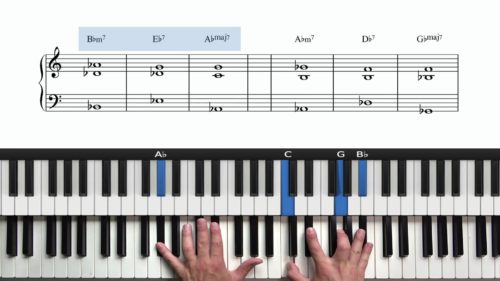
We introduce the concept of whole-step 251 drills, and how they can be an interesting alternative to drills around th...
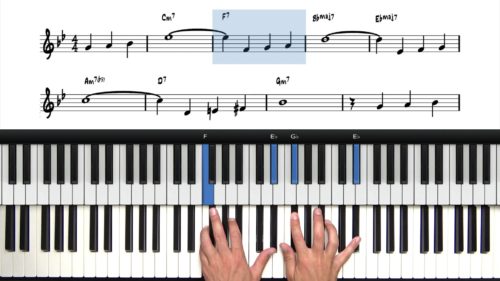
In this lesson we explore how you can navigate over the minor line cliché using bass lines, two-handed chords and le...
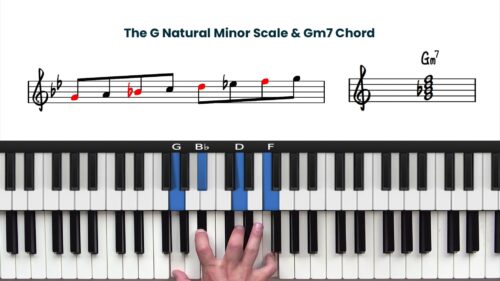
A seventh chord is a triad which has been extended to include the 7th degree of the scale. This creates a fuller soun...
Practice Tips
-
A Section Variations: Play through the 1st and 2nd A sections and notice the slight variations in the final two bars. Aside from the final 2 bars, the harmony and melody in the A sections is identical.
-
Add Embellishments: Experiment with the melodic embellishment on the A sections to make your performance more interesting. This is important to add more interest to repeating sections of jazz standards.
- B Section Mastery: Break down the B section into smaller parts and practice each part slowly to understand the harmony and melodic movement which differs from the A sections.


In your bar 22, you are going to a C7, but the lead sheet that we download has a D7. The D7 seems to make more sense as a 2 5 aff the am (am D), but the C makes sense as a 5-1 going into the F (C F)? Which is correct?
Hi Seth 👋
Great question!
I think the word “correct” can be problematic here. When playing jazz standards we have a lot of freedom to change the harmony, often by adding additional chords which are related, harmonically speaking. This is essentially the process of “arranging a jazz standard” where we take the limited information on the lead sheet and ‘spruce it up’ into something more sophisticated.
I believe the original chord changes for this song are the ones that you see in the PDF file where we have a full bar of A-7 in bar 21, and then D7 and F7 in bar 22.
In the lesson and in my demonstration, I pull the D7 forward into bar 21 which creates a 25 progression, and I then proceed the F7 with C-7 which creates another 25 progression. I didn’t realise that the PDF lead sheet and the lesson show different chord changes – I have fixed that so that the PDF lead sheet shows what I am playing and demonstrating.
Also I play a C-7, not a C7. You could play a C7, but I personally think that C-7 sounds better in bar 22.
—–
Once you have learn this basic arrangement, check out the course “Misty – Cocktail Piano Improvisation” where we dive deeper into arranging principles and techniques – you can find that course here: https://www.pianogroove.com/jazz-piano-lessons/cocktail-improvisation-for-beginners/
—–
Please let me know if you have any further questions Seth, and if you re-download the PDF chord chart you will see that I have updated it to match my demonstrations in the lesson.
Talk soon,
Hayden
Very helpful explanation. I kind of figured that was going to be the answer, but I wanted to be sure given the difference between the lead sheet and the lesson.
Thanks, I’m really enjoying the course.
Thanks Hayden , this course is the best “remede” against the rain
My pleasure, Nicolas.
I’m glad to hear that you are enjoying the lessons.
If you have any questions with the material, please don’t hesitate to get in touch.
Cheers,
Hayden
Hi Hayden, on bar 17, so the beginning of the B section, the repeating D in the melody is a D flat. This is indeed what you play, so a D flat, but is shows as just D on the lead sheet.
Hi Bertrand,
Thanks for pointing that out. I will ask our video editor to fix that typo in the lesson notation.
In the interim please follow the PDF download “Misty – Beginner Chord Chart” which does contain the correct flat symbol over the D in bar 17.
Apologies for the confusion in the lesson notation – we will get that fixed shortly.
Cheers,
Hayden