



"Misty" – The A Section
Welcome to the first jazz standard lesson in our Novice-level course on the key of Eb major. In this lesson, we focus on the first 8 bars of the tune "Misty".
The first 8 bars is also known as the ‘A section’. The songs follows an AABA form and so by mastering the first 8 bars, we build a very strong foundation for learning the entire song.
Root Position To Spread Voicings
We start by playing the chords in root position to clearly visualise their shapes. However in jazz piano, we typically spread the notes over two hands. This technique, known as ‘2-handed spread voicings’ creates a more balanced and resonant sound compared to playing chords in their basic, closed positions.
Spread Voicings Configuration For Jazz Piano
Spread voicings involve playing the root note with the left hand in the lower registers while the right hand plays the other important tones and the melody at the top. This method helps to avoid the clunky, condensed sound of closed position chords and instead creates a more sophisticated harmonic texture.
Spread Voicings & Guide Tones
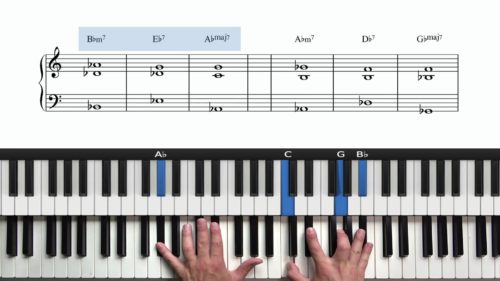
We also explore the concept of smoothly transitioning between chords by outlining the half step movement of 7ths falling to 3rds in 25 and 251 progressions. This involves minimal hand movement and creates smoothly connected chord progressions that are essential for a polished jazz piano performance.
By the end of this lesson, you’ll be able to play the first 8 bars of "Misty" using spread voicings and understand how to transition smoothly between chords.
Related Lessons
We introduce the concept of whole-step 251 drills, and how they can be an interesting alternative to drills around th...
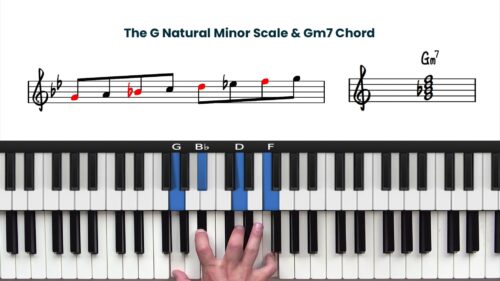
A seventh chord is a triad which has been extended to include the 7th degree of the scale. This creates a fuller soun...
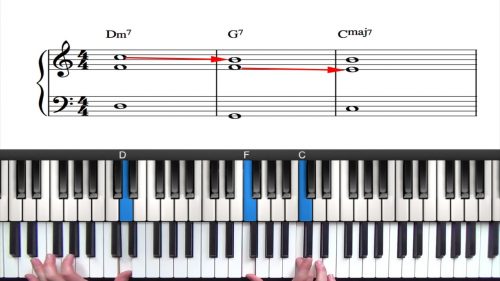
Most jazz standards that you come across will contain a 251 progression in some form so it is essential that you know...
Practice Tips
-
Basic Chord Practice: Practice playing the 7th chords in root position to get comfortable with the basic shapes and sounds.
-
Create Spread Voicings: Next spread the notes of the 7th chords over 2 hands focusing on creating a balanced sound and an even spread of notes on the keyboard.
-
Recognising Progressions: Pay special attention to the 251 and 3625 progressions and how the 7ths fall a half step to the 3rd of the next chord.
- Internalise the Melody: Isolate the melody and practice slowly and accurately to master the big melodic jumps and arpeggio sequences.


Bars 7 and 8 shown in this lesson are not the same as Bars 7 and 8 in the pdf download provided. The pdf shows a Gm7 and and Fm7 but the video shows these cords as the major dominant cords G7 and F7 which are the cords played. I presume I could play whichever version I prefer.
Hi John 👋
Great question!
Yes that’s correct that these chords – the 3, 6, 2, and 5 chords in the key (also known as the 3625 progression) – can all be played as dominant chords.
Diatonically-speaking, the 3, 6, and 2 chords are minor 7th chords, but in jazz it’s common to play these as dominant chords.
In the first lesson of this course I made a special note of this, please revisit the final chapter of the previous lesson which you can find here:
https://www.pianogroove.com/jazz-piano-lessons/eb-major-spread-voicings/
It’s an interesting relationship to understand because when we play each chord in the 3-6-2-5 progression with dominant 7th chord voicings, the 3rds and 7ths of each chord voice lead very smoothly as they are just a half step apart. If you revisit the final chapter of the lesson referenced above you will see my demonstration of this.
—-
Yes, that’s exactly correct that you can choose which version you prefer, and remember that we have a choice on how to voice those chords so you can also ‘mix and match’ so you don’t always have to play that section in the same way.
This is a nice example of how we can start to make more spontaneous choices when playing and arranging jazz standards – so I recommend to learn both.
With these basic voicings (just roots, 3rds, and 7ths) they sound somewhat similar, but as we learn more theory we discover that dominant 7th chords can be enhanced/embellished in more ways that minor 7th chords (such as chord alterations, upper structure triads, chromaticism, inner voice movement).
I show some ideas in the following lesson which is from the Cocktail Piano Improvisation course: https://www.pianogroove.com/jazz-piano-lessons/voicings-for-turnarounds/ – these ideas are more advanced but it should help you to see the later applications and developments of this seemingly subtle tweak to the chord qualities (minor 7th to dominant 7th chords).
I hope that helps John and if you have any follow-up questions just let me know.
Best,
Hayden