


"Moon River" – Learning The B Section
Welcome to the 2nd lesson in our course on reading lead sheets for beginner jazz piano players. In this lesson, we delve into the second section of the beautiful jazz standard "Moon River".
Overview of 3-Note Spread Voicings
We revisit the A Section to review 3-note spread voicing technique. We start by playing the roots of the chord in our left hand, the melody in our right hand, and focusing on the selection of the 3rds and 7ths somewhere in between.
Different voicing techniques are demonstrated and we highlight the creative freedom available to you as the arranger.
Voicing Techniques & Melody
We explore techniques for adding dynamism to our playing, such as playing the notes of the chord in unison versus adding subtle movement between the notes of the chord.
We then examine how the most appropriate chord voicing can often be determined by the melody. We use the repeating A-7 as an example.
Understanding 2-5 Progressions
We introduce the concept of the 2-5 progression and we examine where this common progression appears in the tune "Moon River". We pay special attention to the 3rds and 7ths of chords to ensure smooth transitions in our 2-5 progressions.
In the next lesson we incorporate the C section and also discuss the form of the tune. You will learn why understanding the form is crucial for quick and effective memorisation of jazz standards.
Related Lessons
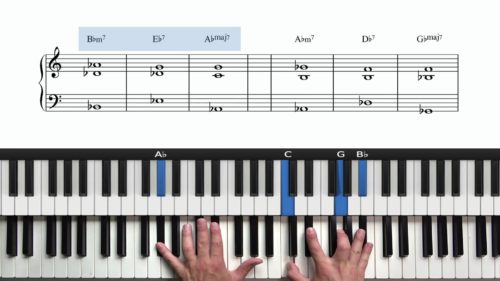
We introduce the concept of whole-step 251 drills, and how they can be an interesting alternative to drills around th...
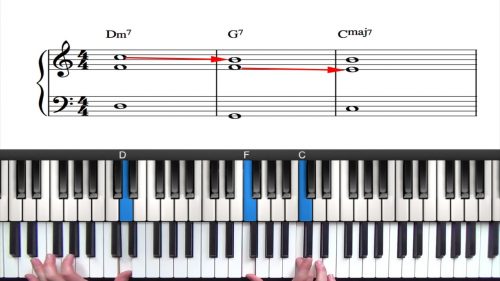
Most jazz standards that you come across will contain a 251 progression in some form so it is essential that you know...
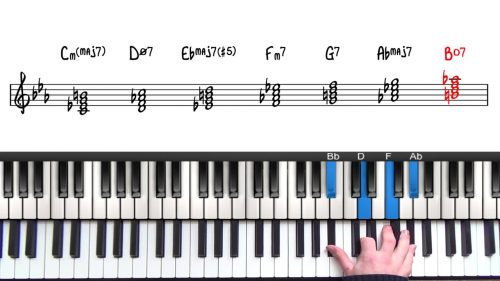
Minor harmony is much more complex than major harmony and so the minor 251 progression takes much more time and patie...
Practice Tips
-
Isolate challenging sections, particularly the quick 2-5 progressions on the second line of the B Section. Practice this section slowly and accurately to build proficiency.
-
Practice counting the 3/4 time signature. This is particularly useful for establishing the correct rhythmic placement when there are 2 chord per measure.
-
Listen to lots of recordings of "Moon River" to gain inspiration for how the melody can be phrased.
- Remember that the lead sheet is just a rough interpretation of the song and we have creative freedom to interpret and embellish the melody and to add our own personal touch.


So far really enjoying and getting a lot from these lessons. Thanks so much!
Hey Paul 👋
Thanks for letting me know and I’m glad you are enjoying the course.
I think you will also enjoy the other courses in our “Lead Sheet Fundamentals” Learning Path:
https://pianogroove.com/syllabuses/lead-sheet-fundamentals/
These courses are designed to build strong foundations in terms of reading lead sheets and playing spread voicings which will prepare you for the more advanced jazz standard studies on the website.
Talk soon,
Hayden
I started to practice the 2-5-1 exercises in parallel with Moon River but a theory question stumped me: the key signature of Moon River appears to be C, so a 2-5-1 progression is D minor – G7 – C Major. E7 is a third above C, while F# is a 4th above C, which confuses me. So my basic questions are:
> What are these 2-5-1 progressions based on if not the key signature?
> Starting in bar 13, there are several 2-5 patterns, e.g. F#m7(b5) –> B7, then Em7 –> A7. If F#m7 is the ii chord (minor), that implies that the I chord is E?
> Similarly, if Em7 is the ii chord, that implies that the I chord is D?
> How do these 2-5 patterns relate to the key signature or melody?
Hi Rico,
Great question!
These 2-5-1 progressions are used to approach the main diatonic 7th chords in the key of C major.
The 2-5-1 progression into E-7 can be viewed as a 2-5-1 into the iii-7 chord in the key of C major which is E-7.
A 2-5-1 in E- would be F#-7 to B7, and then to E-7 – which is exactly what we see on the lead sheet.
This then starts a new 2-5-1 into the ii-7 chord in the key of C Major, which is D-7. So that would be E-7 to A7 to D-7. And finally, this starts a 2-5-1 into the ‘home base’ or the ‘tonic’, which is C major. So the final 2-5-1 is D-7, G7, and Cmaj7.
When playing jazz standards, it’s very common to have chords that are outside of the key. So in this case, B7, and A7 are not in the key of C major, and these dominant chords are called “secondary dominant chords” which are used to create interesting harmony and cadences into the main diatonic 7th chords. The F#-7 is simply the related ii-7 chord which creates a full 251 into E-7.
So to answer your question, always look at where the 251s are resolving, in this case E-7 (iii-7 chord in C major), D-7 (ii-7 chord in C major), and Cmaj7 (Imaj7 chord in C major), and then we can see that these progressions are used to target the diatonic 7th chords from the key of C major.
A useful analogy is to think of the diatonic 7th chords as a ‘solar system’ where each diatonic 7th chord is a planet in the solar system. When we approach these chords with their 2 and 5 chords, we can see these as ‘the moons’ that orbit the planets, and so whilst they are not strictly in the key of C major, they are very much related to the diatonic 7th chords, or the ‘planets’ in the ‘C Major solar system’.
Please let me know if this helps to answer your question.
If you do have any follow-up questions, please post them here and I’ll be happy to assist.
As you study more jazz standards you will see these kind of progressions all of the time and so hopefully the above analogy is useful when trying to analyse the harmonic relationships.
Talk soon,
Hayden
Excellent answer — I especially like the paradigm of the ‘planets in the C Major solar system’ …
My pleasure Rico – I’m glad it’s useful.
Yes I also find the “solar system/planets/moons” to be a great analogy for visualising the harmony found in jazz lead sheets. The trick is to always look at the resolution points of the 251s and usually these will be one of the diatonic 7th chords.
Let me know if I can help further and enjoy the lessons!
Best,
Hayden
Totally, out of this world. LOL!!
Haha yes indeed!
For something a little more out of this world you might like to check out Jovino’s 5-minute masterclasses, particularly this one on “Orbital Intervals”:
https://www.pianogroove.com/bossa-nova-lessons/intervals-as-orbital-vectors/
Cheers,
Hayden
I am exercising my brain a lot more than my fingers. From the triads to the sevenths, to the possible configurations, to the voicings. Once I understand and remember in my head, the fingers will follow.
Hi Guillermo,
Thanks for the comment.
Indeed it is a workout for the brain. Soon you will recognise the 25 and 251 relationships and your hands will gravitate towards the voicing shapes.
I recommend to complete this whole step 251 drill on a daily basis – https://pianogroove.com/jazz-piano-lessons/251-progression-with-3-note-voicings/ - It will help you to develop the muscle memory when playing these essential chord progressions.
Also pay attention to the form of the song and the repeating section. For Moon River, the song follows an A-B-A-C form and so the A section repeats twice identically. Remembering this information can greatly speed up the memorisation of jazz standards.
I hope that helps and please let me know if you have any other questions.
Best,
Hayden
Hi and Thanks for the course. I find it challenging to follow the fingering in the video – having to hit pause in Screen, retract 10secs, play, hit pause etc. There is no way to slide through the vid and stop at the exact point. It would help me if either in the video or the pdf showed the suggested fingering / Hank
Hi Hank,
Thanks for your comments. That’s a great suggestion to include the fingerings in the PDF downloads and certainly something that we can add.
Here are some tips which I think will help you with controlling the video playback:
Firstly you can set the video speed to 0.75, 0.5, and 0.25. Please see the option “1x” in the bottom right hand corner of the video player. Reducing the speed will help you to see study the fingerings without needing to pause the video.
Next, in each of these beginner lessons I include a full demonstration without my narration. For this video please see chapter 5 “Performance & Demonstration”. You can set the speed control to 0.5 and watch this chapter to see my fingerings in slow motion.
Finally, to efficiently pause and resume playback it depends on what device you are using:
If you are using a touchscreen device such as an iPad, simply tap the centre of the video player twice in quick succession and the video will immediately pause, so you don’t need to press the actual pause button.
Once the video is paused on a touchscreen device, a grey overlay appears and click anywhere except the play button, and the grey overlay will disappear so that you can study the voicings and fingerings.
To resume playback, double click the centre of the video player again.
If you are using a laptop, simply tap the “space” button and the video will pause/resume playback.
—–
With regards to fingering for spread voicings, there are some golden rules to remember:
1) The left hand pinky always plays the root of the chord.
2) The melody note is usually played with the right hand pinky, the 4th finger can also be used but more often than not we play the melody note with our right hand pinky which frees up our other right hand fingers to play the 3rds and 7ths below.
3) The 3rds and 7ths of the chords are usually, not always, but usually played with our index fingers and thumbs. The right hand 3rd finger is used more frequently that the left hand 3rd finger.
I appreciate that it can be difficult when starting out but after working through 5 or so of these beginner jazz songs, I guarantee that the fingering process will become much more intuitive for you.
—-
Please try my suggestions above and let me know if I can help further.
Cheers,
Hayden
Hi Hayden,
Thx for a speedy and good reply. Different video speeds will probably help a lot. In particular with respect to the iPad screen finction – pause etc – because at normal speed playback, I struggle to hit exactly the point where your fingering shows.
Also very helpful with the ‘golden rules’ 😃
/ Hank
Thanks for this deeper explanation as I also have struggled with watching your fingers on expanded Kenny Barron chord voicings. Overall, your instruction is above and beyond the other two online jazz programs that I have used, and these comments just reveal some fine-tuning so that beginners like me can easily and at a reasonable tempo, mimic your chordal journey through these beautiful jazz standards!
My pleasure Rico – I’m really glad to hear that you are enjoying the lessons.
The more tunes we learn the easier it becomes to find the voicing shapes.
When starting out, it appears that the jazz standards are all unique in their harmonies and structure, but after learning 10 or so songs you will quickly start to spot similarities in the harmonies and chord progressions used.
Keep me posted on your progress!
Cheers,
Hayden
Any chance you make a 5 minute master class about embellishing the melody? So single grace notes, double grace notes, turns etc
Thanks gabe
Hi Gabe,
Yes I will host a seminar on this topic.
I think it would be difficult to explore melodic embellishment in a 5-minute masterclass, but a 1-hour seminar will certainly give us enough time to dive deeper into the topic and for me to demonstrate with a selection of tunes.
Do check out the links that I shared in my previous reply to you.
Here they are again:
“Georgia On My Mind” – Bluesy Embellishment
pianogroove.com/blues-piano-lessons/embellishing-the-melody/
“Sentimental Mood” – Grace Notes:
pianogroove.com/jazz-piano-lessons/grace-notes-melodic-embellishment/
“Over The Rainbow” – see chapter 3:
pianogroove.com/jazz-piano-lessons/over-rainbow-full-playthrough/
This will give you some quick ideas and insights on adding melodic embellishments whilst still keeping the essence of the melody.
Talk soon,
Hayden
I guess that my ears are getting better. I hear the Wedding March chords in measure 14, F#m7(b5) to B7. Jeff
Hi Hayden,
I’m another beginner struggling to catch exactly what you are doing with your fingers with your lovely embellishments.
I was chuffed to be about to begin the B section, but it has been half an hour I have been trying to get the first three measures with the new embellishments clear to me on my iPad even with the speed change etc.
Before moving on, should I be integrating these new embellishments right now, or are you just showing us why different voicings can be of interest? Or is it just part of the beginner’s struggle as I learn my first jazz standard and I should just put in the work now to play like you 😉 when I have five or ten pieces under my belt?
Please don’t misunderstand me, I love what I’m doing and I love this course even if my brain is smoking at the end of each session.
Hi Deborah 👋
Great question and please excuse my late reply.
Fingering can be challenging to start but as you learn more jazz standards your fingering choices will become more intuitive and natural.
Yes to answer your question, I’m just showing possible variations and that we don’t need to play the melody exactly as it’s written. In fact, if we do play the melody exactly as it’s written on the lead sheet, it can sometimes sound quite uninteresting.
If the embellishments are difficult right now, you can always come back to them later. It’s important to remember that we are constantly developing and enhancing our arrangements. As we learn new theory we can then apply it to the songs that we already know.
I view all of my jazz standard arrangements as a ‘work in progress’, if that makes sense. They are always in a ‘fluid state’ as I’m constantly finding new ways to play them. This is one of the main ways that playing jazz and jazz standards differs from classical music pieces, for example.
Yes I recommend to keep working through the songs in the Lead Sheet Fundamentals Learning path – https://www.pianogroove.com/syllabuses/lead-sheet-fundamentals/ – which teaches 9 jazz standard studies. Right now the main priority is to expose yourself to different harmonic situations in different keys. For example this course focuses on the key of C Major, the next course Bb Major, and the next course Eb Major.
It’s normal to forget some of the jazz standards along the way, particularly in the first year or so of studying jazz piano. Songs will drop in and out of your repertoire over the years, and you will resonate with some songs more than others. For the tunes that you do resonate with, you will naturally play them more frequently and with time develop a deeper understanding of their harmonies and that’s when we can start to play them more freely and spontaneously.
In summary, yes continue learning new tunes as a priority. You can always cycle back around to this tune at a later date to work on melodic embellishment.
——-
Also make sure that you are listening to recordings of the tunes you are working on, for example here is a short playlist on Moon River: https://open.spotify.com/playlist/1hAQwuZhDA0QNsY7QwpYSk – I find Spotify is a great tool for organising my music like this.
I create playlists for all of the songs that I am working on, you can find more here: https://open.spotify.com/user/haydenhillpiano/playlists – regular listening gives us inspiration for melodic embellishment and how other musicians phrase and embellish the melody of the songs that we are learning.
I hope that helps Deborah. Please let me know if you have any other questions and enjoy the lessons!
Best,
Hayden
Hi Hayden,
Thank you so much for your lengthy and complete answer, including resources!
I see that I didn’t express myself clearly in my question. I was excited about being able to move on to the B section, and when you did a quick review of what we had done on the A section, you added lots of beautiful flourishes that I have been trying to slow the video down enough to capture painfully note by note what you are doing, and trying to unlearn the A section to play what I thought was the new way we should be playing the A section – before moving on to the B section. I was telling myself that this course is obviously for more advanced pianists than me, but I want so much to learn this that I just told myself, well, this is going to take a while…but I confess I was discouraged to be undoing what I had taught myself to do.
However, you have intuited my real question and given me the answer, and I am now just forging on. I can play Moon River in a “classic” non-jazz way so I should be able to do this.
What a great idea for using Spotify – I do look up versions of pieces, but never had the bright idea of making it into a playlist ;-D. Thank you.
Very grateful for your giving me such a long and thoughtful response.
Hi Deborah, I went through the same transition and it’s slow at first but you will find that if you practice diligently, you will master these standards! I studied and practiced both Moon River and Days of W&R in three phases: 1) learn the basic melody and basic chord voicings until you can play in rhythm; 2) once you memorize the tune, start some some embellishments, e.g. the Kenny Barron stretched left hand chord voicings. These add richness and movement to the tunes. 3) add your own embellishments, which I did via alterations in the chord voicings along with grace notes in the melody. Good luck!
Rico
Rico, thank you for this comment! This encourages me. That might be a more solid way of advancing, getting the chords in a good rhythmn and then adding the embellishments. I’m so eager to gettng to the jazz sound that I may have been rushing things too much, and I have just been copying Hayden’s embellishments after making sure I understand the how and why of his doing them. I’ll give your approach a shot on the B section of Moon River and see if that helps me move forward better. How long did it take you to make that progress? And thank you for chiming in, I really appreciate it!
it took about 4 weeks to master the melody and simple voicings with acceptable rhythm, then another 4-6 weeks to stretch into the Kenny Barron voicings with some of the melodic improvisations that Hayden suggested in his videos. In sum, each of these miniature jazz standards takes 2-3 months to achieve that jazz feeling that you describe and that is with daily practice (I am retired so music is a daily practice). Cheers, Rico
Hi Hayden!
I am working on moon river it’s taking me awhile still doing the first eight bars. I am practicing all the 251’s A&B the diatonic 7 chords and the other chords in all keys doing good with them. I am having a hard time understanding the connection to the two five the in songs. Should I complete moon river before moving on. I can play the song using the 7 chords in left hand and playing melody in right hand just having problems moving pass the A section doing the two hand spread
Hi Sam 👋
What you’re experiencing is normal so do persevere.
Here are some suggestions for you:
– Annotate the 25s and 25s on your lead sheets using pencil or pen. This will help to jog your memory of the 251 relationships when playing from lead sheets. Do this for every tune you are working on.
– Don’t feel like you have to “perfect” the first 8 bars before moving on. It’s better to work through the whole tune, even if it’s a bit rough.
– When playing jazz standards, try to think of 25s and 251s as ‘small units of harmony’ rather than 2 or 3 separate chords.
– Repeat this process for the other songs in the Lead Sheet Fundamentals Learning Path: https://www.pianogroove.com/syllabuses/lead-sheet-fundamentals/ – you can work on multiple songs at the same time.
—-
Since you can already play LH 7th chords + RH melody, you have the foundations in place and playing 2-handed spread voicings is simply rearranging the order of the notes, not adding any new notes!
As Rico mentioned in his comment above, this process is slow to start, but with diligent daily practice it will become much more comfortable.
To summarise:
Yes, keep working on this tune, but at the same time start some of the other songs in the Lead Sheet Fundamentals Learning Path. I’d recommend these 2 songs for you:
Tenderly: https://www.pianogroove.com/jazz-piano-lessons/tenderly-for-beginners/
Autumn Leaves: https://www.pianogroove.com/jazz-piano-lessons/autumn-leaves-for-beginners/
You’re on the right track Sam. This is exactly the stage where it feels a little unclear before it starts to come together. You can already play the 7th chords and melody, so you already know all of the notes, now it’s just about moving the chord tones out of root position to create 2-handed spread voicings.
Keep up the great work and if you have any further questions just let me know.
Best,
Hayden
Hi, I’m fairly new to your course and to jazz piano. My background is in playing from sheets. I love it. Never felt so much direct connection with the instrument and the sound before. Playing from sheets was such a mental endeavor for me that it never was emotionally fulfilling. Now, even though I am starting slowly and simply, there is a connection with sounds, harmonies and emotions that I never had before. So grateful I found your course.
I do have one question about this song. For some reason the C7th in measure 12 sounds off to me. Not sure why but it feels somehow discordant to me. Something inside me wants another chord here but I’m not sure why. Any ideas?
Thanks again for the wonderful course.
Hi Phillip,
Firstly, please excuse my late reply – I had a few gigs last week and I’m just catching up on comments and emails. Also thanks for your message…. It was a real pleasure to read.
What you described is actually one of the main reasons I created PianoGroove. So many classically-trained pianists tell me that, although they could play beautifully from sheet music, they never felt truly connected to the harmony or the sound. Developing that connection where we’re listening, reacting, and making spontaneous musical choices is what jazz is all about.
I’m delighted to hear you’re already experiencing that!
Regarding your question about the C7 in bar 12, it’s great that you’re ‘hearing’ other options here. As your ear develops, you’ll naturally begin to question the harmony and imagine alternative colours.
This is a beginner tutorial so I kept the lead sheet as simple as possible.
Here are some options for you:
First try E7, this creates a V –> I cadence into the A-7 in bar 13. This is an interesting choice because the melody note “G natural” then becomes the #9 of the E7 chord, and that creates a very tense and interesting flavour.
To make that E7 chord a little more tense and interesting, try this voicing:
Left hand: Root (E) and 7th (D)
Right hand: 3rd (G#), #5 (C natural), and the melody note G which is the #9 of E7.
That voicing is E7#5#9 which creates some beautiful tension and then resolution into the A-7 in bar 13.
—-
Another option is the tritone substitute of E7 which would be Bb7. Try playing a Bb7 ‘shell voicing’ in the left hand (Bb, D, Ab) and then a C major triad in the right hand in root position. That’s an upper structure triad voicing which gives us Bb13(#11) which is a beautiful chord to play there.
Both of those options are more advanced, but I think they will give you the more sophisticated sound that you are looking for.
I cover both of these options in the advanced lesson here: https://www.pianogroove.com/jazz-piano-lessons/moon-river-tutorial/
Please see the PDF download on that lesson page which is called “Moon River Reharmonised”. That PDF contains my handwritten notes and reharmonsations. I recommend to annotate your lead sheets like this in pencil with the different harmonic options available.
That arrangement is quite advanced, but beautiful to play. It’s a good idea to be comfortable with the basic R-3-7 arrangement that we cover in this lesson, and then just start to sprinkle in some more advanced harmonic ideas that I cover in the more advanced lesson referenced above.
You might also like to check out this series of 4 seminars on Upper Structure Triads: https://community.pianogroove.com/t/upper-structure-triads-for-beginners-beyond/12629 – it’s an intermediate level topic but I think it will be very nice topic for you to study and help to take your playing to the next level.
I hope that helps Phillip, and please let me know if you have any other questions.
Best,
Hayden