



"My Foolish Heart" For Beginners
For the first lesson in this module we focus on the A section of "My Foolish Heart". The A section is the first 8 bars of the song and this section repeats twice in the A-B-A-C structure of the tune.
Triads Drills & Exercises
The lesson begins by exploring the most basic of all chord voicings — triads. We play triads in our left hand and then add the melody in our right hand. Whilst this is a simple starting point, clearly visualising the foundations of the harmony will help when moving onto more complex chord structures.
7th Chord Drills & Exercises
We then introduce 7th chords by extending each triad up to the 7th note and we play these chords in root position for the entire A section. We identify that root position 7th chords can be problematic when arranging jazz standards as there are large jumps in our left hand. The root position 7th chords can also interfere with the melody line which leads us onto the concept of "2-handed spread voicings".
2-Handed Spread Voicings
To transform the basic triads and 7th chords into a simple but beautiful jazz piano arrangement, we must voice the notes of the chords over two hands.
This technique, known as "2-handed spread voicings" or "3-note spread voicings", is essential for achieving balanced, smooth, and free-flowing harmony which is characteristic of jazz music.
We spend time to break down each chord and distribute the notes over 2 hands. The golden rule to remember is: ‘melody in the right hand pinky, root note in the left hand pinky, and the 3rd and 7th somewhere in between played with either hand’.
Related Lessons
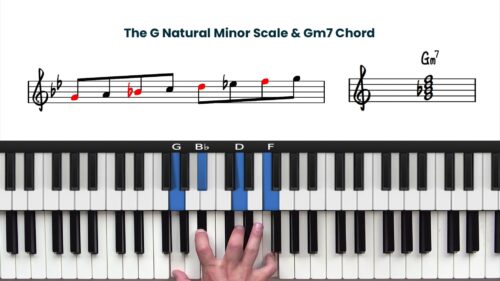
A seventh chord is a triad which has been extended to include the 7th degree of the scale. This creates a fuller soun...
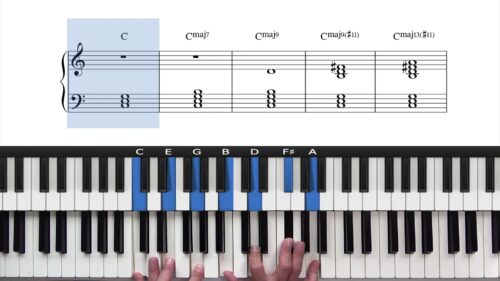
The triad is the basic building block for many different types of chords. The 4 types of triads are major, minor, dim...
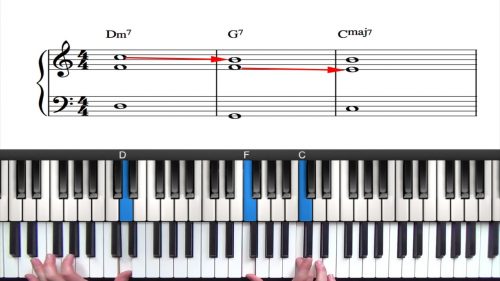
Most jazz standards that you come across will contain a 251 progression in some form so it is essential that you know...
Practice Tips
-
Master Triads & 7th Chords: Begin by isolating the triads and 7th chords in your left hand. Whilst this doesn't sound like a jazz arrangement, it will help you to memorise these important chord shapes.
-
Spread Voicing Formula: Practice spreading the notes of the chords over two hands. The formula is: melody in the right hand pinky, root note in the left hand pinky, and the 3rd and 7th somewhere in between played with either hand
-
Smooth Voice Leading: Pay special attention to how the 7ths fall to 3rds in 25 and 251 progressions. This subtle movement is key to achieving a smooth sound when playing jazz piano.
- Jazz Foundations Theory: If you find yourself struggling with these concepts, review the theory lessons in our jazz piano foundations course on triads, 7th chords, and the 251 progression. See the related lessons above.


Hi Hayden,
I keep running into an issue on bar 5 of this song (My Foolish Heart). Since there is a D7 on the third beat of the measure my ear has that F# from the harmony stuck in my head. I end up altering the melody to F# (beat 4 – 1st eighth note) to match what I hear in the harmony. Do you ever hove this issue? Is the F natural melody note there just a quick passing tone, or is it a #9 in relation to the harmony? The melody sounds like a D major triad arpeggio to me, so my ear pulls to the F#.
Hi Ray,
Great question!
Firstly, there are no ‘set-in-stone’ changes for jazz standards and so we often find many variations.
You are correct that the note “F” would be the #9 of D7 – which I like the sound of – but I wouldn’t hang around on that note too long. It just adds a little tension which aids and strengthens the movement to the G-7 – as D7 is the V7 of G. We can look at the D7 as a passing chord.
We could completely omit the D7 and just play Bbmaj7 for the whole of bar 5, I like to arpeggiate the chord tones in my right hand to fill the space. That’s one option to experiment with.
An alternative is to play bar 5 as D-7, because D-7 shares most of its tones with Bbmaj7. This also makes sense because we have E-7 to A7 in the bar 4 which creates a whole minor 251 progression moving us into bar 5. Again I would arpeggiate the chord tones of D-7 to fill the space if I am playing D-7 for the whole bar.
But yes avoid playing F# as the melody, because it is not the original melody. Perhaps you could make it work, but I feel that the options above are a better solution.
Let me know if I can help further and enjoy the lessons.
Best,
Hayden
The way you explain it, voicing does not sound too difficult but when you add the melody, you need a third hand!
Dm7, i could play with my right hand the 7th which is C and either the 3rd or the 5th, so F or A but the melody line in G which clashes with either F or A, although as this is followed by G7 with G in the melody line, I guess it is resolved. I must go back slowly to see how you do this.
Hi Bertrand,
I recommend to practice slowly and try to figure out the most comfortable fingering.
You will find speed controls in the bottom right hand corner of the video player so you can slow down the playback to 0.75, 0.5, or even 0.25% – this can be helpful to analyse the fingering and the movement between the chords.
I guarantee that once you have learnt the 9 beginner arrangements in this learning path, the process of choosing spread voicings and visualising the voice leading (7ths dropping to 3rds) will become much more intuitive and easy-to-visualise.
If you have any further questions don’t hesitate to get in touch.
Best,
Hayden
Hi Hayden,
You said in the My Foolish Heart:
Dm7 and G7 is a 2-5 progression, 25 of what? how would I recognize without you pointing it out it is a 2-5?
The same at Em7 and A7, 25 of what?
What got me confused that the song is in Bb Major and neither of these are 2 or 5 of that scale!
Thanks!
Gabor
I have been working through the Major 251s exercise provided in one of the downloads associated with this lesson and I have found this very valuable, well worth working through this exercise many times times with 7 for 2 dropping the 3rd for 5 and then dropping to 7 for one, so one step at a time. . If you do this exercise, you will see that the first one is 251 in C, so Dm7, G7 Cmaj7 and the second one is 251 in D, soEm7, A7 and Dmaj7 but with theses progressions in my foolish heart, we don’t get to do the one, only 2-5.
Good point about the scale being Bb major.
Hi Bertrand 👋
I’m really glad to hear that you are finding the 251 exercises useful.
Once you have a basic grasp on the 3 note voicings, you can also check out the next drills that I share in this course: https://www.pianogroove.com/jazz-piano-lessons/whole-step-251-exercises/ – where we start to add chord extensions (9, 11, 13) and chord alterations (b9, #9, #11, b13).
Also please see my response to Gabor where I explain the 25 progressions and how they function in the key of Bb major.
Any further questions don’t hesitate to get in touch.
Cheers,
Hayden
Hi Gabor 👋
Great question here!
Firstly it’s very important to understand that it’s very rare for jazz standards to only contain the diatonic 7th chords of the key they are written in, otherwise the music would sound very boring and predictable.
Your question dives into harmonic analysis, here’s what’s happening:
I’m sure you are familiar with the diatonic 7th chords in the key of Bb major… we have:
Imaj7 = Bbmaj7
ii-7 = C-7
iii-7 =D-7
IVmaj7 = Ebmaj7
V7 = F7
vi-7 = G-7
vii-7b5 = A-7b5
Now imagine a solar system – our solor system for example – and imagine that the “tonic” or “home base” is the sun of the solar system, so in this case Bbmajor is the ‘sun’. This is the central point around which all of the other chords of the key ‘orbit’.
The other diatonic 7th chords are the planets in the solar system. It’s not necessary for us to give them names for the purpose of this analogy but we now have the sun which is Bbmaj7 and then we have the other 6 diatonic 7th chords which are the planets in the solar system which orbit around the sun.
Now each planet (or diatonic 7th chord) can also be orbited by moons. Think of the moon that orbits around the earth for example.
That’s essentially what we are seeing here.
You first question is:
This is a 25 progression into C-7 which is the ii-7 chord in the key of Bbmajor.
Jazz musicians will also refer to this as “25 of 2” which means it is a 25 into the ii-7 chord in the key of Bb major. I find the solar system and moon analogy makes it a little easier to grasp this concept.
So essentially the D-7 and G7 chords temporarily ‘step outside’ of the Bb Major tonality but the resolution point is one of the diatonic 7th chords in the key of Bb (C-7 in this case) which is the ii-7 chord.
—–
You next question is:
This can be seen as a 25 of D-7 which is another planet in the Bbmajor solar system. D-7 is the iii-7 chord in the key of Bbmajor.
Jazz musicians would call this a “25 of 3” or 251 into the 3 chord in the key of Bb Major.
Now you might be thinking “but we move to Bbmaj7 in bar 5, not D-7” which is true.
But… if we play a D-7 in our right hand and put a Bb in our left hand, we then have a Bbmaj9 chord, and so Bbmaj7 and D-7 share a lot of common tones and therefore we can approach Bbmaj7 with E-7 and A7.
In some charts you might see D-7 at the start of bar 5, and it can be played there and sounds quite nice.
—-
This kind of movement happens in most jazz standards. Not all, but most.
What we are explaining here is not a modulation. A modulation is when the key changes for an extended period of time (typically 4 bars or more).
We explore modulations in this beginner course: https://www.pianogroove.com/jazz-piano-lessons/intro-to-modulation-key-changes/
In the 2 examples that you point out from this lesson, the ‘alternate harmony’ only last for a single bar (D-7 / G7) and (E7 / A7) and so essentially we are just adding harmonic decoration around the diatonic 7th chords in the key of Bb Major.
This is one of the primary pillars of jazz standards which creates more interesting harmonic sequences and cadences. If we only stuck to the seven diatonic 7th chords in the key of Bb major, then the music would be very limited.
When we approach the diatonic 7th chords with their 25 progressions… that’s when the harmony becomes interesting. Of course the great composers who wrote these songs and jazz standards understood all of these relationships which allowed them to write such beautiful tunes.
Harmonic analysis is not really a beginner-level topic so it’s omitted from the lesson to make these beginner lessons as accessible as possible.
—-
Understanding ‘numeric harmony’ is important to be able to transpose jazz standards, and also it helps to group jazz standards together that have similar harmonic movements.
I hope that helps to answer your question – and please let me know if you have any follow up questions.
Cheers,
Hayden
Hi Gabor,
I realised I didn’t answer the 2nd part of your question:
The way you would do this is to learn the 12 x 251 progressions.
A 251 progression is always a minor 7th chord, followed by a dominant 7th chord, and the roots are always a 5th apart.
As soon as you see a -7 chord followed by dominant 7 chord, that’s a very strong indicator that we are dealing with some kind of 25 or 251 progression.
—-
My recommendation is exactly what Bertrand suggested, and that is to complete the 251 drills on a daily basis, for example this one: https://www.pianogroove.com/jazz-piano-lessons/251-progression-with-3-note-voicings/ – until you have internalised and memorised the 12 x 251 progressions.
In that drill we are playing 251s in the “whole steps sequence”. You can also practice the same voicings around the circle of 5ths. Then pick keys at random to make sure you can find the 251 voicings.
That way when you see 25s and 251s in jazz standards you will be able to instantly recognise them and play suitable voicings.
I hope that helps – if you have any follow up questions please let me know.
Cheers,
Hayden
Hi Hayden,
Excellent tutorial as always.
I was a bit naughty and tried this in a C major version…but unrelated to that, it has slightly different harmonies, and I’m struggling to make bars 5-6 sound good (E minor 7 –> E7 with sharp 9 –> A minor 7 –> Eb 7 –> D minor 7.
Any tips welcome!
Thanks,
Will
Hi Will,
Great question here and I’m glad you’re enjoying the tutorials.
It’s also brilliant that you have tried to learn the song in a different key. Transposing is extremely important as a jazz musician. All time spent transposing (whether it’s transposing a melody line, a chord voicing, a chord progression, or a jazz standard in this case) is time well spent.
—–
Anyhow, to answer your question:
The harmony in your C Major version is actually very similar to what we cover in this lesson, there are just some different ways that the chords are written, which are also common chord substitution options.
When you see E-7 in bar 5, this can be substituted for the 1 chord. For your lead sheet, the 1 chord is Cmaj7. If you play E-7 in your right hand, and then play C in your left hand, you then have a Cmaj9 voicing, and so E-7 and Cmaj7 (the 1 and the 3 chord) are harmonically similar and can often be used interchangeably.
In the key of Bb version, the first chord in bar 5 is Bbmaj7, but can be played as D-7 due to the same relationship (D-7 is the 3 chord in the key of Bb major).
—–
To give you some chord voicings, I would play the following for your C Major version:
Bar 5:
E-7 – I would play this as a “So What Voicing”.
Left hand: E and A
Right hand: D, G, and B
E7#9 – the interesting this here is that to move from the E- So What Voicing to E7#9, all we have to do is drop the A in our left hand to G#, and then we are playing E7#9. I would keep the melody note held down, but replay the notes below it.
Bar 6:
A-7 – I would play root and 7th in my left hand (A and G) and 3, 5, 3 in my right hand (C, E, C).
Eb7 – here notice that we have the note C in the melody which is the 13th of Eb7. I would play an Eb7 shell voicing in my left hand (R-3-7) and then an F major triad in root position in my right hand which gives us the note C on top. This is an Eb13#11 voicing.
Bar 7:
D-7 – I would play root and 7th in my left hand (D and C) and 9, 3, 7 in my right hand (E, F, C).
—-
Please also note that in bar 4, you could play F#-7b5 for the first chord, moving to B7, which then creates a full minor 251 (F#-7b5 to B7 to E-7).
The F#-7/B is a strange way of implying B7sus – which can also be played there.
—–
Here are some lesson and seminar references related to my explanations above should you wish to dive deeper into these topics – which I recommend you do 😉
So What Chords Tutorial:
https://www.pianogroove.com/jazz-piano-lessons/so-what-chord-voicing/
Upper Structure Triads – 4 Seminars
https://community.pianogroove.com/t/upper-structure-triads-4-seminars-workshops/12629
Sus Chords:
https://www.pianogroove.com/jazz-piano-lessons/how-to-play-sus-chords/
This theory is moving into intermediate-level jazz territory – so it’s a nice taste of what’s to come in the next courses.
I hope that helps Will – if you have any further questions don’t hesitate to get in touch.
Best,
Hayden