


“The Nearness Of You” – B Section Improvisation
In this lesson we explore improvisation principles over the B section of the jazz standard “The Nearness Of You”. We apply the concepts covered in the previous module and focus creating flowing melodic lines by targeting resolution points, using altered tensions, and drawing inspiration from classic recordings.
By the end of this lesson, you will have a clear framework for improvising over the B section harmony and developing your own melodic ideas with confidence.
Understanding The Harmony Of The B Section
Before improvising, we must clearly identify the harmonic structure. The B section begins with:
- G-7 to C7 to Fmaj7
This is a 2-5-1 progression in F major (the key of the song). Recognising this resolution into Fmaj7 is crucial because this is where our melodic lines tend to rest.
Next we have:
- C-7 to F7 to Bbmaj7
This is another 2-5-1, resolving to the 4 chord (Bbmaj7) in the key of F major. Again, Bbmaj7 is a key resolution point and an ideal place to land on strong chord tones such as the 3rd or 7th.
We then encounter a minor 2-5 progression:
- A-7b5 to D7b9
Instead of resolving to G minor, we move to:
- G7 to C7
This creates a chain of dominant movement that takes us smoothly back into the final A section.
When improvising, always identify:
- The 2-5-1 progressions
- The resolution points
- The 3rds and 7ths of each chord
These guide tones form the backbone of strong melodic improvisation.
Breaking Up The Harmony: The Minor Line Cliché
Instead of sitting on G-7 for a full bar and C7 for a full bar, we can create motion using a minor line cliché:
- G-7 → G-maj7 → G-7 → C7 → Fmaj7
This introduces stepwise descending motion inside the G minor harmony. It creates rhythmic pulse and gives us more “stepping stones” for melodic development.
Breaking longer chords into shorter segments adds harmonic interest and gives more opportunities for melodic colour in our improvisation.
Targeting Resolution Points
Strong improvisation is about tension and release. Over C7, we can introduce altered tensions using:
- Half-whole diminished ideas
- Altered dominant sounds
- Arpeggios with b9, #9, or #5
Altered scales and arpeggios create tension which resolves beautifully into Fmaj7.
The same concept applies to:
- C-7 to F7 to Bbmaj7
And also:
- A-7b5 to D7b9 to G7
In every 2-5 movement, the 7th of the 2 chord drops to the 3rd of the 5 chord. Bringing this voice leading into your melodic lines creates clarity and synergy with the underlying harmony.
Related Lessons
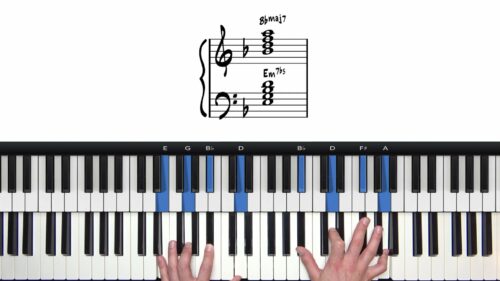
In this lesson we introduce the colours and flavours of the harmonic minor scale into our right hand improvised melod...
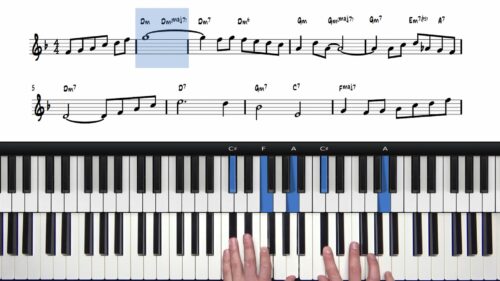
In this lesson we introduce the melodic minor flavour into our improvised lines and phrases. We target the #11 colour...
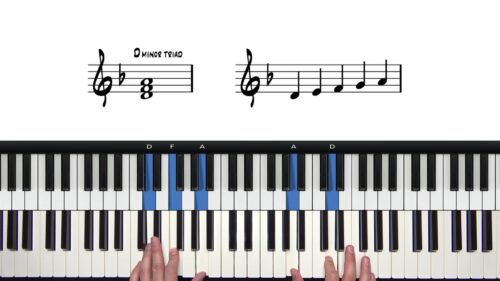
It’s important to understand that ‘improvising using triad shapes’ doesn’t mean that we have to exclusively p...
Practice Tips
-
Identify All 2-5-1 Progressions: Before improvising, locate every 2-5-1 in the B section and clearly visualise the resolution points.
-
Target 3rds & 7ths: Practice landing on the 3rd of Fmaj7 and Bbmaj7 after altered dominant lines.
-
Practice The Minor Line Cliché: Play G-7 → G-maj7 → G-7 → C7 slowly in your left hand until the motion feels natural.
-
Use Enclosures Around Guide Tones: create enclosures to strengthen the sense of resolution. This adds tension and sophistication.
- Transcribe & Extract Concepts: Study recordings by Red Garland and identify how he navigates dominant chords and resolution points.

