


Common Ways To Create An Intro
In this “5-minute masterclass”, we’re going to talk about the different ways you can create a solo piano intro to a jazz standard. We can always play the last 4 or 8 bars of the tune as an intro, but during this masterclass, we will explore other ways to create introductions for any tune.
Keep It Simple!
It’s important to introduce the song in a way that it is clear to everyone when to come in. The first rule to follow is: The simpler the introduction the better. This makes it easier it is for others to come in, and it will create a comfortable mood for everyone who you are playing with.
And remember, that “simple” does not mean “uninteresting”, it just means that it is clear and logical.
The 1625 Progression
We will explore a few ways to derive an introduction from the basic 1625 harmonic progression. This is very commonly used as an intro. The intro can be as long as you want, but it’s good to decide how long it would be, it’s common to choose either 4 or 8 bars.
Lesson Downloads
-
 Introductions PDF File Type: pdf
Related Lessons

Intros can be useful to extend the length of your performance and also to establish the tonality or the key in which ...
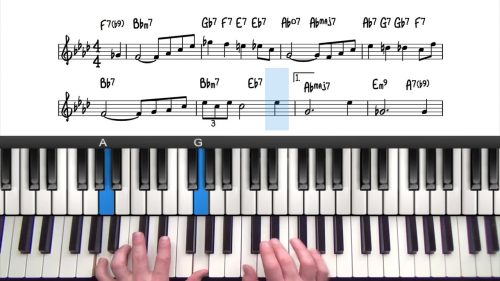
Block chords are used for harmonising a melody line by moving the notes of the chord in parallel, following the same ...

Slash chords contain 2 bits of info, the 1st letter indicates what chord should be played & the 2nd letter specifies ...
Practice Tips
-
The related lesson on "1625 & 436251 Progressions" gives accessible examples for beginner students. This is a good place to start if you are new to the 1625 progression.
-
Many tunes start on the 1 chords, and so the 1625 progression is perfect to lead smoothly into the start of the form.
-
You will come across tunes that start on other scale degrees. Use the examples in this lesson to create beautiful intros into any scale degree.
-
Check out the related lesson on "Block Chords" for information and guidance on this voicing technique.
-
Take these examples around all 12 keys to memorise and internalise these introduction formulas and variations.


I simply love these short video lessons, focused, clearly explained and oh so very useful. Keep going Hayden et al., congratulations. Ivan
Thanks Ivan… I’m glad to hear you enjoyed the lesson, if you have any questions let me know. More 5 minute masterclasses coming soon! -Tuomo
This is cool, but it would be nice if these examples of intros were notated.
Hi Rachel,
Thanks for the feedback – I have asked our transcriber to create a PDF of the introductions in full notation. I will post an update here when it’s ready.
Cheers,
Hayden
That’s fantastic! Thank you Hayden.
Rachel
How do you decide what chord progression to use for the intro of a tune? Do they actually come from the tunes themselves? For example, in the ii-7 Easy to Love example, did the tune have that chord progression in it or did you decide to start on the ii-7 on your own? Thank you.
Great questions, Rachel.
There are many ways to derive chord progressions for introductions.
Exactly as you say, often the best source of inspiration is to use the harmony of the song itself. It’s common to use the harmony from last 4 bars of the song, the last 8 bars of the song, or sometimes the entire B Section of the song.
This works because the harmony in jazz standards is cyclical in that the final bars usually lead us back to the start via a 251 or 25 progression which takes us back to the first chord.
—-
There are also a number of chord progression formulas which work very well for introductions. The most used ones are 1-6-2-5 progressions, 3-6-2-5 progressions, and also longer variations which we explore in detail in the course below:
https://www.pianogroove.com/jazz-piano-lessons/intros-endings-turnarounds/
This course starts with chord progression theory lessons where we explore the chord progression formulas. You will likely already be familiar with the 1625 / 3625 progressions as we find those progressions in many jazz standards. These 2 progressions are also known as “turnarounds” as they are very commonly found in ‘turnaround passages’ which are the final 2 bars of the 8 bar sections in jazz standards.
Think of bars 7 and 8 of Misty:
G-7 / C7 / F-7 / Bb7 = 3625 progression in Eb Major
or bars 7 and 8 of Nearness Of You:
A-7 / D7 / G-7 / C7 = 3625 progression in F Major
etc…
The function of the turnaround is to set up the repeat of the A Section (ie. go back to the first chord in the song) and so naturally these progressions are well suited to introductions.
—-
You will also see that the course above contains a module called “Jazz Standard Studies” and this is where I show you how to use the actual harmony and melody of the jazz standard to derive introductions.
Both approaches work beautifully. Check out the lessons in that course and if you have any specific questions with the techniques or theory you can post your questions on those lesson pages.
Keep me posted on your progress!
Best,
Hayden
Will do! Thank you so much for your great reply. It was very helpful and I’ll be sure to watch the course that you recommended. I’m enjoying your lessons and I love your UST cheat sheet!
Rachel