


Major 251 Drills: UST b9/#11 & UST #5#9
In this lesson we explore the b9/#11 and #5#9 upper structures over major 251 progressions. We then apply these voicings to the well-known jazz standards "Autumn Leaves" and "The Nearness Of You".
Recap Of Previous Practice Slot
We start this lesson with a recap of the last practice slot where we explored upper structures 13#11 and 13b9. We discuss the application and similarities between these 2 upper structure triads.
UST b9#11 Drills & Exercises
We then explore the sound and construction of the b9#11 upper structure which is a major triad built from the #11.
We examine the voice leading between the ii-7 and V7 chords and discuss a shortcut which can be used to access the b9#11 altered tensions.
UST #5#9 Drills & Exercises
The second upper structure triad that we explore contains #5#9 alterations. To access this sound we build a major triad from the #5.
The #5#9 upper structure can be applied to dominant 7 chords followed by the word "alt". "Alt" is shorthand for "altered" and #5#9 upper structure can be used create a tense altered dominant sound.
Related Lessons
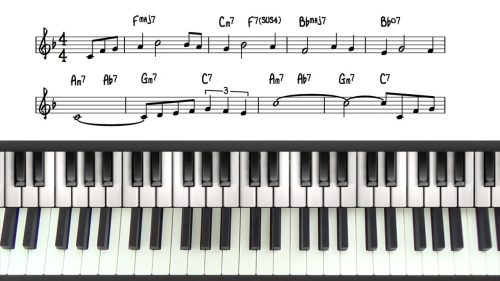
We start with simple two-handed voicings and then create interest by adding in upper structure triads, block chords &...
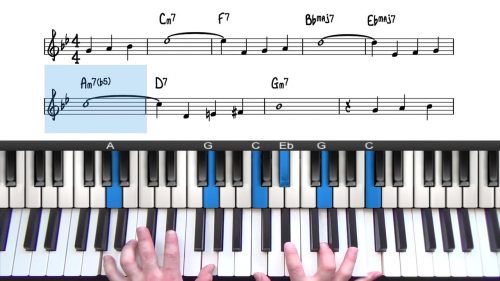
Usually played in the key of G Minor, the tune follows a 32 measure AABC form and contains both major and minor 251 p...
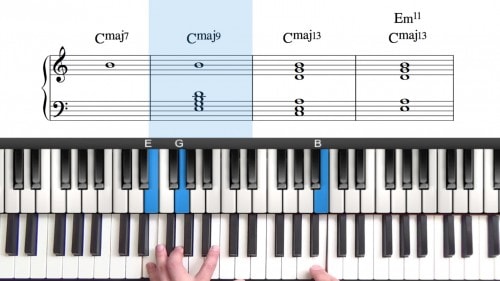
We explore how you can use So What voicings not only for minor chords, but also major chords by creating a quartal ma...
Practice Tips
-
Download the upper structure triad cheat sheet and keep it close to the piano for quick and easy reference.
-
Start the drills in different places on the circle of fifths to ensure that you are evenly distributing your practice time throughout all 12 keys.
-
For each upper structure voicing, make a conscious analysis of the scale degrees. In particular identify the altered tones in relation to the root note.
-
Experiment with these upper structure triads over your favourite jazz standards.
- Understand the role of tritone substitute and how this creates different upper structure triad possibilities in 251 progressions.


Hi
where are the exercises in PDF ?
thank you
Maurizio
Let me second Maurizio999. It would be a great help to have all or at least some of these exercises in a .pdf. Then we could review and review them easily, until they come naturally.
Hi Mary,
Understood – I will create a PDF file with some of these chord movements.
I will be hosting a “Guided Learning Path” on upper structure triad theory. It will be a 2-month long bootcamp where we explore these voicings and apply them to jazz standards. More to be announced shortly.
Wishing you a wonderful New Year and talk soon.
Cheers,
Hayden
Hayden:
I also agree with the other students that having a PDF of the exercise drills could help us learn and memorize the exercises faster.
Thank you,
Hector
Hey Hector,
Understood – I will create some PDF files for this theory.
I will be hosting a “Guided Learning Path” on upper structure triad theory. It will be a 2-month long bootcamp where we explore these voicings and apply them to jazz standards. More to be announced shortly.
Wishing you a wonderful New Year and talk soon.
Cheers,
Hayden
Hayden:
In the related lessons on sw chords, if you add a maj 3rd below the sw chord voicings you get all the Imaj13 voicings referenced in the exercise drills above. Am I correct?
Thank you,
Hector
Hi Hector,
Great question and yes that is correct.
If we add the major 3rd below any So What voicing, it will give us the major 13 voicing that we reference in this lesson.
I recommend to take this drill around all 12 keys, or at least familiarize yourself with the relationship between the So What chord and the major 13 voicing that can be built by adding the major 3rd below. I use this voicing all of the time for major chords and it has a very beautiful sound.
Please let me know if I can help further, and enjoy the lessons!
Cheers,
Hayden
Hi, Hayden – at the end of Training Module 5 you mention that Training Module 6 will follow, and it does indeed appear on the 1 Hour Practice Schedule .pdf (as “Minor 251s: USTs with b9 or #9”). But my version of the “Altered Harmony and USTs” course doesn’t seem to include it.
Any thoughts?
Many thanks –
Andrew
Hi Andrew,
Please excuse my late reply here.
I have fixed this issue. The lesson was not in the correct order on the course page, and it was shown at the bottom of the jazz standard module.
Here is the direct link to the lesson you are looking for: https://www.pianogroove.com/jazz-piano-lessons/ust-drills-over-minor-251s/
and if you check out the course page now you will see that the practice module contains 6 lessons.
My apologies for the confusion here and thanks for letting me know about this.
—-
On a related note, did you check out my series of seminars on Upper Structure Triads?
You can find them all listed here in this forum thread: https://community.pianogroove.com/t/upper-structure-triads-4-seminars-workshops/12629
These are the most recent tutorials that I have created on Upper Structure Triads and they are very much related to the content in this course.
—-
Please let me know if I can be of further assistance Andrew, and enjoy the lessons!
Best,
Hayden
Thanks very much, Hayden! And thanks as well in general for these wonderful courses you’ve created – I’m making so much progress in my playing!
All best,
Andrew
My pleasure, Andrew! I’m really glad to hear that you’re enjoying the courses.
Again please excuse my late reply to your last question.
—
I have taught solo piano harmony and jazz ballads quite extensively on the website now and so over the past year or so I have been working predominantly on my up-tempo playing and improving my ability to play with other jazz musicians.
This style has a stronger focus on rootless left hand voicings and improvisation and you can see my first improvisation course here:
https://www.pianogroove.com/improvisation-courses/autumn-leaves-improv-masterclass/
I’m working on the next batch of lessons for this course and I’ll also be creating more jazz-standard specific improv courses in the new improv section here: https://www.pianogroove.com/improvisation-courses/
I think you will find my above new course interesting as the improvised melodic material requires a good knowledge of altered harmony.
If you have aspirations to play with other jazz musicians, or perhaps sit in at a jazz jam session, check out the course above and get started on the chord tone and enclosure drills that I outline.
If you have any other questions or need additional guidance, please don’t hesitate to get in touch.
Talk soon!
Hayden