


10th Intervals & Harmonizing with 3rds & 6ths
Welcome to the final lesson in our novice-level exploration of the jazz standard "Fly Me to the Moon". In this lesson, we’ll build on the foundational harmony and voicings we’ve covered, introducing new techniques that add variety and depth to your performance.
Jazz Piano 10th Intervals For Beginners
Throughout this lesson, we’ll revisit the concept of 10th intervals in the left hand—a technique you may recall from our lessons on the tune "Moon River" earlier in this course. 10th intervals create a stronger harmonic foundation simply by restructuring the notes of simple triad shapes. For example, instead of playing the notes of an A minor triad sequentially, you can space them out as follows:

Notice that we simply move the root note an octave down and position the 3rd and 5th above it. This rearrangement strengthens the chord’s harmonic effect and creates a fuller sound in the lower registers of the piano. 10th intervals are a invaluable voicing technique for jazz pianists.
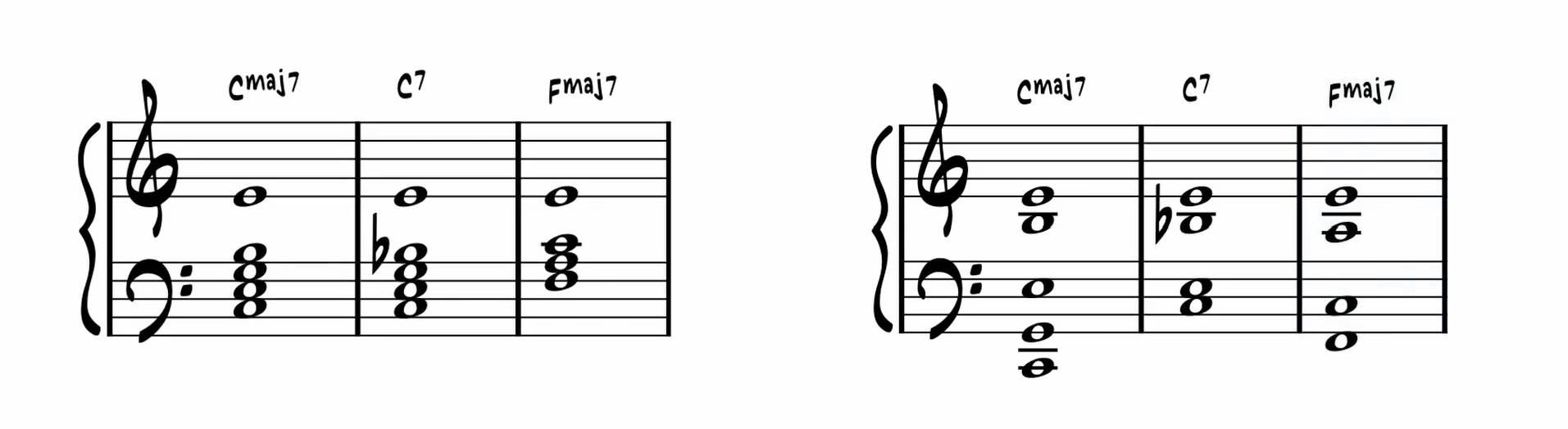
While 10th voicings may be challenging to execute, remember to adjust your approach by rolling notes or using the pedal to make these long stretches more manageable. With time you will build up the strength and muscle memory to execute 10th voicings cleanly.
Harmonizing Melodies with 3rds & 6ths
As we’ve learned in previous lessons in this course, jazz standards often have repetitive sections such as ABAC or AABA as you will learn in the next Novice courses. This repetition offers an opportunity to vary our playing with different voicing and melodic techniques.
Harmonizing the melody is useful technique to add melodic richness to our performance and create variety in repeating sections. By harmonising the melody with 3rds or 6ths we can create a more resonant and layered sound. However, these harmonizations require careful attention to hand positioning and can be physically demanding particularly when first attempting them. It’s essential to be patient and allow your hands to adapt gradually to these new shapes.
Bringing It All Together: Flexibility and Variation
One of the key takeaways from this lesson is the importance of flexibility in your approach. As you become more comfortable with these techniques, you’ll find that your arrangements of "Fly Me to the Moon" will evolve over time. Jazz is an ever-changing art form, where each new theory or concept you learn can be applied to refresh and reinvent your interpretations of standards.
Related Lessons
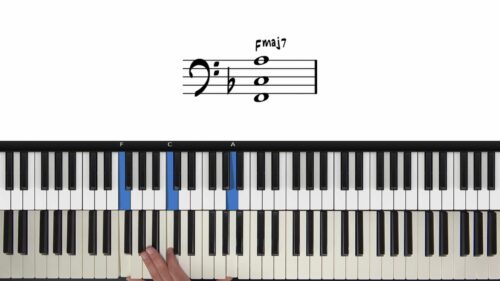
Left hand 10th intervals establish a strong foundation of the harmony and free up the right hand for melodic decorati...
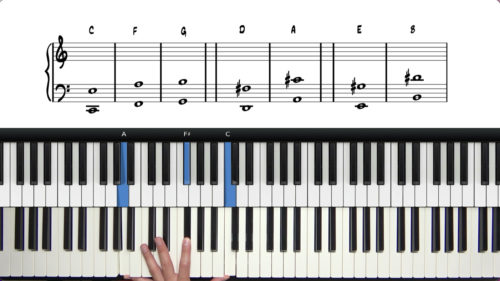
When we play 10th intervals in our left hand it creates a strong foundation which frees up the right hand for melodic...
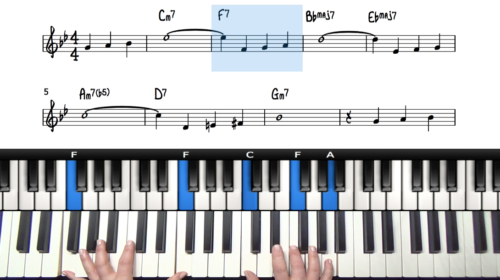
Using the well-know tune “In A Sentimental Mood” we'll explore the options available to harmonise step-wise melod...
Practice Tips
-
Experiment with 10th Intervals: Start by practicing simple triads in the left hand, then expand them into 10th intervals to strengthen the harmonic foundation of your left hand.
-
Explore Spread Voicings: Work on distributing chord tones between both hands, adjusting for register and melodic context.
-
Harmonize with 3rds and 6ths: Experiment harmonizing the melody using 3rd and 6th intervals. Start slowly and gradually speed up.
-
Vary Your Register: Practice playing the same melody in different registers of the piano to understand how it affects the overall sound and how this can open up new possibilities for voicings and melodic embelishment.
- Always Be Flexible: Try different combinations of voicings and harmonizations, allowing your arrangements to evolve as you incorporate new techniques.


Hello,
I have just joined Pianogroove and am really enjoying it. I have just completed the beginners guide to lead sheets and am not sure which course to choose next. Is there a structured learning matrix which tells me which courses to do in which order, or should i just work through all of the beginners jazz courses in any order i fancy?
Many thanks, Russell
Hi Russel,
Firstly, apologies for the late reply – I had a few gigs over the weekend and I’m just catching up on comments and questions.
I’m really glad to hear you are enjoying the lessons and courses.
Yes have you checked out the syllabus/learning path section here: https://www.pianogroove.com/syllabuses/
—-
I recommend the “Lead Sheet Fundamentals” learning path as a good place to start for new students – https://www.pianogroove.com/syllabuses/lead-sheet-fundamentals/
This learning path covers 9 jazz standards with simple yet beautiful arrangements. The goal of this learning path is to build out your repertoire of jazz standards and learn basic skills for harmonising lead sheets.
We cover these 9 tunes throughout the PianoGroove courses and seminars and so learning the basic arrangement provides strong foundations upon which we can add more advanced theory and jazz harmonisation techniques.
You have already completed the first course in this learning path and so there are 4 other courses remaining. That would be my main suggestion for you.
—-
To move at a faster pace through the theory, check out the Essential Jazz Harmony learning path – https://www.pianogroove.com/syllabuses/beginners-jazz-syllabus/ – this contains 5 courses which I deem to be the most important theory elements for beginner and early-intermediate jazz studies.
Generally I recommend new jazz piano students to start with the “Lead Sheet Fundamentals” learning path, and then move onto the “Essential Jazz Harmony” learning path.
—
A final option is to study our Dedicated Jazz Standard Courses.
These are in-depth courses of 15 to 20 lessons focusing on a single tune. Think of them as Jazz Standard Masterclasses where I share my insights and discoveries from playing these songs for many years:
“Misty” – Cocktail Piano Improv: https://www.pianogroove.com/jazz-piano-lessons/cocktail-improvisation-for-beginners/
“Nearness Of You” – Ballad Fills & Runs: https://www.pianogroove.com/jazz-piano-lessons/ballad-voicings-fills-improv/
“Body & Soul” – Elegant Stride Piano: https://www.pianogroove.com/jazz-piano-lessons/elegant-stride-improvisation/
“Georgia” – Bluesy Stride Piano: https://www.pianogroove.com/blues-piano-lessons/bluesy-stride-piano-beginners/
These courses are mixed-level, starting with basic 3-notes voicings and then each lesson introduces new voicing options and arranging techniques.
—-
Please take a look over the links and suggestions above – and let me know if you’d like any more recommendations.
Talk soon,
Hayden
Thanks for the lessons Hayden. Clearly i need loads of practice, specially the spread voicings on wide registers with embelished melodies. I really liked your ending of flying to the moon with the Cmaj13, i need to revisit as i did not quite get it all, did you do an arpeggio on Cmaj13 and back down a bit ?
What is best to do? Build a stronger foundation, practising what I have just learnt or move on to something new or a bit of both I guess.
Hi Bertrand,
Yes learning these songs is an ongoing process. Our arrangements are always in a ‘fluid state’ where we learn new theory and use it to develop our arrangements further. You will be playing these same songs for many years and still getting a lot of enjoyment out of them. The possibilities are almost endless in terms of arranging and I recommend to pick a ‘shortlist’ of maybe 5 or so tunes that you really like and that resonate with you. Some tunes you will love, others you won’t so much, which is normal.
I agree the ‘major chord a half step up ending’ is a very nice way to delay the final resolution into the tonic chord. Another way to view that chord is a “So What Voicing” build from the major 3rd. The major 3rd of Cmaj7 is “E” and so it’s basically an E- So What Chord played over a C bass note.
You can learn more on So What Voicings in our course on Chord Extensions which is the next course to study after the Foundations, you can find that course here: https://www.pianogroove.com/jazz-piano-lessons/extended-chords-voicings/ – please see the 2nd lesson.
—-
With regards to “what is best to do?” – my recommendation would be “a bit of both”. It’s very good to dip into more advanced topics and so I recommend to get started with the chord extensions course straight away.
For all of the tunes that we cover in this beginner section, we also have more advanced lessons and courses on the same tunes, and so once you have some of the basics down I recommend to dive into some more advanced theory and more advanced arrangements.
I hope that helps Bertrand and please let me know if you have any other questions.
Best,
Hayden
How do I get back to 2 preceding lessons on Fly Me to the Moon
Hi Nancy,
Please see the lesson title on this page (this is above the top left corner of the video player).
You will see the course name underneath the lesson title, and if you click the green course title it will take you back to the course page.
Please see the screenshot attached and let me know if I can be of further assistance.
Enjoy the lessons!
Best,
Hayden
Hi Hayden,
At the end of this lesson 10, you say “So I’ll see you in the final lesson where we have a listening session and if you have any questions with what I’ve covered you can post them in the comment box below”
Have I missed a lesson 11 on this subject? I think not – it seems you covered the subject pretty well but I’m just checking. 🙂
Cheers,
Andrew
Hi Andrew 👋
Thanks for getting in touch.
Yes I had originally planned to add a ‘listening and emulating’ lesson for each song in these beginner course, but I never got around to recording them.
The idea was that we would listen to a handful of recordings of the tune and examine how each musician phrases and embellishes the melody in their own personal way.
After reading your comment a few days ago I took a listen to my playlist on this tune which you can find here:
https://open.spotify.com/playlist/30RGXutjQMPxQ1JEZjF6PK?si=e319909623644611
I rearranged the songs in the playlist based on ones that I found interesting from a melodic standpoint.
I will try and record a on this lesson later this week. It’s very important that students are listening to recordings of the tunes that they are working on, and also trying to emulate the recordings that they like best.
I’ll post an update here when the lesson is ready.
Cheers,
Hayden
Hi Hayden,
Thanks for your reply, Spotify playlists are very useful. I listened to your playlist for this tune and recognised some of the styles and embellishments.
Quite a variety of interpretations. I think Mr Waterman was working hard there to empty his bag of licks before they called last orders!
But it’s all good.
Cheers!
Andrew