



Autumn Leaves Tutorial – Swing Feel
In part 2 of this jazz standard tutorial on ‘Autumn Leaves’, we create an up tempo arrangement.
First we discuss how the melody is phrased when playing with a medium swing. We also look at the placement and syncopation of the chords.
We introduce some passing chords in the bridge to create more energy and forward motion.
Related Lessons
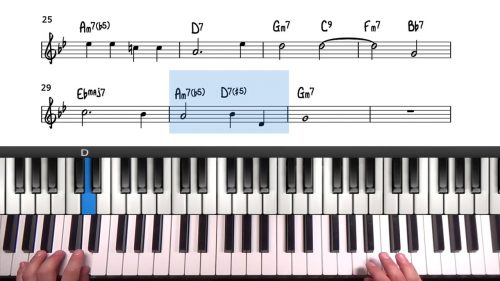
In this lesson we will explore a simple way to approach the tune "Autumn Leaves" with a walking bass outlining just t...
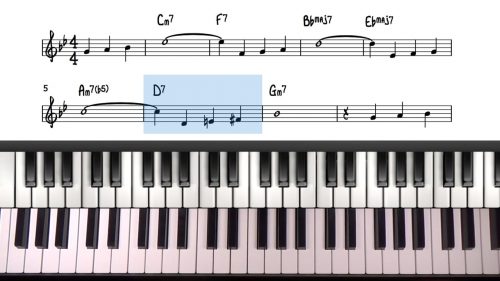
In this lesson we will apply the theory from the walking bass lessons and also introduce rhythmic comping and other s...
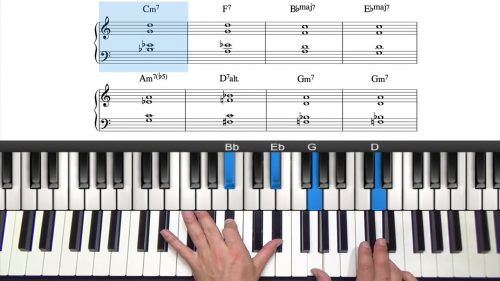
One of the most important things to remember is that "Comping" is shorthand for 'accompanying." It's a subordinate ro...
Comments
7 Comments
Leave Comment


Whats the difference between medium swing and ballad?
Hey Ivan,
Medium swing is played with a swing feel, generally around 120 – 160 bpm.
Ballads are generally played with a straight feel, from 60 – 100 bpm.
Those tempos are just rough guides for you, it can be change for different tunes. The key thing is the feel.
Cheers,
Hayden
Great lesson Hayden!
Cheers 🙂
Hi,
At minute 7, on the F7 chord, you say quartal stack off the 13… where to find out more on this?
Thanks,
Gabe
Hi Gabe,
Great question!
Check out this lesson around 12:15 where I show these voicings in rootless configuration in context of 251 progressions:
https://www.pianogroove.com/jazz-piano-lessons/2-handed-comping-voicings/
We play the essential chord tones in our left hand (3 and 7) and a quartal stack in the right hand. This is a very common rootless voicing structure used for comping voicings. It also works playing a stack of 5ths in the right hand.
—-
In the example that you highlight in this video, my left hand is playing b7-3-13 and then my right hand plays a stack of 4ths from the root of the chord, G-C-F in this case. However, the left hand can just play b7-3 and the right hand can play the stack of 4th from the 13.
Both of these are rootless F13 voicings but one has the root on top which creates a bigger sound:
1st variation:
Left hand: b7-3 and right hand: 13-9-5 … for F13 that’s RH: Eb-A and LH: D-G-C
or
2nd variation:
Left hand: b7-3-13 and right hand: R-9-R … for F13 that’s RH: Eb-A-D and LH: G-C-F
Both of these voicings are rootless F13 chords.
I hope that helps and let me know if you have any other questions.
Cheers,
Hayden
Thanks… and I am guessing that left hand can also play 3 and b7 as opposed to b7 and 3?
Yes of course.
For F7 if we played 3 and b7 in the left hand (type B rootless voicing) then the right hand could play G(9) C(5) and F(root) and that would be a rootless F9 voicing.
We could add the 13 into our left hand for that voicing (it would be a half step under the b7) and the right hand is playing a 3-note quartal stack from the 9th (G-C-F) in this case.
Any other questions please let me know.
Cheers,
Hayden