


Develop More Freedom At The Piano
Welcome to day six of PianoGroove’s 7-Day Jazz Piano Jumpstart.
In this lesson, we explore how to play with more spontaneity, flexibility, and creativity at the piano.
Up to this point, we have used two-handed spread voicings as our main way of arranging the chords in “Moon River.” Spread voicings sound beautiful, but they are only one possible way to interpret a chord.
Depending on what the melody is doing, we might use spread voicings, or instead use shell voicings, 10th intervals, or even simple triads.
The goal is to stop thinking that every chord has one fixed shape and instead begin choosing the chord configuration that best supports the melody, phrasing, and expression of the arrangement.
What You’ll Learn In This Lesson
In this beginner jazz piano lesson, you’ll learn:
-
Why there is no single correct voicing for a jazz chord
-
How to choose between spread voicings, shell voicings, and 10th intervals
-
How simpler left-hand shapes can create more freedom in the right hand
-
How to create a stronger foundation with left-hand 10th intervals
- How to mix different chord configurations within the same arrangement to play with more spontaneity and creativity
There Is More Than One Way To Voice A Chord
A common habit for beginner jazz pianists is to find one chord voicing and then use that same shape every time the chord appears. However, jazz piano is much more flexible than this.
A Cmaj7 chord, for example, could be played as a two-handed spread voicing, a shell voicing, or a more open left-hand shape such as a 10th interval.
Each configuration has a slightly different sound and, more importantly, gives our right hand different amounts of freedom.
Rather than asking, “What is the correct voicing?”, a more useful question is:
“Which voicing works best for what I want to play next?”
Use Shell Voicings To Create Space
A shell voicing is a left hand chord configuration that uses only some of the notes of the full chord. For example, instead of playing root, 3rd, 5th, and 7th, we might play:
Root + 7th
or:
Root + 3rd + 7th
By removing ‘non-essential’ chord tones such as the 5th, the harmony becomes lighter and less dense.
This can be especially useful when we want the right hand to play melodic ornamentation, because fewer chord tones mean more fingers are available to shape and decorate the melody.
Sometimes, playing fewer notes gives us more musical freedom.
Let The Melody Influence The Voicing
The melody should help determine how we arrange the chord underneath it. For example, if the right hand needs to play a turn, grace note, slide, or another embellishment, a large two-handed spread voicing might make that movement awkward or even impossible.
In that situation, we can simplify the harmony. We might use a shell voicing in the left hand, play only the root and 7th, or use a simpler triad-based shape spread over a 10th interval.
This is one of the most important ideas in the lesson:
The chord voicing should adapt to the melody — not the other way around.
Create A Strong Foundation With 10th Intervals
A very useful option is to play a 10th interval in the left hand.
Instead of playing a triad as:
Root – 3rd – 5th
we can rearrange the notes as:
Root – 5th – 3rd
with the 3rd placed an octave higher.
This creates a wide, open sound and gives the left hand a strong harmonic foundation while leaving the right hand free to focus on the melody.
For example, a C major triad can be spread across the left hand using C – G – E.
The interval may initially feel like a stretch, so it is important to practice the movement slowly and allow the hand position to become comfortable over time.
Mix Different Chord Configurations
You do not need to choose one voicing style and use it throughout the entire song. A more natural arrangement might combine:
- Two-handed spread voicings
- Shell voicings
- Left-hand 10th intervals
- Occasional chord extensions
For one chord, a spread voicing may sound perfect. For the next, a shell voicing might create more space for a melodic turn. A 10th interval might then provide a stronger foundation underneath a more active right-hand phrase.
This constant adjustment is what begins to make an arrangement feel less fixed and more spontaneous. The goal is not to memorize a different voicing for every possible situation.
Instead, we want to develop a small collection of reliable chord configurations and become comfortable moving between them.
As your vocabulary grows, you can begin making these choices in the moment.
You might start a phrase with a spread voicing, move into a shell voicing to free the right hand, use a 10th underneath a melodic embellishment, and then return to a spread voicing.
These are creative choices, and there is not always one correct answer. This flexibility is one of the things that makes jazz piano feel spontaneous and personal.
A Brief Introduction To Chord Extensions
We briefly introduce the idea of chord extensions.
For example, adding the note D to a Cmaj7 chord creates a Cmaj9 sound. Extensions such as the 9th can add extra richness and color to a chord, but you do not need to explore this theory deeply yet.
An important point is that the melody itself will often contain a chord extension. So even when we think we are playing a simple 7th chord, the melody may already be adding a 9th, 11th, or another upper chord tone.
We’ll explore these sounds in much more detail in the upcoming PianoGroove courses.
Don’t Try To Plan Every Voicing
At first, it is perfectly fine to decide your chord voicings in advance. As you become more comfortable, however, try to loosen that approach.
You do not need to play “Moon River” exactly the same way every time. On one performance, you might use more spread voicings. On another, you might leave more space with shell voicings or use 10ths to create a stronger left-hand foundation.
The aim is to gradually move from memorizing an arrangement towards understanding the musical options available to you.
That is where real creative freedom starts to appear.
Related Lessons

We introduce the "9th" chord extension and left-hand 10ths to create fuller sounding chord voicings with a strong har...

We explore chord voicing techniques for the C section of "Moon River" and consolidate the overall structure and form ...
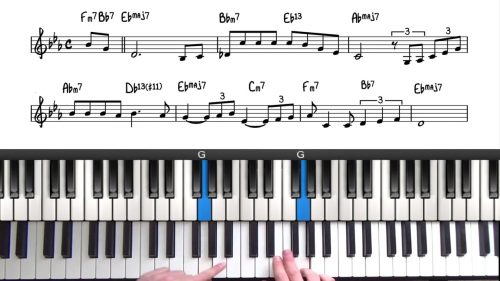
Extended chords create a richer and more complex sound than triads and 7th chords and are used to create more interes...
Practice Tips
-
Avoid using one fixed voicing for every chord. Experiment with spread voicings, shells, 10ths, and listen to how each configuration changes the sound.
-
Let the melody guide your left hand. If the right hand needs more freedom for ornamentation, simplify the chord underneath it.
-
Practice 10ths slowly. Work on the root–5th–3rd rocking motion without forcing the hand into painful positions.
-
Mix chord configurations within one song. Try moving from a spread voicing to a shell, then to a 10th, rather than using the same texture throughout the arrangement.
- Make choices by ear. Instead of asking whether a voicing is theoretically “correct,” listen for whether it gives the melody enough space and freedom and make you own decision.

