


Tuomo Uusitalo
Tuomo is an award-winning pianist, composer, arranger and educator. Having released two albums as a leader, he has established himself in the New York jazz scene and continues touring internationally both as a leader as well as sideman.
Live Seminar Resources
Live Seminar Resources
PDF Downloads
- Seminar Handout
Join PianoGroove Pro to access all downloads and learning resources.
Download theory supplements, midi files, chord changes and full note-for-note transcriptions of every lesson.
- "Nearness of You" Backing Track
Join PianoGroove Pro to access all downloads and learning resources.
Download theory supplements, midi files, chord changes and full note-for-note transcriptions of every lesson.
Related Lessons
Forum Threads
Seminar Description
Seminar Description
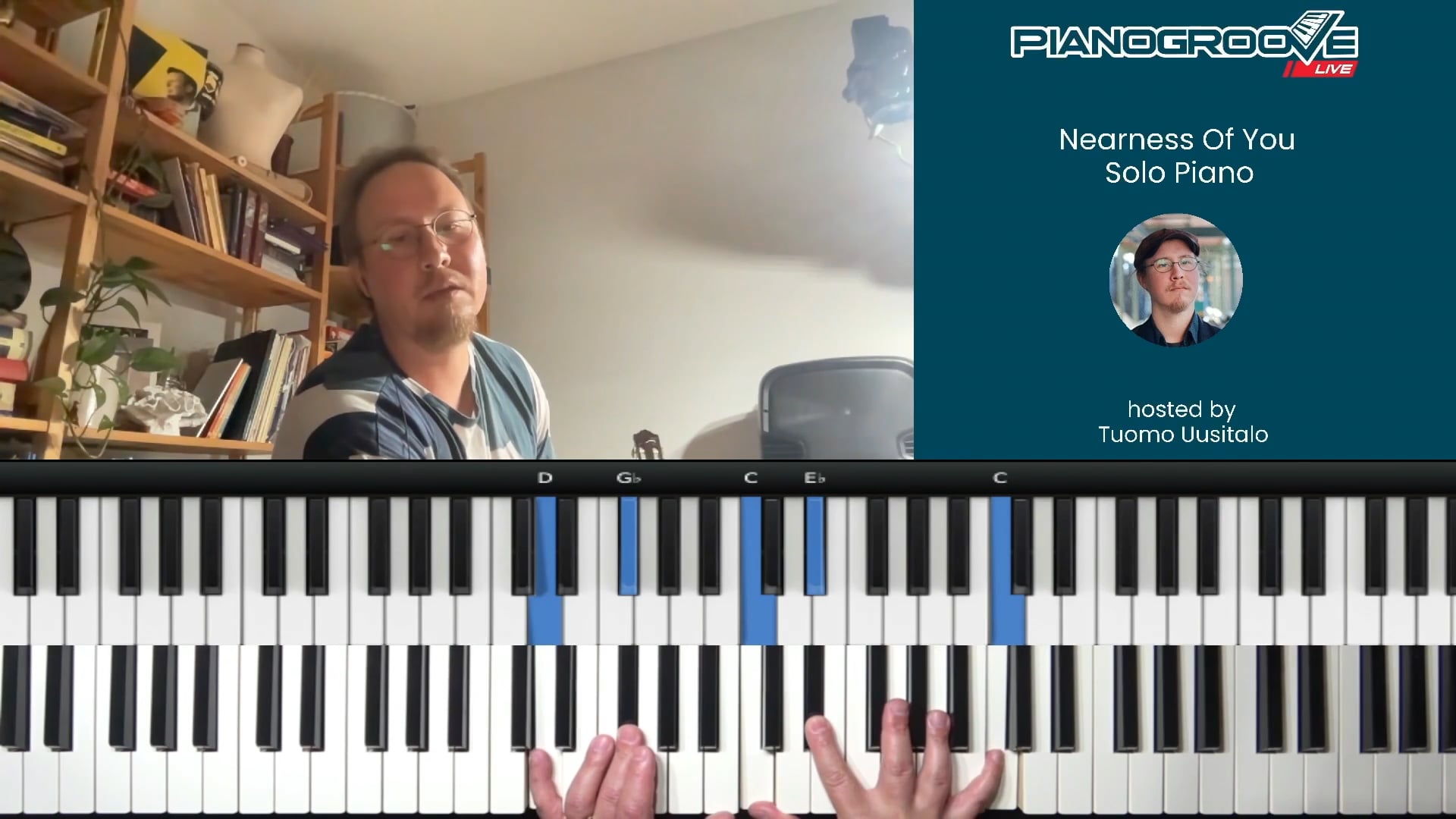
The Nearness of You – Trio Workshop for Beginners
In this workshop we explore the jazz standard “The Nearness of You” in a piano trio setting, focusing on how to play with bass and drums rather than solo piano.
This lesson is ideal for beginner jazz pianists who want to understand how to comp, voice chords, and interact musically in a trio. We work in the key of F major and use a slow ballad tempo to clearly hear harmony, voice leading, and time feel.
By the end of this lesson you’ll have a structured approach to playing ballads in a trio context, using simple but effective tools that translate directly to real jazz performances.
Thinking in 2-5s and Harmonic Movement
A key concept in this lesson is learning to see harmony as movement rather than isolated chords. Much of jazz harmony can be understood as either tension (2-5) or resolution (1).
We also explore how sounds like 4 minor and b7 dominant function as the same harmonic idea. For example, in the key of F:
- Bb-6
- Eb7
These chords contain the same notes and serve the same harmonic purpose. This “backdoor” movement is simply another color of a 2-5 resolving to 1.
Understanding these relationships helps you recognise familiar sounds across many tunes and builds a strong internal harmonic map.
Learning the Melody with a Backing Track
The first practical step is to learn the melody thoroughly, using the provided trio backing track with bass and drums.
Start by:
- Playing the melody with your right hand only
- Keeping it simple and rhythmically clear
- Memorising the melody and internalising the form
Once the melody feels comfortable, you can begin to add small variations, always staying close to the original shape of the tune. This is the foundation for expressive jazz phrasing.
Left Hand Shell Voicings in a Trio
In a trio setting, the bass player covers the root, which frees your left hand to focus on shell voicings.
We use 3-note voicings built from:
- Root
- 3rd
- 7th
And then gradually reduce these to 2-note shells (3rd & 7th). These voicings provide everything the band needs harmonically while staying light and supportive.
Strong voice leading is the goal—notice how 7ths resolve smoothly to 3rds in progressions like:
C-7 to F7 to Bbmaj7
Core Left Hand Voicings for 2-5s
We introduce a small set of core left hand voicings that work for:
- 2-5-1s in major
- 2-5s resolving to minor
These voicings include extensions like 9, 13, b9, and b13, but always remain compact and playable in a comfortable register below middle C.
The key is to:
- Learn these shapes thoroughly
- Practice them through all 12 keys
- Apply them consistently to the tune
This gives you a reliable comping vocabulary that works across hundreds of jazz standards.
Harmonising the Melody
Next, we explore ways to harmonise the melody while still respecting the trio texture.
Drop 2 Voicings (Without Bass)
You can use the same drop 2 voicings from solo piano, simply removing the bass note. This allows you to:
- Spread harmony between both hands
- Support the melody without cluttering the low register
Barry Harris / George Shearing Approach
We also touch on the classic approach of harmonising melodies using:
- Major 6 or minor 6 chords
- Related diminished chords
This creates a smooth, orchestral sound that works beautifully for ballads and comping behind soloists.
The Red Garland Trio Sound
Finally, we explore the iconic Red Garland trio approach, which is especially effective for beginners.
Key elements include:
- Melody played in octaves
- Left hand using simple shell or rootless vocings
- Optional use of a perfect 5th inside the octave (“Red Garland bells”)
This sound is instantly recognisable on classic recordings and provides a powerful yet accessible way to play ballads in a trio setting.
Putting It All Together
This lesson gives you a complete framework for playing “The Nearness of You” with a trio:
- Clear melody
- Strong harmonic understanding
- Simple, effective comping
- Multiple textural options
Rather than trying to do everything at once, focus on one approach at a time and let structure guide your playing. Even in improvised music, clarity and simplicity always win.
Practice Tips
-
Memorise the melody and play it repeatedly with the backing track before adding harmony.
-
Practice 2-note shell voicings (3rd & 7th) through the entire tune in time.
-
Isolate all 2-5 progressions and practise smooth voice leading between them.
-
Try the Red Garland approach by playing the melody in octaves with simple left hand voicings.
- Always listen to the bass and drums and aim to support, not dominate, the trio sound.
This structured approach will give you the confidence to play ballads in real jazz settings and lay a strong foundation for comping, arranging, and ensemble playing.
Comments
Leave a reply
Ask questions and get instant replies from our team of teachers. Get Started With PianoGroove Pro.Details
‘Nearness Of You’ For Jazz Trio
Related Seminars





Great seminar!
How do I access the supplemental material (e.g. study sheet, etc…) for this seminar?
Thanks!
Frank
Hi Frank,
I have just added the PDF handout to the seminar Downloads section.
I also added the seminar chapters.
Cheers,
Hayden
Hi Hayden,
Thanks!
I appreciate your timely replies.
Thank you for what you do!
My pleasure, Frank.
If you need further assistance and have more questions, don’t hesitate to get in touch.
Best,
Hayden