


Turnarounds For Beginners
In this lesson we introduce the concept of the turnaround. The turnaround is typically the final two bars in the blues form and it’s used to lead smoothly and convincingly back to the top of the form.
Why Is The Turnaround Important?
Well, the blues is a cyclical chord progression in the sense that it is repeated many times during a single performance and so smoothly transitioning back to the top of the form is an important skill.
If we play the exact same turnaround voicings each time we arrive at the end of the form, our playing can start to sound repetitive and so this module will teach you many variations and permutations of the turnaround.
Left Hand Embellishments
We have several options in the left hand when playing turnarounds. One option is simply to play single bass notes walking up from the I to the V chord. Notice the chromatic passing tone "B" between the IV and the V chords:
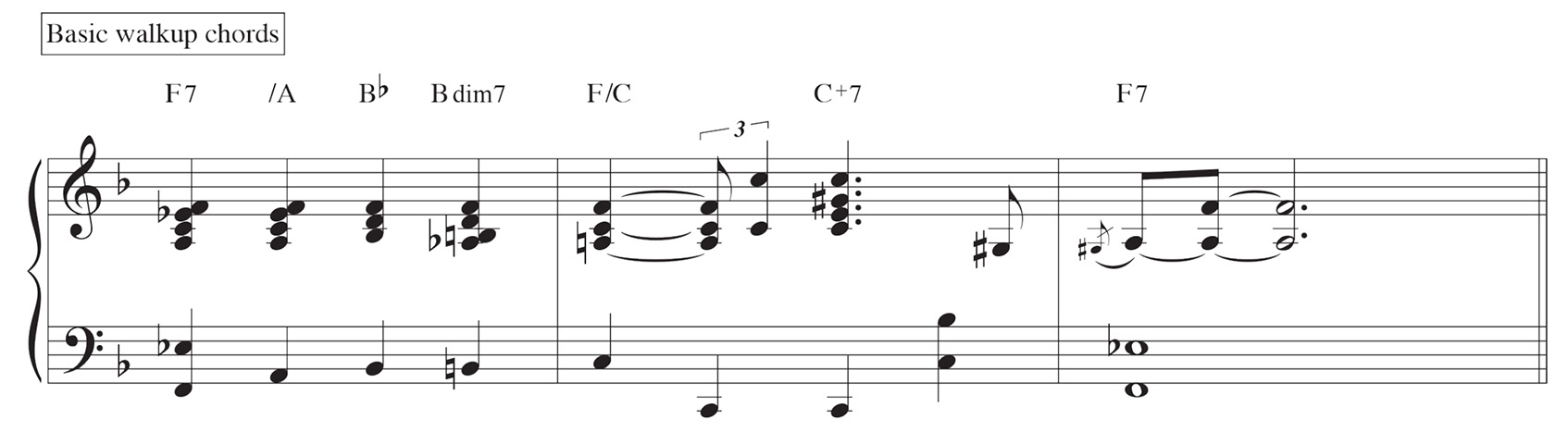
We can also play octaves in the bass for a thicker sound and grace notes can be used to add ornamentation and additional interest to our left hand. All of these techniques can then be combined to create interesting turnaround passages.
Blues Turnaround Variations
There are a potentially infinite number of ways that we can navigate the turnaround section of the blues. In this lesson we start with a the most basic turnaround examples. Another useful movement is descending 3rd in the right hand melody:
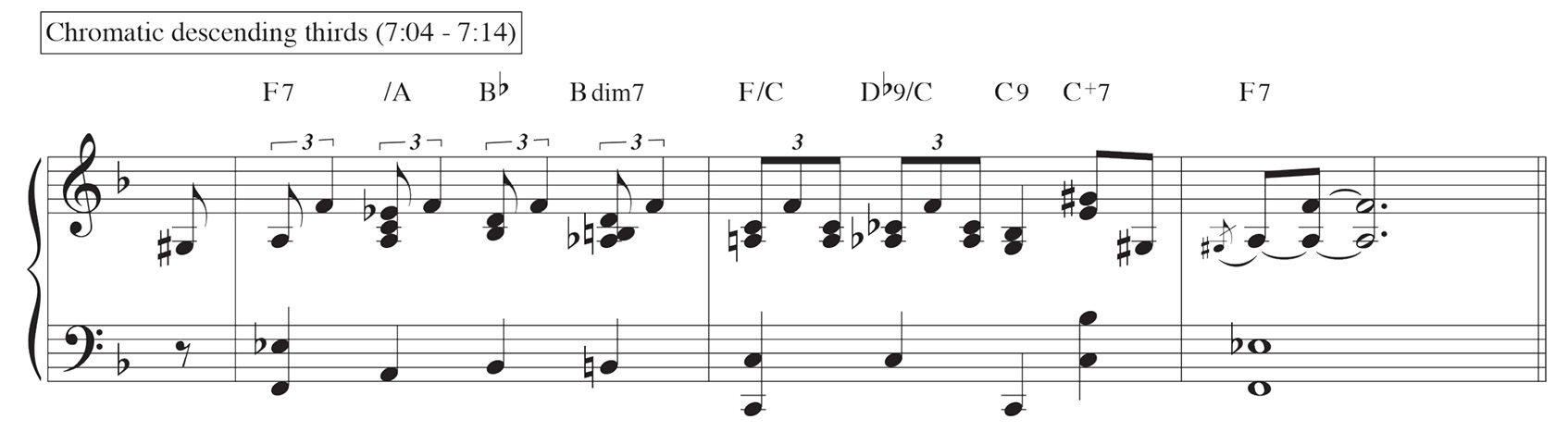
In the next lessons we explore a range of options and techniques that incorporate blues scales, extended chords, altered chords, gospel chord progressions, and more.
Lesson Downloads
-
 Basic Blues Turnarounds File Type: pdf
Related Lessons
In this lesson we will learn how to embellish the turnaround sections with extensions, echoing, inner voices, USTs, a...
We examine the slight variations on the A Sections and we will then learn how to connect the A & B Sections together ...
In this lesson we will be exploring the common intros, endings, and turnarounds that are found in the Chicago blues p...
Practice Tips
-
The turnaround sequence typically incorporates both chromatic and step-wise bass line movement from the I chord to the V chord.
-
Try to visualise the ascending bass line and outline this movement with single note bass, octave bass, and also add embellishments using grace notes.
-
Familiarise yourself with the different options that we have for the V7 chord in bar 12. The F/C moving to C7#5 can be used, or alternatively the descending line using 3rd intervals.
-
Start a habit of spontaneously choosing between these subtle turnaround variations to add more interest and variety to your blues piano playing.
- Once you are comfortable with the basic versions of the turnaround outlined in this lesson, move onto the next lessons in this module.


Hello (from France) , 2weeks on this site, i started blues and jazz beginner courses. Would you have a suggestion on what order to follow lessons, i have gone form the first one to this first turn around course on bleus… but following other turnarounds might be a lot, can i look further at leading tones for exemple or stick to this order ?
Thanks for you reply.
Hi Nicolas,
Thanks for getting in touch.
There is no ‘set-in-stone’ path to follow the lessons, but here is some guidance for you:
The Lead Sheet Fundamentals learning path – https://www.pianogroove.com/syllabuses/lead-sheet-fundamentals/ – will teach you basic jazz arrangement skills such as taking triads and 7th chords and voicing them as two-handed spread voicings. If you’re new to reading lead sheets I recommend to learn the songs in this learning path as we cover the same songs in the more advanced jazz courses.
For Blues, I recommend starting with the Slow Blues In F Course – https://www.pianogroove.com/blues-piano-lessons/slow-blues-piano-for-beginners/. This course incorporates a wide range of jazz theory, including chord extensions, chord alterations, passing chords, substitutions, and many other jazz elements.
If you want to skip over some of the turnaround lessons, that’s fine. You can revisit them later.
Yes you can absolutely move onto the leading tones lesson. Each lesson is a ‘mini-study’ and whilst I did design the course to be studied in this order, it’s fine to choose the lessons that interest you most.
I also created a slow blues course in the key of C which you can find here: https://www.pianogroove.com/blues-piano-lessons/slow-blues-piano-for-beginners/ – I think it’s nice to learn the blues in 2 different keys and see how the techniques are transferable.
—–
For jazz theory, the Essential Jazz Harmony Learning Path, – https://www.pianogroove.com/syllabuses/beginners-jazz-syllabus/ – contains a significant chunk of beginner and intermediate level jazz theory.
There is a lot of theory in this learning path which take many months to multiple years to fully assimilate, depending on your current level. So please understand that this is a gradual process. It’s not something that happens overnight, but by following this learning path you will find all of this theory laid out in a logical, step-by-step format.
——
I recommend that you broadly split your time 50% on the blues lessons and 50% on jazz lessons and that way you are working on both styles.
The jazz theory is applied in my blues piano courses and so the theory is very much interrelated between the courses on the website.
I hope that helps Nicolas, and if you have any other questions please let me know and I’m happy to help.
Best,
Hayden
Ok thanks, i am on the right path then. It’s good you say we don’t have to understand everything allready because even in the beginner’s study, there is a lot of information!
Hi Nicolas,
Yes that’s exactly correct.
Jazz theory is a vast subject – compare it to learning a language – and so it does takes time to fully absorb the material.
As you progress through the different courses on the PianoGroove website you will see the same theory areas and harmonic devices being used and developed.
Turnarounds for example are present in every jazz standard (typically the last 2 of each 8-bar section) and so as you learn more jazz standards you will encounter different chord voicings that we can use and different techniques to navigate these common progressions.
Make sure that you are not spending all of your time on the theory lessons, as it can quite quickly become overwhelming.
Instead divide your time between jazz standards, jazz theory drills, and also the blues as you have an interest in playing blues piano.
For example if you have 1 hour to practice each day, you could spend 20 minutes on each of these 3 areas. Repeat daily.
—-
You might also find these seminars useful where I explain the main theory areas for beginner and early-intermediate jazz studies and how it is applied to jazz standards:
https://www.pianogroove.com/live-seminars/how-what-to-practice/ (this is more theory related)
https://www.pianogroove.com/live-seminars/jazz-voicings-for-beginners/ (here showing how the theory is applied so that you can see the result of following the drills)
In these seminars, I am essentially explaining the “Essential Jazz Harmony Syllabus” and showing the exact drills and how the theory is used in practice.
These seminars are long (around 1 hour) but after watching them you will have a clear ‘birds eye view’ of the main theory milestones that lie ahead.
—–
The key is consistent practice Nicolas.
I recommend students to spend at least 1 hour a day, ideally 2 hours per day, and split this practice time into chunks of 20 minutes where you focus on a different topic or different song.
After a few weeks of spending just 20 minutes per day on a theory topic or jazz standard, you will see very noticeable improvements.
—–
Don’t hesitate to get in touch if you have any further questions.
Cheers,
Hayden
Hey I really love this content so far and I appreciate the work that must’ve gone into this course. I’d like to offer some feedback as a student. Towards the end of the video (starting around the inner movements section) you really sped up and didn’t break things down quite as well.. for me, at least. It made it harder to digest the information and really practice implementing it. Again though, really enjoying the course overall!!
Hi Xavier,
Thanks for the feedback – it’s much appreciated and I’m glad you are enjoying the course.
I will keep in mind to slow down my demonstrations with future lessons. I do generally try to play and explain slowly so my apologies for speeding up in this section of the video.
Are you using the slow down controls? You can find these in the settings in the bottom right hand side of the video player.
We can slow down the playback to 0.75x, 0.5x, and even 0.25x – I know this won’t fix my explanations, but at least it will help you to copy the notes.
Finally, we have many lessons on turnarounds, please see here using the search feature: https://www.pianogroove.com/?s=turnarounds – you will find turnarounds in different keys and this can really help to solidify the concepts (when you learn the same pattern or motion in a different key).
I hope that helps Xavier and please let me know if you have any further questions.
Best,
Hayden
Thanks for the reply! I definitely make use of the slow down and it has been very helpful. I think one thing that makes it challenging is that you don’t really count out some of what you do. For instance, I’m in the blues scale turnaround section right now, and the first lick you do is quite playable, but it isn’t easy to see where things land in rhythm bc there’s no metronome or counting. Little things like that. I appreciate you being so open to the feedback! As I said, it’s a great course, I just want to help make them even better! Cheers to you!
Hi Hayden, compared to the last lesson I’m having a harder time understanding the theory in this one. When it comes to turnarounds, why exactly are you choosing these chords? For example: F7 – F7/A – Bb – Bdim7. What theory is used to decide the chord progressions?
And do you also have a separate course for primarily theory as a piano beginner? I feel like going into this course—after doing the foundations course—that I should have known a few things prior. I know all my major scales, a couple minor scales, seventh chord variations, triads, and other subjects taught in the foundations. Other than that, I’m rusty or unfamiliar with other topics.
Thank you.
Hi Madison,
Great questions.
I do try to push students in these lessons. Each lesson adds a new layer of complexity and so it’s natural to find these lessons difficult and challenging – particularly if you are just starting out with jazz and blues piano.
My view is that it’s very good to push ourselves into ‘unfamiliar territory’. To start it won’t make sense but with time, the theory and harmonic relationships will start to make sense.
—-
To answer your question, the most basic turnaround is simply the I chord (F7) moving to the V chord (C7) and that C7 creates a V-I resolution which takes us back to the top of the 12 bar form. The turnaround is just that: a chord sequence which takes us back to the top of the form or into the next section of the song.
If we just played F7 in bar 11, and C7 in bar 12, it would sound rather plain and uninteresting.
What you are seeing here:
F7 –> F7/A –> Bb –> Bdim7 –> F/C –> C7 —–> starts the form again at F7
is a more embellished way to move from I to V.
– F7 is the I chord or the ‘home base’
– F7/A is just F7 with the 3rd of the chord in the bass. Playing the A in the bass creates a smoother connection to the Bb chord which comes next.
– Bb is the IV chord in the key of F Major. We have already explored the I-IV-V structure of the blues in the previous lessons.
– Bdim7 is a passing chord with allows us to very smoothly connect the IV chord and the V chord.
Then instead of going straight to C7, we play F/C which feels like we are ‘almost home’ but not quite. This then moves very smoothly to C7 and at that point we have set up the V –> I resolution to take us back to F7.
So essentially this is just a more sophisticated way to move from the I chord (Fmaj or F7) to the V chord (C7).
There are a virtually infinite number of ways that the turnaround can be navigated. I have been playing jazz and blues for around 15 years and I’m always learning new ways to navigate turnarounds.
Another very common turnaround sequence is: I-VI-II-V which would be F –> D7 –> G-7 or G7 –> C7 —-> back to F.
—-
Here are some related lessons for you:
Georgia On My Mind Course: https://www.pianogroove.com/blues-piano-lessons/bluesy-stride-piano-beginners/ – this is also in the key of F Major, and so you will see similarities in the harmony and the chord voicings used. The first 6 lessons are beginer/intermediate focused, and the last few lessons are more advanced level.
Intros, Outros, Turnaround Course: https://www.pianogroove.com/jazz-piano-lessons/intros-endings-turnarounds/ – you can check out the first 4 lessons where we explore common chord progressions used for intros, endings, and turnarounds, such as the 1625 progression that I mentioned above.
—-
Just to reiterate Madison, this slow blues style is challenging to play and so it’s very natural to find it difficult as a new jazz/blues piano student. You are certainly ‘throwing yourself in the deep end’ with your current knowledge of major scales, a few minor scales and 7th chord variations. However, in my opinion this is the best way to learn. It was the same for myself when I started learning jazz harmony, I was simply copying and emulating my teachers demonstrations even though at the time I didn’t understand all of the harmonic relationships. Just keep pushing through and have faith in the process. Just like learning to speak a new language, it takes time and consistent practice.
If you’d like some more accessible lessons, I’d recommend the jazz standard studies in the Lead Sheet Fundamentals Learning Path: https://www.pianogroove.com/syllabuses/lead-sheet-fundamentals/ – I’d suggest following this learning path in tandem with the slow blues course.
That way you can make some quick progress on the beginner level jazz standards, and at the same time gradually ‘chip away’ at the theory in this course as it seems you have an interest in blues piano.
After the foundations course has been completed, the next theory milestone is learning about Chord Extensions which you can find here: https://www.pianogroove.com/jazz-piano-lessons/extended-chords-voicings/
I outlined the most important jazz theory in this Learning Path: https://www.pianogroove.com/syllabuses/beginners-jazz-syllabus/ – this learning path covers the theory for chord extensions, rootless harmony/stride, and altered harmony – all of which we incorporate and apply in these slow blues lessons.
I hope that helps Madison, and please let me know if you have any follow up questions.
Best,
Hayden
Hi Hayden, Really enjoying the course content so far. The site is great, and I really like the tools you’ve enabled for slowing and looping the videos. I’m confused on one point: You talk in the video and in the Blues Turnaround Variations section above about the C9 and D flat 9 chords, but I’m not seeing the ninth note in any of these. They look like 7th chords to me. Can you help me understand that better? Thanks!
Hi Ed,
I’m glad to hear that you are enjoying the course, and please excuse my late reply.
I just checked out the section of the video that you are referring to, and I confirm that I am playing 9th voicings for Db9 for C9.
At 6:06s – I play Db9 which contains the notes Db (root) in the left hand, and the notes F (3rd), B (7th), and Eb (9th) in the right hand. The note Eb is the 9th of Db7. You can also think of this as the 2nd note of the scale.
At 6:08s – I then move the voicing down chromatically (which means all 4 notes fall by a half step) and then the chord becomes C9. Here the left hand plays the root (C) and the right hand plays the 3rd (E), the 7th (Bb) and the 9th (D).
For both chords, the left hand plays the root, and the right hand plays 3-7-9.
Adding the 9th sounds a little richer than the basic 7th chord, but it is optional to play. The 3rds and 7ths are the ‘essential chord tones’ and the 9th is a ‘colour tone’.
I hope that helps Ed, please let me know if you have any follow up questions.
Cheers,
Hayden
No worries, and thanks Hayden. I can see the ninths in the sections you referred to. I should have clarified that I was referring to 5:45 and 5:46 where you initially referred to Db9 and C9, and I wasn’t see the ninth notes there. I also wasn’t seeing them in the score shown under the Blues Turnaround Variations (3rd measure) above. In any event, had I continued onward in the video I would have seen the section in the video you refer to where the Eb and C ninth notes are indeed played.
Hi Ed,
My apologies, I missed the part that you are referring to. Yes now that you highlight that I agree that it is a little confusing.
Sometimes we will use the same lesson graphic for multiple demonstrations, and there might be slight variations in what I play due to this being improvised music.
If a chord symbol in a lesson graphic shows a specific extension or alteration, it should be demonstrated in the video, and in this case it was demonstrated but a little later on in the video. Ideally that should have been 2 separate graphics so apologies for the confusion – I’ll keep that in mind when editing the lessons.
Perhaps the most useful and practical point that we have discussed is that the 9th (and other chord extensions) are optional tones, and so as the performer we can choose whether we want to include them or not. This means that if we see “C7” we can add the 9 or 13, and if we see “C9” we can simplify it to C7.
The chord is C7, and the chord extensions are optional ‘color tones’ that we can add on top.
—–
Whilst we’re on this topic, it’s also good to be aware that in jazz and blues music, it’s very common for musicians to abbreviate chords to just “7” even if they include chord alterations (9s/11s/13s) and/or chord alterations (b9/#9/#11/b13). Think of this as shorthand and it applies both to lead sheets and in verbal communication between musicians or in a student/teacher setting.
You’ll notice as you watch more of my lessons that I often will just say “7”, for example C-7, F7, Bbmajor7, even if I added chord extensions and alterations into my voicings.
I do generally try to be specific and say/explain exactly what I’m playing, but it’s important to be aware of this ‘shorthand’ on lead sheets, in jazz education, and also when you communicate/play/perform with other jazz musicians.
Don’t hesitate to get in touch if you have further questions, and enjoy the lessons!
Best,
Hayden
No worries at all Hayden. I just wanted to make sure I understood how to apply the concept of a 9th, and now I’m totally clear. Appreciate your detailed explanation and the tip on notation. Thanks so much!